Donald Trump has telling response after being booed during national anthem at Knicks NBA Finals game

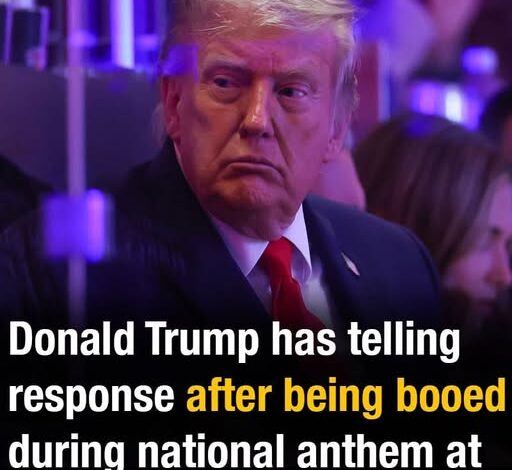
For a few unforgettable seconds, the basketball game stopped mattering.
The players were still on the court. The lights still shined over Madison Square Garden. Tens of thousands of fans remained in their seats. Yet all attention shifted away from the sport itself and toward a moment that felt larger than the game, larger than the arena, and perhaps larger than politics alone.
It happened during the national anthem.
As cameras scanned the crowd, President Donald Trump stood with his hand raised in salute. The image appeared on the arena’s giant video screens, instantly transforming an ordinary pregame ceremony into a revealing snapshot of America’s political divide.
The reaction was immediate.
Boos echoed through parts of the arena.
Not everyone joined in, but enough voices did that the sound became impossible to ignore. The atmosphere changed in an instant, replacing the anticipation of a major sporting event with the unmistakable tension of a nation still deeply divided.
For supporters, the reaction felt disrespectful. They viewed the jeers as directed not only at a former president but at a moment traditionally associated with national unity and respect.
For critics, the boos represented something entirely different—a public expression of political opposition and a reminder that dissent remains a fundamental part of democratic life.
Depending on where someone stood politically, the exact same moment carried a completely different meaning.
And that contrast is what made the scene so powerful.
Then came an even more revealing moment.
The cameras shifted away from Trump.
The Jumbotron landed on New York Knicks star Jalen Brunson.
Almost instantly, the boos disappeared.
In their place came a roar of applause.
The crowd erupted with enthusiasm.
Fans jumped to their feet.
Cheers thundered throughout the arena.
The transition was so sudden and dramatic that it felt almost symbolic.
One figure had divided the room.
The other united it.
At least for that night.
At least for that crowd.
The contrast captured something difficult to ignore. Sports arenas have long been places where political, cultural, and social tensions occasionally surface, but they are also among the few spaces where people from vastly different backgrounds gather around a common passion.
For a brief moment, the reactions to Trump and Brunson seemed to highlight the difference between figures who represent political identity and figures who represent shared community.
Politics asks people to choose sides.
Sports often give people a reason to stand together.
Yet even inside one of the world’s most famous arenas, the separation between those worlds appeared increasingly difficult to maintain.
Outside Madison Square Garden, the atmosphere reflected that reality as well.
Security measures were significantly increased.
Traffic restrictions affected surrounding streets.
Some planned gatherings and watch parties were reportedly altered or canceled because of logistical concerns tied to the president’s visit.
The event demonstrated how modern politics no longer remains confined to campaign rallies, government buildings, or television debates.
Today, political presence follows leaders almost everywhere they go.
Concerts.
Sporting events.
Restaurants.
Public ceremonies.
Even a basketball game can become a stage for larger national conversations.
Inside the arena, however, one detail stood out above all others.
Trump never visibly reacted.
As boos echoed through parts of the crowd, he maintained the same expression.
The same posture.
The same smile.
Whether that response reflected confidence, discipline, indifference, or political calculation depended largely on the viewer.
Supporters interpreted it as composure under pressure.
Critics viewed it as detachment.
Others saw it simply as experience from a public figure who has spent years operating under intense scrutiny.
Whatever the explanation, his reaction—or lack of one—became part of the story itself.
Because in modern politics, perception often matters as much as the event.
Images travel faster than explanations.
Moments become symbols.
And symbols quickly become narratives.
What unfolded inside Madison Square Garden was about more than applause or boos.
It was about identity.
It was about loyalty.
It was about the increasingly blurred line between entertainment, politics, and public life.
For decades, sporting events were often viewed as temporary escapes from the divisions of everyday life. Today, those divisions frequently arrive at the arena doors alongside the fans.
The crowd’s reaction revealed that political feelings remain deeply personal and intensely present, even during moments intended for recreation and celebration.
Perhaps that is why the scene resonated so strongly.
It wasn’t merely a reaction to one politician.
It was a reflection of a broader national reality.
A reality in which the same image can inspire admiration, frustration, pride, anger, or hope depending on who is watching.
A reality in which two groups can witness the same event and leave with entirely different interpretations of what happened.
And a reality in which public figures increasingly serve as symbols for larger cultural battles.
As the game continued and attention eventually returned to basketball, the moment lingered.
Not because it changed anything immediately.
But because it captured something many Americans already feel.
The country remains engaged in an ongoing conversation about itself—its values, its leaders, its future, and its identity.
The boos.
The cheers.
The silence.
The smile.
Each became part of a larger story unfolding far beyond the walls of Madison Square Garden.
And perhaps that is the question the moment ultimately left behind:
Was it a demonstration of resilience?
An act of political defiance?
A sign of growing polarization?
Or simply another chapter in a nation that increasingly conducts its debates everywhere—from campaign stages and television studios to basketball arenas packed with fans?
Whatever the answer, one thing was clear.
For a few brief moments, Madison Square Garden stopped being just a sports venue.
It became a mirror.
And millions of people saw something different reflected back.