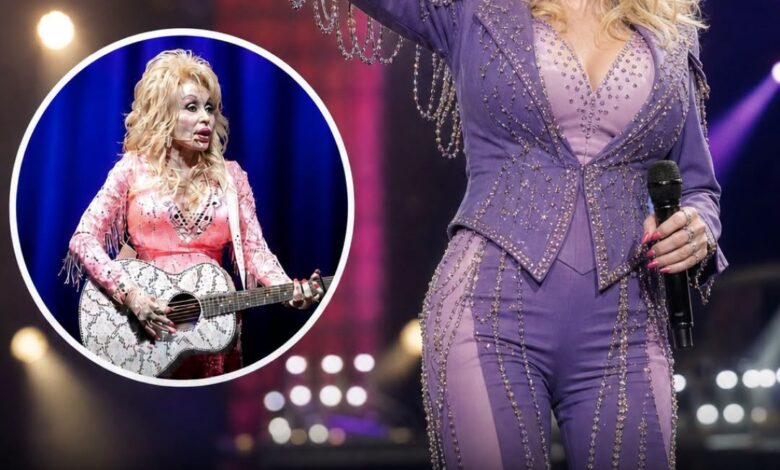
The photographs showed Dolly Parton moving slowly.
Her words showed something else entirely.
At a ribbon-cutting in Tennessee, she stepped carefully through the crowd, leaning on an arm for support as cameras flashed and phones rose around her. There was no hiding that movement required more effort than it once had. Age—and whatever private burdens she was carrying—could be seen in the measured pace of each step.
But then Dolly smiled.
And when she spoke, the frailty visible in her body seemed to disappear behind the familiar force of her personality.
She joked about getting older.
She brushed away attempts to make the moment entirely about her.
Again and again, she redirected attention toward music, community, the work being done around her, and the people who would continue that work long after the ceremony ended.
It was classic Dolly.
A serious question could become a joke.
A compliment could become praise for someone else.
Concern about her could become enthusiasm about a project.
She had spent decades learning how to control a room without appearing to demand control of it, and even when her steps had become slower, that instinct remained.
Then, only days later, came another appearance.
This time Dolly was seated.
Dressed in radiant white at the ACM Poet’s Award, she looked almost luminous beneath the lights. There was less movement to study, fewer opportunities for viewers to analyze her walk or search her posture for clues.
Instead, there was her voice.
Soft.
Steady.
Grateful.
She spoke with the calm confidence of someone who seemed to have all the time in the world.
That contrast would become more powerful later.
At the time, fans could see that Dolly appeared physically diminished. Some worried. Others insisted that aging naturally changes how someone moves and that every photograph did not need to become a medical investigation.
Dolly herself seemed determined not to turn her condition into the main event.
That choice matters.
Because famous people are often expected to surrender privacy precisely when they become most vulnerable.
If they lose weight, people demand an explanation.
If they walk differently, strangers diagnose them.
If they cancel an appearance, rumors multiply.
If they appear despite obvious strain, photographs are enlarged and analyzed as though the body has become public evidence.
Dolly chose another approach.
She kept pointing outward.
Toward songs.
Toward books.
Toward children.
Toward Dollywood.
Toward charitable work.
Toward the people who would eventually have to continue without her.
Only afterward did those appearances begin to look different.
What fans had initially interpreted as determination now felt almost like allocation.
Dolly appeared to be choosing where to spend what energy remained.
Time is valuable for everyone.
Near the end of a life, it can become sacred.
And Dolly did not seem interested in spending hers answering every rumor about herself.
She had work she considered more important.
There were songs still connected to her name and voice.
There were children’s books and literacy efforts.
There was Dollywood, an enterprise that had grown far beyond an amusement park into a major source of employment and pride in the region she had never stopped calling home.
There was the foundation and its quiet machinery of giving.
There were programs that would continue whether Dolly herself stood in front of a camera or not.
That may be the key to understanding those final public moments.
They were not simply appearances.
They were handoffs.
When Dolly praised the people around her, she was doing more than being gracious.
She was directing attention toward continuity.
Look at them.
Trust them.
Remember the work.
Keep it moving.
The instinct made sense for someone who had spent a lifetime building things meant to outlast applause.
Songs were the most obvious example.
A singer eventually leaves the stage, but a song does not require its writer to remain alive.
Someone else can sing it.
A child can discover it decades later.
A lyric written in one lifetime can become useful in another.
Her literacy work operated on the same principle.
A book placed in a child’s hands continues traveling after the person who helped put it there is gone.
A child learns to read.
That child grows up.
Perhaps another generation is read to.
The gift keeps moving.
Legacy, in that sense, is not a monument.
It is momentum.
Dolly seemed to understand that distinction better than most.
Her appearance had always been spectacular—the hair, the rhinestones, the heels, the bright colors—but much of her most enduring work was built around continuation rather than display.
That is why those late photographs and speeches now seem to tell two different stories at once.
The photographs recorded the body.
Her words recorded the intention.
The camera could capture the arm she leaned upon.
It could capture the careful steps.
It could capture the fact that standing and walking no longer looked effortless.
But a photograph could not fully capture what she was trying to leave behind.
For that, people had to listen.
She kept talking about what came next.
Not necessarily what came next for Dolly Parton.
What came next for the work.
There is something remarkably peaceful about that.
Many people fear being forgotten.
Dolly had little reason to worry about that. Her name was already embedded in music history and popular culture.
The more difficult question was whether the things she cared about would continue to live rather than simply become memorials.
And so she seemed to use those final appearances to place attention where she wanted it.
Not on speculation.
Not on morbidity.
Not on strangers trying to calculate how much time she had.
On purpose.
That does not mean there was no sadness beneath the smile.
A person can understand exactly what is happening and still joke.
They can be tired and grateful.
They can be frightened and purposeful.
They can know time is becoming precious without turning every conversation into a farewell.
Perhaps Dolly’s greatest gift in those moments was refusing to make everyone around her rehearse her death before it arrived.
She showed up.
She smiled.
She thanked people.
She celebrated their work.
And when necessary, she sat down.
There was no need to pretend the body had not changed.
There was simply no reason to let the body’s decline become the only story.
That is why the images linger now.
Not because they captured a legend becoming frail.
Because they captured a woman deciding what frailty would not take from her.
Her humor remained.
Her gratitude remained.
Her attention to others remained.
Her sense of purpose remained.
And the work remained.
Perhaps that was the message hidden inside those final appearances.
Do not spend too long staring at the person leaving.
Look at what she is pointing toward.
The songs.
The books.
The children.
The mountains.
The community.
The people ready to carry the next piece.
Dolly’s steps had slowed, but the things she set in motion had not.
That is what makes those appearances feel less like an ending than a transfer of responsibility.
She was not asking anyone to pretend she could stay forever.
She was showing them what could.
The photographs recorded frailty.
The words recorded intention.
And somewhere between the two was Dolly’s final, gentle instruction:
Keep it going.