Every Doctor Treating My 7-Year-Old Daughter Dressed as Superheroes—Then Her Oncologist Whispered, “There’s One Thing Your Mom Doesn’t Know”

For almost a year, I measured my daughter’s life in blood counts, treatment cycles, scan results, and the number of good days between bad ones.
So when Alice turned seven in a hospital room, I thought my job was simple: make one stolen day feel like childhood again.
I had no idea the real gift waiting for her wasn’t the superheroes, the cake, or even the good medical news.
It was freedom.
And I was the one standing in its way.
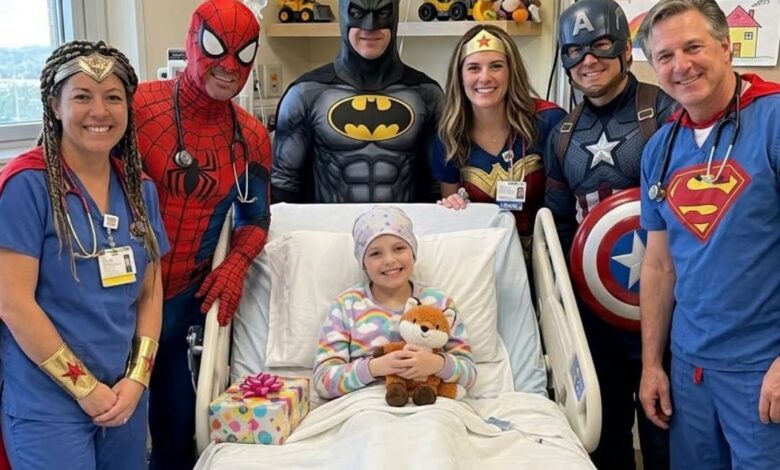
Alice was already crying when Superman knelt beside her hospital bed.
Around him stood Wonder Woman, Batman, Spider-Man, and Captain America. Beneath the costumes were the doctors and nurses who had spent almost a year treating my daughter for leukemia.
Alice pointed at Batman through her tears.
“I know who you are!”
Batman straightened his mask.
“You have no evidence.”
She laughed so hard she had to wipe her cheeks.
I laughed too.
Then Dr. Malcolm—still wearing Superman’s cape—rested one hand on her bed.
“There’s another part of today your mom doesn’t know about.”
My stomach tightened instantly.
“What part?”
He looked at me, and suddenly the costumes disappeared from my mind.
When your child has cancer, you learn to fear changes in a doctor’s expression.
“The results we were waiting for came in this morning,” he said.
My hand closed around the bedrail.
“They’re encouraging. Alice is responding very well. Treatment isn’t finished, but we’re comfortable moving her into a less intensive phase.”
Alice looked at me.
“Is that good?”
I laughed and cried at the same time.
“It’s very good.”
“Is cancer losing?”
Dr. Malcolm smiled.
“Yes.”
Her whole face lit up.
Then someone handed him a bright blue backpack covered in superhero symbols and messages written in fabric marker.
Alice sat straighter.
“What’s that?”
“Something your class made.”
Inside was a card.
Whenever you’re ready, your seat is waiting.
Alice read it twice.
“School?”
Dr. Malcolm nodded.
“Not tomorrow. Not all day right away. But medically, we can start talking about returning gradually.”
Alice looked at me.
“Mom?”
I should have smiled.
Instead, fear arrived before joy could.
School meant germs.
Fatigue.
Children bumping into her.
People coughing.
Teachers missing signs I had trained myself to notice.
Alice saw the hesitation immediately.
On the drive home she talked nonstop at first.
Was the class hamster still alive?
Would Sophie sit beside her?
Could she go to recess?
Then she went quiet.
“You don’t want me to go.”
“That’s not true.”
“You haven’t said yes.”
“We need a plan.”
She turned toward the window.
Even at seven, she understood what I meant.
I wasn’t ready.
A week later, I met with her teacher and school nurse carrying three pages of questions.
What if another child came in sick?
What if Alice got tired?
What if she needed medicine?
What if someone knocked into her?
Her teacher answered patiently until another parent came in to drop off paperwork.
She overheard Alice’s name.
“Oh,” she said. “Is she coming back?”
“Gradually,” the teacher replied.
The woman hesitated.
“Is she safe to be around the other kids?”
My chair scraped backward.
The nurse answered first.
“Cancer isn’t contagious.”
The woman flushed.
“I didn’t mean it like that.”
Maybe she didn’t.
But Alice had been waiting outside with my mother and heard enough.
Later she asked, “Does she think I can give people cancer?”
“She doesn’t understand.”
“Everyone’s going to look at me weird.”
And before I could stop myself, I said, “Then maybe we wait.”
Alice stared at me.
I heard what I had said too late.
A few days later, Sophie and her mother came over.
The moment Alice saw them, she looked at me.
“You told.”
“I asked your teacher if everything was okay.”
“I asked you not to.”
“I was trying to help.”
“I didn’t ask you to.”
That stopped me.
Alice turned to Sophie.
“Why didn’t you sign my birthday card?”
Sophie stared at her shoes.
“My mom kept telling me not to talk about cancer unless you wanted to.”
“I didn’t want to talk about cancer.”
“I didn’t know what else we had to talk about.”
Alice frowned.
“We had dinosaurs.”
Sophie finally smiled.
“You still think a shark beats a T. rex?”
“Obviously.”
Five minutes later, they were arguing exactly the way they used to.
I stood in the kitchen listening.
Alice had handled the problem I had tried to solve for her.
And she had done it better.
A few weeks later, her care team approved a short classroom visit.
I packed water, medicine, snacks, spare clothes, emergency information, wipes, and the hospital bag we had carried everywhere for months.
Alice looked at the pile.
“Are we going to school or moving there?”
“At most two hours.”
She pointed at the bags.
“It looks like three weeks.”
At school, I watched her constantly.
Eventually she leaned toward me.
“Can you stop looking at me?”
“I’m checking on you.”
“Every minute?”
I didn’t answer.
“You’re watching me breathe.”
An hour later, she became pale and tired.
“We’re leaving.”
“I’m okay.”
“You’re exhausted.”
“I am tired, Mom.”
Then she looked straight at me.
“But I’m not dying.”
The room seemed to shrink around those words.
She looked sorry immediately.
I didn’t make her apologize.
I took her home.
At her next appointment, I told Dr. Malcolm everything.
The fatigue.
The paleness.
My fear.
Then I asked, “Would you still let her go back?”
He paused.
“I can tell you what her body can safely attempt.”
I waited.
“I can’t tell you how much fear you’re supposed to feel while she does it.”
I looked away.
“She’ll have limits for a while,” he continued. “Limits are not the same thing as having no life.”
That night, Alice fell asleep with a notebook beside her.
While I repacked the hospital bag, it slid to the floor and opened.
Across the top of the page she had written:
THINGS I WANT TO DO WHEN MOM STOPS BEING SCARED
Ride the bus.
Go to recess.
Sleep at Grandma’s.
Eat cake without Mom asking if my stomach hurts.
Have messy hair in my school picture.
Stop everybody whispering when they think I’m asleep.
Then the last one:
Make Mom laugh without checking if she really means it.
I sat on the floor.
For almost a year, I had watched everything about Alice.
I had never realized she was watching me too.
The next morning, guilt made me move too fast.
“You can go back to school.”
Alice stopped eating.
“Today?”
“No, sweetheart. We’ll plan it.”
Her eyes narrowed.
“You read my notebook.”
“It fell open.”
“But you read it.”
“I saw the page.”
She pushed her bowl away.
“You always fix stuff I didn’t ask you to fix.”
“I’m your mother.”
“I know.”
Her voice softened.
“That’s why I wish you’d just be my mom sometimes.”
I wanted to explain every fear I carried.
Instead, I sat beside her later and asked one question.
“What do you want your first day to look like?”
She studied me carefully.
“A half day.”
“Okay.”
“No big welcome thing.”
“Okay.”
“No telling everyone to be gentle with me.”
That one hurt.
But I nodded.
“Okay.”
“And you’re not standing outside my classroom.”
I swallowed.
“Okay.”
The night before her first half day, Alice complained of a headache.
Every alarm inside me went off.
I checked her temperature.
Followed the medical guidance we had been given.
Contacted her care team when appropriate.
Nothing suggested an emergency.
By morning, she felt better.
I put the hospital bag in the trunk anyway.
Then I stood there staring at it.
That bag had followed us for almost a year.
It represented readiness.
Control.
The desperate belief that if I packed enough, watched enough, and worried enough, I could keep tragedy from surprising us again.
I lifted it back out.
Her necessary medicine and medical information stayed with us.
The overnight bag stayed home.
At the school entrance, Alice grabbed my hand.
“What if everybody looks at me?”
“They might.”
“What if it’s weird?”
“It probably will be.”
She looked up.
“And if I hate it?”
“Then we figure out tomorrow.”
She held my hand for one more second.
Then she let go.
Alice walked inside without me.
And I actually left.
At home, I made coffee and let it go cold while checking the time.
I arrived for pickup fifty minutes early.
When Alice came out beside Sophie, her hair was messy, her backpack hung crookedly from one shoulder, and she looked completely exhausted.
She also looked happy.
My eyes immediately searched her face.
Alice caught me.
“You’re doing it.”
“The hospital face?”
She nodded.
“Sorry.”
She smiled.
“I did the school face today.”
“What does that look like?”
“Like I’m not scared even when I am.”
Then she glanced toward my car.
“You were here early, weren’t you?”
“No.”
“Mom.”
“Forty-three minutes.”
She stared at me.
“Fine. Fifty.”
Alice laughed.
I reached for her backpack.
She pulled it closer.
“I’ve got it.”
My first instinct was to tell her it looked heavy.
My second was to take it anyway.
Instead, I lowered my hand.
“Okay.”
Alice adjusted the strap herself and started toward the car.
I walked beside her.
For almost a year, I thought loving my daughter meant carrying everything for her.
The fear.
The planning.
The bags.
The decisions.
That afternoon, I learned something harder.
Sometimes loving your child means carrying enough to keep them safe—
and knowing when to stop carrying what belongs to them.
Alice was still sick.
We still had appointments ahead.
There were still scans, medicine, and nights when fear woke me before sunrise.
Nothing magical had changed.
Except one thing.
My daughter had started living again.
And for the first time since her diagnosis, I let her.
She carried her own backpack all the way to the car.