As I Woke up from a Coma, I Heard My Son Whisper, ‘Mom, If You Hear Me, Don’t Open Your Eyes – Listen to What Dad Is Planning’

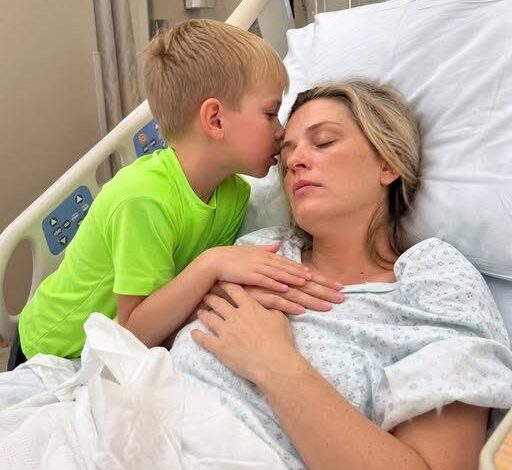
The first moments of awareness didn’t come all at once.
They arrived slowly, like something fragile rising through deep water—uncertain, unsteady, as if the slightest movement might break whatever was holding me together. I didn’t try to fight it. I didn’t try to move.
I stayed exactly where I was.
And in that stillness, I began to understand.
At first, there was only sound.
A steady, rhythmic beeping—mechanical, precise, almost distant. It echoed through the darkness, pulling me upward, piece by piece, from wherever I had been. It didn’t feel comforting. It felt like something insisting I return.
My body, however, didn’t agree.
It felt heavy. Not tired—heavy. As if it didn’t belong to me anymore. I tried to move my fingers, my arms, anything at all, but nothing responded. My eyelids felt sealed shut, like they were no longer under my control.
But my mind…
My mind was awake.
Fully aware.
And then I felt it.
Something small slipped into my hand. Warm. Unsteady. Holding on tighter than it needed to.
A child’s grip.
“Mom… if you can hear me… don’t open your eyes.”
It was Bruce.
My son.
Every instinct inside me screamed to react. To open my eyes, to pull him close, to tell him I was there. But there was something in his voice—something I had never heard before.
Fear.
Not the kind that comes and goes.
The kind that settles deep.
I forced myself to stay still.
His fingers tightened around mine, trembling slightly. I could feel his breath near my ear as he leaned closer.
“You have to listen,” he whispered. “Please… just pretend you’re still asleep.”
I didn’t understand what he meant.
But I trusted him.
And that trust kept me still when everything in me wanted to move.
Moments later, the door opened.
Footsteps.
Two people.
I didn’t need to see them to know who they were.
My husband.
My sister.
“Are you sure she’s still out?” Arthur asked.
There was no worry in his voice. No exhaustion. No grief.
Just impatience.
That was the first crack in everything I thought I knew.
“The doctor said she won’t wake up,” Chloe replied, calm, casual… detached.
And then—
A soft sound.
A kiss.
My chest tightened, but I didn’t move.
“Good,” Arthur said, exhaling slowly. “Everything’s falling into place.”
Falling into place?
My pulse started to race.
What was he talking about?
“Once they take her off life support, it’s over,” Chloe added quietly. “No one will question it.”
The words didn’t make sense at first.
Then they did.
And when they did, something inside me went cold.
Bruce’s hand gripped mine harder.
“But we have to be careful,” Arthur continued. “We can’t afford mistakes now.”
Mistakes?
A pause followed.
Then Chloe asked the question that made everything stop.
“And the boy?”
The boy.
My son.
Arthur didn’t hesitate.
“We do exactly what we planned for Bruce.”
If I could have moved, I would have been on my feet in that moment.
But I didn’t.
Because Bruce had told me not to.
And now I understood why.
His hand was shaking violently in mine.
I focused on that—on him—on staying still.
Because whatever they were planning… reacting too soon would only make it worse.
I heard the sound of something being unzipped. Papers shifting. Quiet, deliberate movements beside my bed.
“Is that all of it?” Chloe asked.
“Yeah,” Arthur replied. “Insurance confirmation. Updated beneficiaries. And the forms for boarding school. Everything’s ready.”
Boarding school?
They weren’t just preparing for my death.
They were planning my son’s life without me.
No—worse than that.
They were removing him from it.
“Once she’s gone, everything moves fast,” Chloe said.
Gone.
They weren’t waiting.
They were pushing for it.
Moments later, another voice entered the room.
A doctor.
Polite. Careful. Professional.
Arthur’s tone shifted instantly—smooth, controlled, convincing.
He spoke about “low probability of recovery,” about “recommendations,” about “options.”
Options that sounded a lot like decisions already made.
The doctor hesitated.
Suggested waiting.
Just one more day.
Arthur agreed.
Too easily.
And that’s when it became clear.
He didn’t think I mattered anymore.
And worse—
He didn’t think Bruce understood any of it.
But he did.
And I did.
And if I didn’t act soon…
Neither of us would get another chance.
The moment they left, I gathered everything I had.
Every ounce of strength.
Every bit of control.
And I moved.
Just barely.
Enough.
“Mom?” Bruce whispered.
I forced my lips to respond.
“We… don’t have much time…”
Even speaking felt like pulling words through stone.
But I said what mattered.
“Take pictures… of the documents… bring them tomorrow… don’t get caught…”
There was no hesitation.
“I will,” he said.
That was my son.
Brave, even when he was afraid.
The next day, I waited.
I couldn’t wake up too early.
I needed them to believe their plan was still working.
I needed them to commit.
So I stayed still.
And I listened.
When Bruce came, he whispered softly, pretending it was nothing.
“I’ve got them, Mom.”
That was all I needed.
Moments later, they returned—with the doctor.
Arthur stood beside me, performing concern like it was second nature.
“My wife wouldn’t want to live like this,” he said.
That was it.
That was the moment.
I opened my eyes.
Silence filled the room instantly.
Shock.
Disbelief.
Fear.
I saw it all.
“I heard everything,” I said, my voice weak but steady. “And I want my lawyer.”
Arthur tried to recover.
Tried to control the situation.
But it was already slipping from his hands.
Because this time—
I was awake.
What followed happened quickly.
My lawyer arrived.
Bruce spoke.
The photos were shown.
The documents—signed, prepared, undeniable—told the rest.
And slowly, the truth unraveled.
Tests confirmed what suspicion had already begun to reveal.
Something had been done to me.
Not suddenly.
Gradually.
Carefully.
Planned.
And it all pointed back to the same place.
The same people.
The ones who were supposed to protect me.
Days later, when everything had shifted and the silence in my life had been replaced with something clearer—something safer—I sat beside Bruce and held his hand.
“Are we okay now?” he asked.
Such a small question.
Such a heavy one.
I looked at him.
Really looked at him.
The fear was still there—but so was something stronger.
Courage.
“We are,” I told him.
And this time, I meant it.
Not because everything was fixed.
But because the truth had come to light.
Because we weren’t alone anymore.
And because when it mattered most…
My son didn’t stay silent.
He paid attention.
He acted.
And he saved my life.
Sometimes, the strongest voice in the room isn’t the loudest one.
Sometimes—
It’s the quiet one holding your hand, asking you not to open your eyes… just long enough to see the truth.