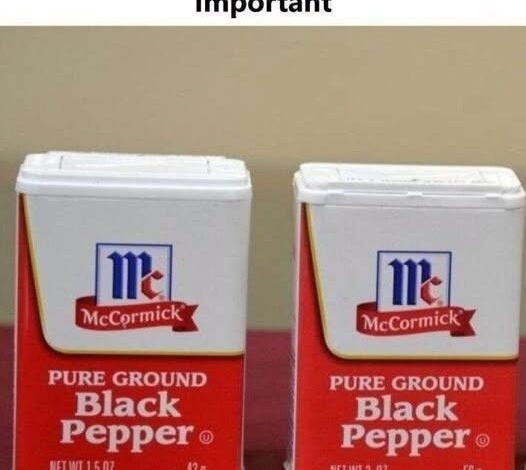
Most people never think twice when they reach for a familiar product at the grocery store. They recognize the brand, grab the package they’ve bought for years, and place it in their cart without comparing labels or checking the weight. That routine is built on trust. Shoppers assume that if a package looks the same, they’re getting essentially the same product inside. When that expectation quietly changes, the disappointment often extends far beyond the missing ounces.
That is why the discussion surrounding McCormick’s black pepper packaging has attracted so much attention. At first glance, the container appears virtually unchanged from previous versions. It still occupies the same space on the shelf, carries the familiar red branding, and projects the same substantial appearance customers have come to recognize. Yet many consumers were surprised to discover that the amount of pepper inside had been reduced while the container itself remained largely the same size.
The issue is not simply about receiving less product. It is about perception.
When people shop, they rarely examine every detail on a label. Few stop to compare net weights from one purchase to the next, and even fewer carry a mental record of exactly how many ounces a spice container held several years ago. Instead, they rely on visual cues. Familiar packaging becomes a shortcut that tells the brain, “This is the same product you’ve always purchased.”
That instinct serves shoppers well most of the time. It makes everyday shopping faster and more convenient. But it also means consumers are especially vulnerable when the appearance of a product remains constant while its contents quietly change.
In contrast, many shoppers have pointed to competing brands such as Watkins, whose transparent containers allow customers to see exactly how much spice is inside before making a purchase. A clear jar leaves little room for uncertainty. The contents are visible, making it easier for buyers to judge the quantity for themselves rather than relying solely on the stated weight printed on the label.
Placed side by side, the two packages create a striking visual comparison. One conceals its contents behind opaque packaging that reveals very little. The other openly displays the product inside. Whether intentional or not, the difference shapes how many consumers perceive each brand.
For some shoppers, that distinction feels symbolic.
They see transparency not only in the physical sense but also as a reflection of how a company communicates with its customers. A package that openly reveals its contents can create an impression of honesty and confidence, while one that appears larger than necessary may raise questions about whether appearance is being used to influence purchasing decisions.
It is important to recognize, however, that reducing package contents is not unique to one company. The practice, often referred to as “shrinkflation,” has become increasingly common across many industries. Faced with rising production, transportation, and ingredient costs, manufacturers sometimes choose to reduce the amount of product rather than significantly increase the retail price. Companies argue that this approach helps keep products within a price range consumers are willing to pay.
Legally, businesses are generally permitted to do so, provided they accurately disclose the product’s net weight and comply with applicable packaging regulations. From a regulatory standpoint, the critical information appears on the label, allowing consumers to compare products if they choose.
But shopping rarely happens inside a courtroom.
Consumers do not make purchasing decisions with legal statutes in mind. They make them in crowded grocery aisles, often with limited time, distracted children, long shopping lists, and dozens of competing products surrounding them. In those moments, visual familiarity carries tremendous influence.
That is where trust becomes far more important than legality.
A company may fully comply with labeling requirements while still leaving customers feeling misled if the overall presentation creates expectations that no longer match reality. Once consumers begin questioning whether a package accurately reflects its contents, rebuilding that confidence can be difficult.
Brand loyalty develops over years of consistent experiences. Families often purchase the same spices, cereals, coffee, or household products generation after generation because those brands have earned a reputation for reliability. That relationship depends on more than product quality alone. It depends on the belief that the company is treating its customers fairly and communicating honestly.
When shoppers begin to suspect that packaging has been designed primarily to preserve the illusion of receiving the same value while quietly providing less, frustration naturally follows. Even if the information is disclosed exactly as required by law, many consumers feel that transparency involves more than meeting minimum legal standards.
Of course, manufacturers face genuine challenges as production costs continue to rise. Companies must balance ingredient prices, supply chain expenses, labor costs, and consumer expectations without making products unaffordable. There is rarely an easy solution. Raising prices risks losing customers, while reducing package sizes can generate criticism when consumers notice the change.
The debate ultimately reflects a broader question facing many industries today: how should companies balance business realities with customer trust?
Some consumers may accept smaller quantities if changes are communicated clearly and openly. Others prefer paying a higher price rather than discovering that familiar packages contain less than they once did. Neither perspective is inherently unreasonable, but both highlight the importance of transparency in maintaining long-term relationships between brands and the people who support them.
In the end, shoppers often remember how a company made them feel more than the exact number of ounces printed on a label. A package can attract attention, protect a product, and stand out on a crowded shelf, but lasting loyalty depends on something far less visible.
It depends on trust.
A familiar container may continue winning space in grocery carts for a while, but trust is earned one purchase at a time. When customers believe a brand is being straightforward with them, they return year after year without hesitation. When that confidence begins to fade, even the most recognizable packaging may no longer be enough. The true value of a brand has never rested solely in what fits inside the box—it rests in the quiet assurance that consumers know exactly what they are buying every time they reach for it.