In today’s political climate, outrage often arrives faster than understanding.
A headline appears.
A clip goes viral.
A controversy erupts.
Within minutes, people are sorted into opposing camps, motives are assigned, and entire groups of strangers become symbols rather than human beings. The pressure to choose sides is immediate. The temptation to reduce complex realities into simple explanations is constant.
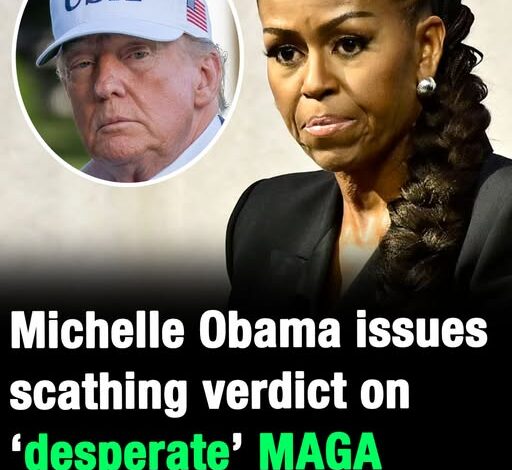
That is what makes Michelle Obama’s words so striking.
Not because they avoid difficult truths.
Because they refuse easy ones.
For years, Michelle Obama has occupied a unique place in American public life. Admired by many, criticized by others, scrutinized by nearly everyone, she understands perhaps better than most what it means to become a symbol in a national argument.
She has experienced adoration.
She has experienced hostility.
She has witnessed the way political narratives can transform ordinary people into representations of larger cultural battles.
And she has endured attacks that moved far beyond policy disagreements.
Some of the most disturbing moments directed toward her family carried unmistakable racial undertones. Among them was an AI-generated video depicting racist imagery that Barack Obama publicly condemned as crossing every conceivable line of decency and humanity.
For many observers, incidents like these seemed to demand a particular response.
Anger.
Condemnation.
Retaliation.
The expectation felt understandable.
After all, how should someone react when their family becomes the target of dehumanizing attacks?
How should someone respond when public discourse descends into cruelty?
Yet Michelle Obama’s approach has often resisted the emotional script people expect.
Not because she excuses such behavior.
Not because she minimizes its impact.
And certainly not because she ignores the harm it causes.
Rather, she consistently returns to a question many political conversations avoid:
Why are people vulnerable to these movements in the first place?
That question changes everything.
Because it shifts attention away from villains and toward conditions.
Away from personalities and toward systems.
Away from individual outrage and toward collective responsibility.
When Michelle Obama speaks about many of the voters who helped bring Donald Trump to power, she does not pretend there are no extremists.
She does not deny the existence of racism.
She does not erase the reality of prejudice.
Instead, she introduces something increasingly rare into political discussions.
Complexity.
She suggests that many of these voters are not driven primarily by hatred.
Many are frightened.
Frustrated.
Economically insecure.
Disillusioned.
Confused by rapid social and economic changes.
Searching desperately for answers in a world that often feels indifferent to their struggles.
This perspective does not require agreement.
But it does require attention.
Because it challenges a comforting assumption embraced across the political spectrum.
The assumption that people who disagree with us must be motivated entirely by malice.
That assumption simplifies the world.
It also makes understanding impossible.
Michelle Obama’s warning reaches beyond partisan politics.
It speaks to a broader danger.
The danger of reducing millions of people to caricatures.
When entire communities are dismissed as irredeemable, ignorant, or hateful, communication collapses.
Empathy disappears.
Trust evaporates.
And the possibility of persuasion vanishes alongside them.
She argues that writing off large portions of the electorate may feel emotionally satisfying in the short term.
But politically, socially, and democratically, it carries enormous costs.
Because people rarely move toward understanding after being told they are beyond redemption.
They move further away.
Further into resentment.
Further into isolation.
Further toward voices willing to tell them they are victims rather than participants.
History offers countless examples of this dynamic.
Periods of economic instability.
Cultural upheaval.
Rapid social change.
Moments when institutions appeared distant from everyday struggles.
Again and again, these conditions created opportunities for individuals promising simple explanations.
Simple enemies.
Simple solutions.
The appeal of such figures rarely emerges from strength alone.
It emerges from frustration.
From unmet needs.
From communities feeling unseen.
Michelle Obama’s concern appears rooted in that reality.
Her focus extends beyond individual politicians and toward the conditions allowing certain political movements to flourish.
The question is not merely why people support controversial leaders.
The question is what circumstances make those leaders attractive.
That distinction matters.
Because solving the second problem may reduce the first.
Throughout modern political history, working-class and middle-class communities have often expressed similar complaints regardless of ideology.
Jobs disappear.
Wages stagnate.
Housing becomes less affordable.
Healthcare grows more expensive.
Educational opportunities become unevenly distributed.
Communities once built around stable industries struggle to redefine themselves.
People begin feeling disconnected from institutions that claim to represent them.
Over time, disappointment hardens into anger.
And anger searches for direction.
Sometimes it finds constructive outlets.
Sometimes it does not.
Michelle Obama’s warning suggests that political leaders ignore these frustrations at their own peril.
Not because every grievance is justified.
Because many grievances are real.
And real grievances rarely disappear simply because people dislike the way they are expressed.
Ignoring pain does not eliminate it.
Ignoring frustration does not resolve it.
Ignoring fear does not calm it.
Unaddressed emotions tend to accumulate.
Eventually, they seek expression elsewhere.
This is where her message becomes particularly challenging.
Because it directs criticism toward multiple audiences simultaneously.
Conservatives are not the only ones being asked to reflect.
Liberals are too.
She suggests that progressive movements sometimes underestimate the consequences of contempt.
When voters feel mocked rather than heard, lectured rather than understood, they become increasingly receptive to alternative narratives.
Even narratives containing misinformation or harmful ideas.
The emotional need to feel respected can become more powerful than policy preferences.
People want economic security.
But they also want dignity.
Recognition.
Belonging.
When those needs go unmet, political behavior becomes difficult to predict.
This observation does not excuse harmful choices.
Nor does it suggest all political movements deserve equal moral evaluation.
Rather, it highlights a practical reality.
Democracy depends upon persuasion.
And persuasion becomes impossible when entire populations are treated as permanently unreachable.
Michelle Obama’s comments ultimately point toward a deeper concern about democratic health itself.
Democracies rely upon disagreement.
That much is unavoidable.
But they also rely upon a shared belief that opponents remain fellow citizens rather than permanent enemies.
Once that belief disappears, polarization accelerates.
Compromise becomes betrayal.
Debate becomes warfare.
Every election feels existential.
Every defeat feels catastrophic.
Every victory feels temporary.
The system grows increasingly fragile.
This fragility creates opportunities for demagogues.
History demonstrates this repeatedly.
Demagogues rarely emerge from societies characterized by widespread trust and stability.
They emerge from division.
From cynicism.
From anger.
From populations convinced nobody else cares about their concerns.
The less people trust institutions, the more appealing strong personalities become.
The less people trust one another, the easier it becomes to weaponize fear.
The less people feel represented, the more likely they are to embrace disruption.
Whether that disruption ultimately helps or harms them often becomes a secondary consideration.
At least someone is paying attention.
At least someone seems willing to fight.
At least someone appears to understand their frustration.
This emotional dynamic has shaped political movements across countries, generations, and ideologies.
Michelle Obama’s warning appears rooted in recognition of that pattern.
The solution, in her view, is not merely defeating particular candidates.
It is addressing the conditions making those candidates attractive.
Economic insecurity.
Social isolation.
Political alienation.
Institutional distrust.
These challenges cannot be solved through outrage alone.
Nor can they be solved through slogans.
They require attention.
Investment.
Leadership.
And perhaps most importantly, a willingness to see complexity where simplicity feels easier.
What gives her message its power is not optimism.
It is realism.
She does not pretend that empathy instantly heals division.
She does not suggest understanding eliminates disagreement.
She does not argue that all perspectives deserve equal acceptance.
Instead, she offers a practical observation.
A democracy cannot afford to abandon large segments of its population.
Not morally.
Not politically.
Not strategically.
Doing so creates vacuums.
And vacuums rarely remain empty for long.
Someone always steps in.
Someone always offers explanations.
Someone always promises answers.
The question is what kind of answers they offer.
In the end, Michelle Obama’s remarks are less about Donald Trump than about the environment that produced him.
Less about one election than about recurring patterns.
Less about assigning blame than about understanding causes.
That focus may frustrate those seeking simpler narratives.
But perhaps that is precisely the point.
Complex problems rarely yield simple solutions.
And societies divided by fear, resentment, and economic uncertainty cannot be repaired through condemnation alone.
They require something harder.
Listening.
Understanding.
Leadership.
And a commitment to addressing the frustrations that continue driving people toward anger.
Because when pain remains ignored, it does not disappear.
It searches for explanations.
It searches for enemies.
It searches for someone willing to give it a voice.
And in that search, democracy itself can become vulnerable.
That is the warning beneath Michelle Obama’s words.
Not a defense of division.
Not an excuse for prejudice.
But a reminder that healthy democracies require more than winning arguments.
They require understanding why so many people felt unheard in the first place.
And they require leaders willing to confront that reality before frustration becomes something far more dangerous.