My 12-Year-Old Son Built Wheelchairs for 3 Stray Dogs – Our Neighbor Smashed Their Shelter, but 24 Hours Later, Someone Showed up at Her Door

I used to think I fully understood my son’s kindness—until one decision he made quietly reshaped our entire life. Looking back, that moment didn’t just stand out. It divided everything into “before” and “after.”
My son Ethan is twelve, and he has always moved through the world a little differently. Not louder or brighter—just deeper. He notices what others step over. If something is broken, he doesn’t shrug and move on; he studies it, sits with it, and keeps trying until he understands how to fix it.
For years, I told myself it was a phase.
Now I know better. That’s simply who he is.
It started one evening as the sun dipped low, painting the road in soft gold. We were walking near the edge of our neighborhood when Ethan suddenly grabbed my arm.
“Mom… they’re still alive,” he whispered.
There was something in his voice that made my stomach drop.
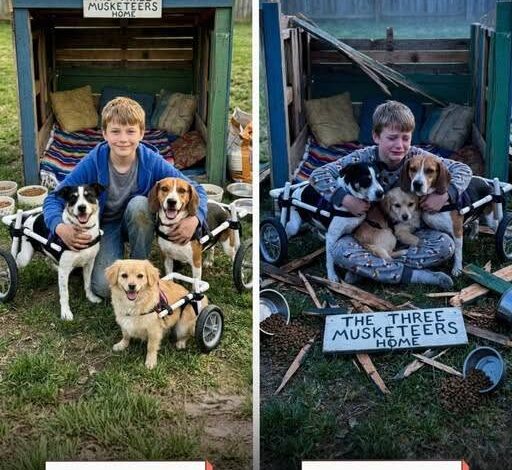
A few feet off the road, three dogs lay in the dirt. Their bodies trembled, and when they tried to move, their back legs dragged uselessly behind them. It didn’t take much to understand what had happened—a hit-and-run, followed by silence.
I remember looking around, hoping someone else would step in. Someone better equipped. Someone with more money. More time. More certainty.
But the road stayed empty.
And Ethan didn’t move.
“We can’t leave them,” he said.
He wasn’t asking.
We barely had enough for ourselves. That was the truth. But another truth settled in just as heavily—we wouldn’t be able to live with ourselves if we walked away.
So we didn’t.
We lifted the dogs as gently as we could and rushed them to the nearest vet, arriving just before closing. Ethan stayed close the entire time, his small hand gripping my sleeve as if letting go might change the outcome.
After what felt like hours, the vet returned.
“They’ll live,” he said.
Relief hit first—sharp and immediate.
Then came the rest.
“But they’ll never walk again.”
The room fell quiet.
Ethan didn’t cry. He didn’t argue. He just looked at the dogs for a long moment, like he was recalculating something invisible.
Then he turned to me.
“Don’t worry,” he said. “I have an idea.”
I didn’t understand—but I believed him.
Over the next two weeks, our backyard transformed into something unrecognizable. Old bike frames appeared. Broken stroller parts. Loose wheels. PVC pipes stacked against the fence. Tools scattered like puzzle pieces waiting to be assembled.
Ethan worked every afternoon after school.
Measuring. Cutting. Adjusting.
When I offered to help, he’d shake his head.
“I’ve got it. I just need time.”
So I gave him that.
The first time he finished one of his creations, he called me outside. His hands were steady as he carefully fitted one of the dogs into the small frame.
“Easy… I’ve got you,” he whispered.
For a second, nothing happened.
Then the wheels turned.
One step.
Then another.
It wasn’t graceful. It wasn’t perfect.
But it was movement.
Soon the others followed—awkward at first, then steadier. The yard filled with the soft clatter of wheels and something even louder: Ethan’s laughter.
It was pure. Unfiltered.
And in that moment, something shifted.
Not just for the dogs.
For us.
Days passed, and the dogs began to explore, bumping into things, learning their new balance. Ethan stayed close, guiding them patiently.
“Turn… no, not that way,” he’d say, adjusting their frames.
Then one afternoon, he came to me with another plan.
“They need a home,” he said.
He had already sketched it out.
Without hesitation, he spent nearly all his saved allowance on supplies. Wood, nails, insulation.
“Are you sure?” I asked.
“They deserve it,” he replied.
So we built it together.
It wasn’t perfect. The lines were uneven, the paint a little messy. But it was warm. Safe. Ours.
For a while, that was enough.
Until it wasn’t.
Our neighbor, Melinda, had been watching. Always from a distance, always with a look that suggested disapproval long before she ever spoke.
When she finally did, it wasn’t subtle.
“It’s an eyesore,” she said. “And the noise—this isn’t acceptable.”
We tried. We really did.
We repainted. Added plants. Trained the dogs to stay quiet.
But nothing changed her mind.
Because it was never about the noise.
Then came the morning that broke everything.
Ethan went outside with their food like he always did.
Seconds later, I heard him scream.
I ran.
The yard was destroyed.
The shelter—gone. Wood splintered across the ground. Blankets soaked and torn. The fence ripped open like something had forced its way through.
The dogs huddled together, shaking.
Ethan stood in the middle of it all, frozen.
Across the fence, Melinda stood on her deck, holding her coffee. Watching.
We called the police. But without proof, there was little they could do.
That day, Ethan barely spoke. He sat beside the wreckage, resting his hand gently on one of the dogs.
“I’m sorry,” he whispered. “I couldn’t protect you.”
There are moments as a parent when you don’t know how to make things better.
This was one of them.
But the story didn’t end there.
The next morning, a black van pulled up outside Melinda’s house. A man stepped out—calm, composed, carrying authority without raising his voice.
His name was Jonathan.
He didn’t go to her first.
He came to us.
He listened as Ethan explained, voice shaking but determined. He looked at the broken yard, the torn fence, the frightened dogs.
“I’ll take care of this,” he said quietly.
Two days later, he returned.
This time, he asked us to come with him.
Inside Melinda’s house, he played a video.
Clear. Undeniable.
It showed her—late at night—cutting through the fence, stepping into our yard, tearing the shelter apart piece by piece.
Ethan stepped forward.
“Why?” he asked.
Her answer came quickly.
“It was ruining everything.”
Jonathan didn’t argue. He didn’t need to.
Her complaints were dismissed. Her requests denied. She was ordered to pay for the damage.
When she hesitated, he asked one simple question.
“Would you prefer we take this further?”
She signed.
The next day, workers arrived. They rebuilt everything—stronger, better. The fence restored. The shelter improved beyond anything we had made.
But something else changed too.
Neighbors began to show up.
First one. Then more.
Food. Toys. Blankets.
Children gathered in the yard, watching the dogs move in their wheeled frames. Ethan showed them how everything worked, explaining each piece with quiet pride.
The yard filled with life.
Melinda stayed inside after that. Curtains drawn.
No one needed to say anything.
Everyone understood.
One evening, as the sun dipped low again, Ethan sat beside me.
“They’re okay now,” he said.
I nodded.
He watched the dogs moving freely across the yard—and smiled.
This time, the smile didn’t fade.
And I realized something I hadn’t fully understood before:
Kindness doesn’t just fix what’s broken.
Sometimes, it rebuilds everything around it.