My Husband Hit Me Six Times for His Mistress and Threw Me Into the Rain—By Sunrise, His Entire Empire Was Falling Apart

The sixth slap knocked me sideways into the marble table beside our front door.
For a few seconds, all I could hear was rain pounding the windows.
Then Vanessa Cole laughed somewhere behind my husband.
My lip was bleeding.
My ribs burned.
And the pearl earrings in Vanessa’s ears belonged to me.
Grant Whitmore stood over me, breathing hard.
“You should have learned your place, Claire.”
Then he opened the front door, threw my overnight bag into the storm, and pointed outside.
“Get out.”
Vanessa stood behind him wearing my silk robe like she had already moved into my life.
I refused to cry in front of either of them.
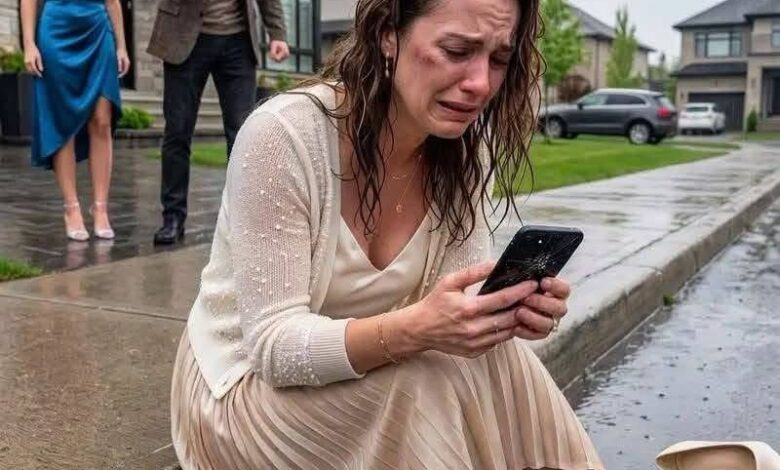
Barefoot, bruised and shaking, I stepped into the rain.
Grant slammed the door.
Seconds later, the security gate opened and I stumbled onto the sidewalk outside our Highland Park home.
Cars passed.
Nobody stopped.
I sat beneath a streetlight and pulled out my cracked phone.
There was only one person I wanted.
My father answered on the second ring.
“Claire?”
“Dad.”
His voice changed immediately.
“What happened?”
I looked back toward the house.
“He hit me.”
Silence.
“How many times?”
“Six.”
Another pause.
“Vanessa was there. He threw me out.”
Arthur Vance did not swear.
He did not shout.
My father had built one of the largest logistics companies in the country by learning that anger was useless unless it became action.
“Are you safe?”
“No.”
“Send me your location.”
I did.
“Do not go back inside. Do not answer Grant. Security is coming. So is a doctor.”
I closed my eyes.
“Dad?”
“Yes?”
“Show him no mercy.”
His answer was quiet.
“Then mercy is over.”
Forty minutes later, two black SUVs pulled beside the curb.
By sunrise, Grant had already begun losing the world he thought made him untouchable.
My father took me straight to Baylor University Medical Center.
Doctors documented everything.
A cracked rib.
Swelling around my eye.
Bruising across my cheek, neck and arm.
Defensive marks around my wrist.
A nurse photographed every injury.
My father stood beside the window making calls.
“Preserve every contract connected to Whitmore Development.”
Then:
“Freeze our pending investments.”
Then:
“Get Rebecca Shaw here.”
He never raised his voice.
That was how I knew Grant was in real trouble.
By seven in the morning, Grant had called twenty-three times.
I ignored every one.
At 8:15, his first message appeared.
Come home. You embarrassed me last night.
Then:
Your father needs to stay out of our marriage.
Then:
You have no idea what you’re doing.
Rebecca Shaw arrived before nine.
She was one of the sharpest litigation attorneys in Dallas and had represented businesses connected to my father for years.
She read Grant’s messages.
“Save all of these.”
“He thinks I’m coming home.”
Rebecca looked at my bruised face.
“Let him keep thinking badly.”
At 10:30, Grant was served at his downtown headquarters.
The papers included a divorce petition, an emergency protective-order request, medical evidence, an asset-preservation demand and claims involving hidden marital property.
Security footage later showed Grant laughing when the process server first approached.
He stopped laughing after reading the first page.
By eleven, Whitmore Development’s chief financial officer had resigned.
At 11:20, Vance National Freight suspended three major agreements involving Grant’s projects.
At noon, one of his lenders demanded a review of construction loans.
Then my father’s accountants started finding things.
Vanessa’s name appeared first.
Over eighteen months, Grant had transferred more than $1.7 million into a Delaware company connected to her.
The money paid for an apartment.
Jewelry.
Vacations.
A condominium in Miami.
But that was only the beginning.
Grant had also used my inheritance as collateral without my permission.
He had hidden marital assets.
Inflated construction invoices.
Moved investor money between projects.
And paid inspectors through intermediaries.
The man who thought throwing me into the rain would make me powerless had left a financial trail long enough to destroy the illusion he had built around himself.
That night, I sat in my father’s library wearing hospital slippers.
My cheek had turned dark purple.
Dad set tea beside me.
“Are you sure you want to continue?”
I looked at the divorce papers.
“Yes.”
Grant thought he had thrown a broken woman out of his house.
What he had actually done was send a forensic team toward everything he owned.
Three days later, we appeared in court.
Grant arrived wearing a charcoal suit.
Perfect hair.
Perfect posture.
Perfect expression of wounded innocence.
Vanessa waited outside wearing oversized sunglasses.
On her wrist was my mother’s diamond bracelet.
Rebecca noticed immediately.
“Don’t react.”
So I didn’t.
Grant’s attorney described what happened as an unfortunate marital argument.
He said I had been emotional.
Jealous.
Unstable.
According to him, I had slipped in the rain.
Then Rebecca played the neighbor’s security footage.
Grant appeared on the screen.
The front door opened.
My overnight bag flew outside.
Then I stumbled onto the porch barefoot.
The door slammed behind me.
Nobody in the courtroom moved.
Rebecca presented the hospital photographs next.
Then Grant’s messages.
His attorney objected repeatedly.
The judge overruled him.
The protective order was granted.
Grant was ordered to stay away from me and the house.
He was prohibited from transferring assets.
Financial records had to be preserved.
He could contact me only through counsel.
When we stepped into the hallway afterward, Vanessa rushed toward him.
“What does this mean?”
Grant snapped, “It means stop talking.”
For the first time, she looked frightened.
The real collapse came two weeks later.
My father’s accountants completed their preliminary review.
Grant had falsified occupancy records for lenders.
Inflated invoices.
Moved investor money into personal expenses.
Used shell companies to hide transactions.
One investor was a pension fund.
Another was a private family office connected to people who knew my father.
Dad did not need to invent consequences.
He simply stopped protecting Grant from them.
Lawsuits followed.
Lenders demanded audits.
Whitmore Development suspended him.
Two projects lost permits.
Then a business newspaper published the story.
Grant began calling Rebecca constantly.
Eventually, she put one call on speaker.
“Claire,” Grant said, “this has gone too far.”
Rebecca answered.
“You are speaking with counsel.”
“I want my wife.”
“My client does not wish to speak with you.”
“Tell her I’m sorry.”
Rebecca looked at me.
I nodded once.
“For what specifically, Mr. Whitmore?”
Silence.
Then:
“For hitting her.”
Another pause.
“For Vanessa.”
Another.
“For the money.”
His voice dropped.
“For losing control.”
Something inside me loosened.
Not forgiveness.
Proof.
Grant was finally saying aloud what he had spent weeks denying.
Rebecca ended the call.
The divorce negotiations were vicious.
Grant wanted the house.
He lost it.
He wanted access to frozen accounts.
Denied.
He wanted Vanessa removed from the financial record.
Impossible.
He demanded confidentiality.
I refused.
Then Vanessa realized there might not be much money left to enjoy.
She hired her own lawyer.
She claimed Grant had told her we were separated.
She insisted she knew nothing about fraudulent transactions.
But while trying to protect herself, she confirmed the apartment, the jewelry, the shell company and the timeline.
Grant’s position got worse.
Nearly a month after the night in the rain, I returned to the house with security and movers.
Grant was gone.
Without him, the rooms felt enormous.
Not comforting.
Empty.
My earrings were missing.
So was the silk robe Vanessa had worn.
Several handbags were gone.
But a photograph of my mother remained on the bedroom dresser.
I picked it up and held it against my chest.
For years, I had mistaken endurance for loyalty.
Grant had not suddenly become cruel the night he hit me six times.
He had built cruelty slowly.
An insult.
A criticism.
Control over a bank card.
A friendship I stopped seeing because he disliked her.
A rule about clothing.
An apology after the first shove.
Little by little, my life became smaller until violence felt like merely the latest step in something that had been happening for years.
I decided I would never shrink for him again.
The investigations continued.
Whitmore Development entered restructuring.
Its board sued Grant.
Lenders pursued him.
Vanessa moved away and began blaming him publicly.
Grant’s mother called me crying.
“Think about what you’re doing to our family name.”
I answered calmly.
“I am.”
Then I hung up.
Seven months later, the divorce became final.
I recovered the house, hidden assets and damages connected to Grant’s misuse of marital funds.
The court record confirmed much of the financial misconduct he had tried to conceal.
The domestic-violence case proceeded separately.
Grant eventually accepted a plea arrangement involving probation, counseling requirements, fines and a permanent criminal record.
His company survived.
He did not.
At least not as the man he had once believed himself to be.
The board removed him.
Major assets were sold.
His name disappeared from the branding.
Private clubs stopped returning calls.
Political friends stopped inviting him to dinner.
Business partners who once called him brilliant began describing the whole thing as “unfortunate.”
That was how Grant’s powerful world ended.
Not in one spectacular explosion.
Door by door.
A year after he threw me into the rain, I stood inside the lobby of a new legal-aid center funded by the Vance Foundation.
It provided attorneys, temporary housing assistance and financial investigators for people trying to leave abusive relationships.
Dad stood beside me during the opening.
On the wall was a plaque bearing my name.
For several seconds, I stared at the surname Whitmore engraved beneath it.
My father noticed.
“You can remove it.”
I shook my head.
“No.”
“You’re sure?”
“It doesn’t belong to him anymore.”
After the ceremony, Dad asked me something.
“Do you regret what you said that night?”
“What?”
“Show him no mercy.”
I looked across the waiting area.
A woman sat holding a little boy’s hand.
Another wore sunglasses large enough to hide half her face.
A third spoke quietly with an attorney.
“No.”
Then I thought about it.
“But I understand it differently now.”
Dad waited.
“I thought I wanted you to destroy him.”
“And now?”
“I wanted him to stop being protected from the truth.”
Dad nodded.
“That’s different.”
“Yes.”
Two weeks later, a letter arrived.
No return address.
Grant had written only four words.
I lost everything, Claire.
I read them once.
Then placed the letter inside the file marked CLOSED.
He was wrong again.
He had not lost everything because of me.
He lost it because he spent years believing money, influence and fear could erase consequences.
That evening, rain began falling over Dallas.
For a moment, I stood beneath the awning outside the center and listened.
A year earlier, that sound had meant humiliation.
Cold pavement.
Blood on my mouth.
A locked gate behind me.
This time, I stepped into the rain willingly.
I walked toward my car without checking whether anyone was following me.
And I finally understood what my father had really given me that night.
It was not revenge.
It was not money.
It was not enough power to destroy my husband.
It was the chance to choose myself after years of being taught that I should not.
Grant hit me six times because he believed strength belonged to the person who could cause the most pain.
He was wrong.
Strength was sitting on that curb, barefoot and bruised, and making one phone call.
Strength was documenting the truth.
Walking into court.
Refusing to return.
And eventually realizing that the most important door that closed after that night was not one of Grant’s.
It was mine.
And he would never be allowed through it again.