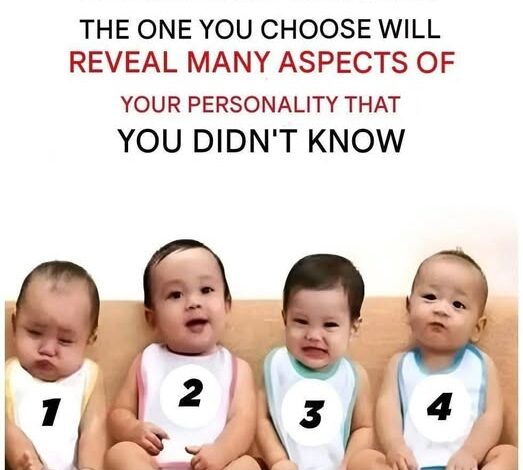
Personality tests built around quick, instinctive choices have become wildly popular because they tap into something people are naturally curious about: the hidden patterns behind why we notice certain things first.
Whether it’s choosing a color, identifying a shape in an optical illusion, or, in this case, deciding which baby “looks like” a girl, the real purpose is rarely scientific accuracy. Instead, these exercises invite people to pause briefly and reflect on their own emotional tendencies, instincts, and ways of relating to the world.
The important part is not being “right.”
It’s noticing what your choice might quietly reveal about how your mind and heart operate beneath conscious thought.
In this playful test, participants imagine four babies labeled 1 through 4 and choose, without analyzing too carefully, which one they instinctively believe is a girl. There is no factual answer hidden inside the image. The interpretation comes entirely from the emotional associations attached to the choice itself.
If someone chooses baby number 1, the interpretation suggests a personality shaped strongly by empathy, emotional sensitivity, and protectiveness.
Psychologically, this makes sense symbolically.
People who are naturally nurturing often respond instinctively to softness, vulnerability, or expressions they subconsciously interpret as gentle or emotionally open. They tend to notice emotional atmosphere quickly and frequently prioritize comfort, reassurance, and emotional harmony in relationships.
These are the people others often describe as:
easy to talk to,
warm,
patient,
“safe,”
or quietly understanding.
Interestingly, highly empathetic individuals are often unaware of how strongly they affect the emotional lives of others. Friends, coworkers, and even strangers may begin confiding in them unexpectedly because empathetic people unconsciously communicate attentiveness through body language, tone, eye contact, and emotional responsiveness.
Others sense they are unlikely to be judged harshly.
That creates emotional trust almost automatically.
The description of intuition as a “quiet superpower” also resonates psychologically because emotionally perceptive people frequently detect subtle changes before others do:
a forced smile,
hesitation in someone’s voice,
fatigue hidden beneath politeness,
sadness disguised as irritation.
This ability does not come from magic or mind-reading.
It often develops because sensitive individuals spend years paying unusually close attention to emotional cues, consciously or unconsciously. Over time, the brain becomes highly skilled at recognizing patterns in human behavior.
The downside, however, is that empathetic people sometimes absorb too much emotionally. They may carry other people’s pain home with them, overextend themselves helping others, or struggle setting boundaries because protecting someone else feels instinctively more important than protecting themselves.
That is why the final message in the interpretation matters so much:
softness is not weakness.
Modern culture often praises toughness,
speed,
detachment,
and constant productivity.
Sensitivity can therefore feel inconvenient or overly emotional in environments rewarding emotional armor. But empathy remains one of the traits most essential to healthy relationships, parenting, friendship, caregiving, leadership, and community itself.
People who genuinely listen,
comfort,
and notice suffering often become emotional anchors for everyone around them.
Importantly, though, tests like this should be viewed lightly and thoughtfully rather than as psychological fact. Human personality is far too complex to define through one spontaneous choice alone. Mood, memory, personal associations, and countless unconscious factors influence decisions in playful tests like these.
What makes them meaningful is not scientific precision.
It is reflection.
Sometimes simple exercises help people recognize qualities they already carry quietly inside themselves:
kindness,
protectiveness,
intuition,
curiosity,
or emotional openness.
And perhaps that is why these personality games remain so appealing.
In a fast-moving world where people are constantly categorized through achievements, productivity, or public identity, there is something comforting about being reminded of gentler traits:
the ability to care deeply,
to notice emotions,
to make others feel understood.
Whether or not baby number 1 truly “means” empathy scientifically is less important than the emotional invitation behind the interpretation itself:
to see compassion not as fragility, but as strength worth protecting.
And maybe, as the description suggests, the real takeaway is not what the imagined baby says about you —
but whether you extend the same kindness toward yourself that you so naturally offer everyone else.