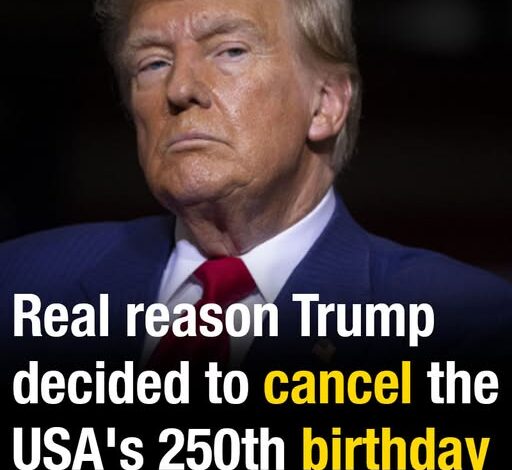
What was originally envisioned as a star-studded celebration of America’s 250th anniversary is increasingly becoming something entirely different.
Instead of concert stages packed with major performers, dazzling musical tributes, and patriotic entertainment stretching across the nation, the event now finds itself at the center of a growing controversy involving celebrity withdrawals, political tensions, and Donald Trump’s latest proposal: replacing portions of the celebration with a massive Make America Great Again rally.
The dispute has transformed what was supposed to be a unifying national milestone into yet another flashpoint in America’s deeply polarized political landscape.
At the heart of the debate is Freedom 250, a large-scale celebration connected to the upcoming 250th anniversary of American independence.
The anniversary itself represents a historic moment.
Two and a half centuries after the signing of the Declaration of Independence, organizers hoped to create a series of events that would commemorate the nation’s history, achievements, culture, and identity.
Music was expected to play a major role.
Concerts featuring well-known artists were intended to attract audiences from across the political spectrum and help transform the anniversary into a nationwide celebration.
For a time, the plan appeared straightforward.
Then the withdrawals began.
One by one, several artists reportedly distanced themselves from the event.
Some claimed they had not fully understood the political associations surrounding the celebrations when they initially agreed to participate.
Others reportedly grew uncomfortable as public attention intensified.
The departures generated headlines almost immediately.
Questions emerged about whether the event was becoming more political than cultural.
Critics argued that musicians had been placed in a difficult position.
Supporters countered that performers were surrendering to political pressure.
What might have remained a routine scheduling issue quickly evolved into a national conversation.
Names associated with the withdrawals attracted significant attention.
Reports indicated that artists including Martina McBride, Bret Michaels, The Commodores, and Young MC either withdrew or distanced themselves from participation.
The reasons varied.
Some expressed concern about the event’s political environment.
Others reportedly sought clarification about how their involvement was being presented publicly.
As news spread, speculation intensified regarding who would remain attached to the celebrations and whether the planned concert series could continue as originally envisioned.
Yet despite the departures, not every performer walked away.
Several artists remained connected to the project.
Among the most frequently mentioned were Vanilla Ice and Flo Rida, both of whom continued to be associated with portions of the planned festivities.
Their participation offered organizers some continuity, but uncertainty surrounding the overall lineup remained.
As the controversy grew, attention inevitably shifted toward Donald Trump.
The former president, never known for remaining silent during public disputes, responded in characteristic fashion.
Rather than simply defending the original plans, Trump escalated the conversation entirely.
In a lengthy post shared on Truth Social, he criticized performers who had chosen not to participate and suggested that the celebration might not need them at all.
His message was direct.
Blunt.
And unmistakably Trump.
According to the former president, the event could potentially be improved by eliminating some of the musical performances altogether.
Instead of relying on entertainers he described as overpriced and unappealing, Trump suggested replacing portions of the celebration with a massive political gathering centered around his supporters.
The proposal immediately generated intense discussion.
Supporters embraced the idea.
Critics condemned it.
Political commentators debated whether the suggestion represented a serious logistical proposal or merely another example of Trump’s ability to dominate media coverage through provocative statements.
Regardless of interpretation, the comments ensured that attention shifted away from the departing performers and toward Trump himself.
That shift has become a familiar pattern throughout his political career.
When controversy emerges, Trump often responds not by minimizing it but by reframing it entirely.
The focus becomes his response.
His proposal.
His criticism.
His alternative vision.
The Freedom 250 dispute followed that formula almost perfectly.
Rather than defending the event as originally planned, Trump proposed transforming it into something more aligned with his political brand.
According to his comments, a giant MAGA rally could potentially replace certain portions of the entertainment schedule.
He argued that such a gathering would attract greater enthusiasm and larger crowds than many of the performers who had withdrawn.
The remarks reflected a theme that has appeared repeatedly throughout Trump’s public life: his belief that his personal appeal rivals or exceeds that of traditional celebrities.
That belief became even more evident as the Truth Social post continued.
In one of the most talked-about portions of his statement, Trump compared his audience appeal to that of Elvis Presley.
The comparison immediately drew national attention.
Trump suggested that he could personally serve as the event’s primary attraction.
Referring to himself in dramatic terms, he argued that his rallies consistently draw audiences larger than those commanded by legendary entertainers.
The comments fit neatly within a style of communication Trump has cultivated for years.
Supporters often view such statements as humorous confidence mixed with political messaging.
Critics view them as exaggerated self-promotion.
Either way, the remarks succeeded in generating exactly what they often generate: conversation.
News organizations covered the comments extensively.
Political analysts weighed in.
Social media erupted with reactions.
The debate over Freedom 250 became, at least temporarily, a debate about Trump himself.
Beyond the headlines and entertainment value, however, the controversy highlights a larger challenge facing modern public celebrations.
Increasingly, cultural events struggle to remain separate from political identity.
Concerts.
Award ceremonies.
Sporting events.
National commemorations.
All have become vulnerable to political interpretation.
What once might have been viewed as broadly patriotic celebrations are now frequently examined through partisan lenses.
Participants face scrutiny.
Organizers face questions.
Audiences bring assumptions shaped by political affiliation.
The result is an environment in which even events intended to unite people can become sources of division.
Freedom 250 appears to have encountered precisely that challenge.
For some Americans, the celebration represents an opportunity to honor national history.
For others, questions about sponsorship, political connections, and public messaging have complicated participation.
The artist withdrawals became symbolic of that broader tension.
Were performers rejecting politics?
Responding to public pressure?
Protecting their brands?
Each explanation attracted supporters.
Each interpretation reinforced existing viewpoints.
Meanwhile, organizers found themselves attempting to preserve momentum amid growing uncertainty.
Trump’s proposal further complicated matters by introducing an entirely different possibility.
Rather than defending the original entertainment-focused vision, he suggested embracing the political nature of the controversy directly.
A rally.
A political gathering.
An event centered not on performers but on political enthusiasm.
For supporters, the idea carries obvious appeal.
Trump rallies have consistently attracted large crowds and significant media attention.
Many attendees view them as cultural events as much as political gatherings.
For critics, however, the proposal risks transforming a national anniversary into a partisan spectacle.
The debate ultimately reflects broader questions about the future of public celebrations in America.
Can major national events remain politically neutral?
Should they?
Who gets to define the tone of commemorative moments?
And what happens when cultural figures and political leaders envision those moments differently?
The answers remain unclear.
What is clear is that Freedom 250 has already become more than a concert series.
It has become a symbol.
A symbol of the complicated relationship between entertainment and politics.
A symbol of the challenges involved in organizing national celebrations during deeply polarized times.
And perhaps most significantly, a symbol of Donald Trump’s continuing ability to reshape public conversations around himself.
As organizers continue navigating performer withdrawals, lineup questions, and public scrutiny, uncertainty remains about what the final celebration will ultimately look like.
Will the concerts proceed largely as planned?
Will new artists be recruited?
Will portions of the event evolve into political rallies?
Or will organizers find a compromise capable of satisfying multiple audiences?
At this stage, no definitive answer exists.
What began as a celebration of America’s 250th anniversary now finds itself at a crossroads.
Part cultural event.
Part political controversy.
Part media spectacle.
And entirely reflective of a nation where even the most symbolic occasions rarely remain untouched by politics.
For now, one thing appears certain.
Whether through concerts, rallies, speeches, or debates, Freedom 250 will continue generating attention.
And if Donald Trump has his way, the biggest attraction may not be a musician at all.
It may be the former president himself, standing before thousands of supporters, transforming a national anniversary celebration into yet another chapter in America’s ongoing political story.