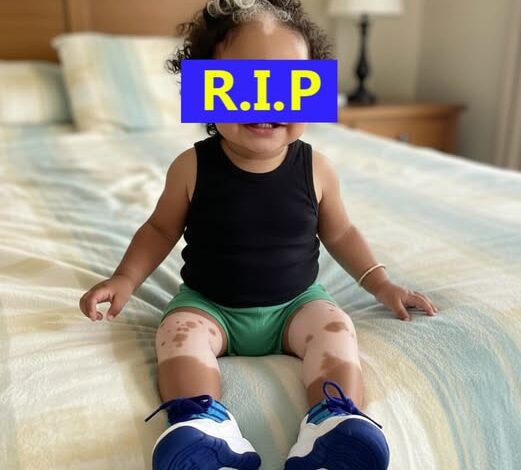
Some tragedies resist language no matter how carefully people try to approach them.
When a child dies — especially an infant — the loss feels almost incompatible with the natural order families expect from life. Parents are supposed to watch children grow, stumble through first steps, learn words, develop personalities, and slowly move outward into the world. An infant’s future exists almost entirely in imagination:
birthday candles not yet lit,
tiny shoes waiting by the crib,
photographs not yet taken,
memories not yet made.
That is why the death of a baby often devastates communities with unusual force.
People are not grieving only a life already lived.
They are grieving every possibility that will now never exist.
In this case, the grief becomes even more unbearable because the danger did not come from illness, accident, or fate. It came from inside the very place meant to offer absolute safety:
home.
There is something uniquely horrifying about violence involving infants because babies exist in complete dependence. They cannot flee,
cannot explain pain,
cannot ask for help,
cannot understand why fear suddenly entered the room around them.
Their survival depends entirely on the emotional stability and protection of the adults caring for them.
When that protection collapses, the betrayal feels almost incomprehensible to outside observers.
The description of the child never speaking a first word or taking a first step captures the emotional scale of the loss powerfully because infancy represents pure beginning. A baby has not yet become fully known to the world. Families are still discovering eye color, expressions, personality traits, sleeping habits, the small details that slowly transform an infant from abstract hope into a distinct human presence.
Everything still exists in fragile possibility.
And then suddenly possibility ends.
The image of the crib afterward becomes emotionally devastating because ordinary objects absorb grief differently after sudden death. A nursery prepared with love transforms instantly into a museum of interrupted expectation:
folded clothes untouched,
blankets still carrying faint traces of scent,
toys waiting permanently for someone who will never return to claim them.
Parents experiencing infant loss often describe this stage as surreal rather than immediately emotional. The room remains physically intact while reality has fundamentally changed. Every object continues behaving as though the future still exists.
That contradiction creates profound psychological disorientation.
The teddy bear remains on the shelf.
The diapers remain stacked neatly.
Tiny outfits still hang in the closet.
But the child is gone.
And because infants leave behind relatively few memories compared to older children, physical objects become emotionally overwhelming symbols of the life interrupted before it fully unfolded.
The community response described in the story also reflects something deeply human about collective grief.
Flowers at gates.
Candles flickering in darkness.
Silent gatherings.
Neighbors speaking softly.
These rituals emerge instinctively after tragedy because people struggle to tolerate helplessness emotionally. When suffering feels too large to fix, communities often turn toward symbolic acts:
light,
flowers,
notes,
vigils,
shared silence.
The gestures cannot reverse loss.
But they create acknowledgment.
And acknowledgment matters enormously after traumatic death.
Families shattered by violence frequently describe feeling emotionally isolated afterward, as though ordinary life continues around them while time inside their own world has stopped completely. Public grieving rituals help counteract that isolation by communicating:
this mattered,
this child mattered,
this pain is seen.
The imagery of candles trembling in the wind feels especially powerful because grief itself often behaves similarly:
fragile,
flickering,
persistent despite instability.
Communities gather not because they possess answers, but because witnessing sorrow together becomes one of the few human responses available when language fails.
Importantly, stories like this also force confrontation with uncomfortable realities surrounding violence inside homes.
Public imagination often associates danger with strangers,
dark alleys,
external threats.
But statistically, many of the most devastating harms against children occur within domestic spaces by caregivers or family members already trusted intimately.
That truth unsettles people deeply because home represents psychological sanctuary. Families build emotional life around the assumption that certain spaces remain fundamentally safe:
cribs,
bedrooms,
kitchens,
nurseries.
When violence enters those spaces, the emotional damage extends beyond one act itself. It fractures communal assumptions about protection and trust.
The story’s reference to the father’s fury highlights another difficult reality:
moments of uncontrolled rage can alter countless lives permanently within seconds.
Infants are especially vulnerable because their bodies cannot withstand force adults may not even fully comprehend in moments of emotional collapse. This is why education surrounding stress, postpartum mental health, caregiver exhaustion, and anger management remains critically important.
None of that excuses violence.
But understanding contributing pressures matters if prevention is the goal.
Many communities still struggle discussing parental overwhelm honestly. Exhaustion,
financial pressure,
mental illness,
relationship conflict,
isolation,
substance abuse,
and emotional instability often intensify privately long before visible tragedy occurs. Shame keeps people silent. Pride prevents intervention. Others notice warning signs but hesitate to interfere in “family matters.”
Then afterward, everyone asks the same impossible question:
How did this happen?
The painful answer is often that collapse rarely begins in a single moment.
It builds quietly beneath surfaces until one catastrophic eruption changes everything forever.
Yet amid all the horror, the story also insists on something deeply important:
the child’s life mattered fully despite its brevity.
Modern culture sometimes measures significance through duration,
achievement,
visibility,
or productivity.
But grief reveals another truth entirely.
A life does not need decades to transform the people around it emotionally.
Infants alter families immediately through hope,
attachment,
dreams,
love,
and vulnerability. Even very brief lives create profound emotional imprint because love does not calculate worth mathematically.
The baby may never have spoken.
Never formed lasting memories consciously.
Never grown old enough to understand the world.
Yet her existence still changed people permanently.
Parents.
Neighbors.
Doctors.
Friends.
First responders.
Entire communities.
That impact remains real regardless of lifespan.
And perhaps the final line captures the deepest emotional truth beneath the tragedy:
a single heartbeat is both fragile and sacred.
Fragile because life can disappear with horrifying suddenness.
Sacred because each human existence — no matter how small or brief — carries immeasurable emotional weight once love becomes attached to it.
That is why empty nurseries haunt people.
Why tiny shoes become unbearable to look at.
Why candles continue burning outside gates long after headlines fade.
Because somewhere inside those rituals lives a collective refusal to allow a child’s brief existence to disappear unnoticed.
Even the shortest life leaves absence behind.
And sometimes absence itself becomes proof of how deeply someone mattered.