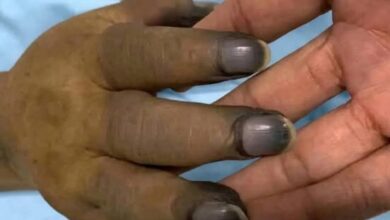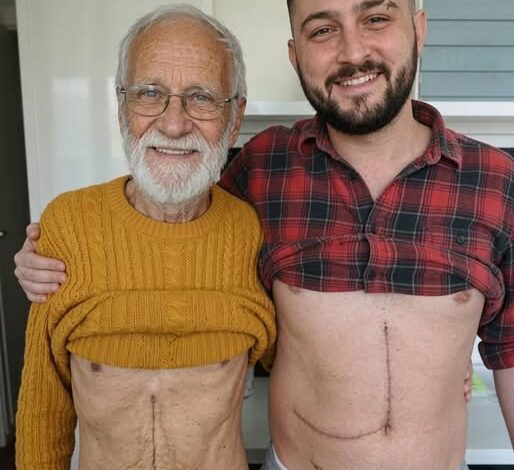
The surgery was supposed to be the moment their family finally exhaled.
Instead, one hospital room became two.
A father who desperately needed a transplant was slowly beginning to recover, while the son who had volunteered to become his living donor was now fighting through serious complications of his own.
It was the outcome nobody had allowed themselves to imagine.
Before the operation, everyone had focused on the father’s illness.
Would a suitable donor be found?
Would his body tolerate surgery?
Would the transplant work?
Then his son stepped forward.
For him, there was barely a decision to make.
This was his father.
The man who had raised him, protected him, worried about him, and spent years putting his children’s needs before his own.
If part of his body could give his father another chance at life, he wanted to give it.
Doctors performed extensive evaluations before approving the donation. Living-donor transplant programs carefully assess potential donors because the donor is undergoing major surgery without receiving a direct medical benefit.
The family understood that surgery carried risks.
But understanding risk on a consent form is different from watching it unfold in someone you love.
Initially, hope dominated everything.
The operation was over.
The father’s new organ was functioning.
Doctors watched his numbers.
Family members exchanged cautious smiles.
For the first time in months, perhaps years, the future seemed to be opening again.
Then attention shifted toward the donor.
Something wasn’t right.
His recovery wasn’t following the course everyone had expected.
The reassuring language became more guarded.
Additional tests were ordered.
Doctors came and went more frequently.
Machines appeared beside the bed.
Family members began recognizing the expression medical professionals wear when they’re trying to remain calm while something complicated is happening.
The son who had entered the hospital healthy was suddenly the person everyone was worried about.
And for his father, the emotional weight was almost impossible to describe.
He had survived because his child volunteered to help save him.
Now that same child was suffering.
Every improvement in the father’s condition carried a terrible contradiction.
His numbers looked better.
His strength slowly returned.
He could sit upright longer.
Take a few more steps.
Eat a little more.
Things that should have felt like victories became tangled with guilt.
Because somewhere nearby, his son remained surrounded by tubes, monitors, medications, and uncertainty.
“How is he?”
It became the father’s first question.
Not:
“How am I doing?”
Not:
“When can I go home?”
Just:
“How is my son?”
The family tried to reassure him without making promises nobody could guarantee.
Doctors reminded everyone of something emotionally difficult but medically important: the father’s recovery had not caused his son’s complications in any moral sense. The son had made a voluntary decision after evaluation and informed consent.
But guilt doesn’t always listen to logic.
A parent spends a lifetime believing his job is to protect his child.
Now the roles had reversed in the most dramatic way possible.
His son had placed himself on an operating table for him.
And the father could do nothing but wait.
The son had understood that living donation wasn’t risk-free.
Every major operation carries possibilities such as bleeding, infection, blood clots, reactions to anesthesia, and other complications. The specific risks vary depending on the type of transplant, the donor’s health, and the procedure performed.
Transplant teams work extensively to minimize those dangers.
Most carefully selected living donors recover successfully.
But “most” is a comforting word until your family finds itself confronting an uncommon complication.
Then statistics become painfully personal.
Outside the hospital, news of the family’s situation began spreading.
First among relatives.
Then friends.
Then neighbors.
People asked what they could do.
The answer was often painfully simple.
Not much.
They couldn’t perform the next procedure.
They couldn’t interpret the monitors.
They couldn’t force an injured body to heal faster.
So they did what communities do when medicine reaches the limits of what ordinary people can contribute.
They showed up.
Meals arrived.
Someone organized donations to help with expenses.
Neighbors took responsibility for practical tasks the family no longer had the energy to think about.
People sent messages.
Former transplant patients and donor families reached out.
Some offered prayers.
Others offered stories.
Many simply said:
We’re here.
It sounds small until you’re the family receiving it.
A medical crisis doesn’t suspend mortgages, electricity bills, childcare, transportation, jobs, or groceries.
Life continues demanding attention even when your entire emotional world has shrunk to a hospital corridor.
A prepared meal can matter.
A ride can matter.
Someone feeding the dog can matter.
Money toward travel or lost wages can matter.
Presence matters.
Because sometimes support isn’t about solving the impossible problem.
It’s about removing enough smaller problems that the family has the strength to face it.
Days inside a hospital have their own strange rhythm.
Morning rounds.
Blood tests.
Medication schedules.
Phone calls.
Waiting.
Always waiting.
Waiting for laboratory results.
Waiting for the specialist.
Waiting to see whether today’s numbers are better than yesterday’s.
Waiting for someone to use the word “stable” and desperately trying to determine whether stable is good news.
For the father, there was another ritual.
Checking on his son.
Sometimes he could receive updates directly.
Other times relatives carried information between rooms.
Every piece of news became enormous.
A slight improvement.
A concerning change.
A treatment working.
Another complication.
When someone you love is critically ill, hope becomes microscopic.
You stop demanding miracles.
You celebrate numbers moving in the correct direction.
You celebrate reduced medication.
You celebrate a better scan.
You celebrate a night without deterioration.
Progress becomes measured in inches.
And inches become everything.
The ordeal also exposed something that often disappears from inspirational stories about organ donation.
Living donors are frequently described with words like “hero,” “selfless,” and “brave.”
Those descriptions may be deserved.
But sometimes they make the medical reality sound too simple.
A living donor isn’t merely handing over something and walking away.
The donor becomes a patient.
There is surgery.
Pain.
Recovery.
Time away from work.
Follow-up care.
Emotional consequences.
And, although transplant programs work hard to keep risks low, the possibility of serious complications cannot be reduced to zero.
That doesn’t diminish the extraordinary importance of living donation.
It makes informed consent even more important.
Potential donors deserve a complete understanding of both benefits and risks, independent medical advocacy, careful evaluation, and the freedom to change their minds.
Nobody should feel pressured to donate simply because someone they love is sick.
A gift means something because it is freely given.
For this son, it was.
He had wanted his father to live.
That intention hadn’t changed simply because the aftermath became frightening.
And slowly, the father began confronting another difficult truth.
His son hadn’t given him this chance so he could spend it drowning in guilt.
He had given it because he wanted his father to have more mornings.
More birthdays.
More ordinary dinners.
More arguments.
More laughter.
More time.
The father’s task now was to recover while hoping desperately that his son would be able to do the same.
That required accepting something parents often struggle to accept:
Love doesn’t always allow you to protect the people you love.
Sometimes all you can do is remain beside them.
The community understood that instinctively.
They couldn’t guarantee the son’s recovery.
So they stood beside the family.
And the family stood beside him.
One day at a time.
One update at a time.
One cautious improvement at a time.
Nobody wanted to transform his suffering into a sentimental lesson while he was still fighting through it.
There was nothing beautiful about complications.
Nothing romantic about frightened relatives sleeping in waiting rooms.
Nothing inspiring about watching monitors and wondering what tomorrow would bring.
But there was something powerful surrounding all of it.
Love had started this story.
A son’s decision to help his father.
And now love was carrying the family through the part nobody had planned.
It arrived through nurses who stayed a few extra minutes.
Through doctors who explained complicated information twice because nobody absorbed it the first time.
Through neighbors leaving food at the door.
Through strangers donating what they could.
Through messages from people the family had never met.
Through a father asking again and again:
“How is my son?”
The transplant had originally been described as a second chance for one man.
Now everyone wanted a second chance for two.
The father was recovering.
The son remained fragile.
And somewhere between those two hospital rooms sat an entire family’s future.
No one could promise how quickly healing would come.
Medicine rarely offers the certainty frightened families want.
But as long as there was progress to measure, treatment to try, and another morning arriving, there was something to hold onto.
Hope.
Not the loud, triumphant kind.
The exhausted kind.
The kind that sleeps in waiting-room chairs.
The kind that celebrates tiny improvements.
The kind that keeps showing up after another difficult update.
A son had entered that hospital hoping to give part of himself so his father could keep living.
Now his father, his family, and an entire community were waiting for him to receive something in return:
Healing.
Time.
And the chance to someday walk out of those hospital doors beside the man he went there to save.