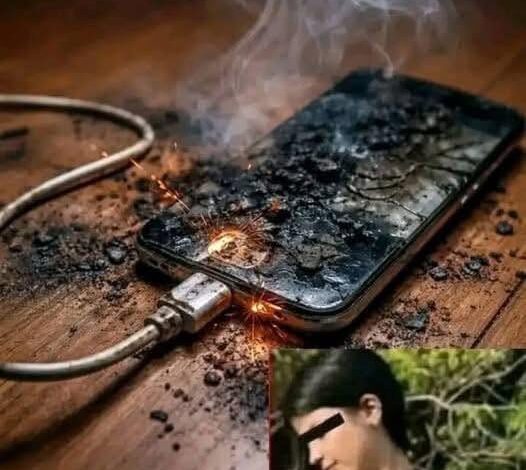
Most electrical accidents don’t begin with dramatic explosions, showers of sparks, or alarms blaring through a house.
They begin quietly.
A charging cable that’s been damaged for months but still works if it’s positioned just right.
A bargain charger purchased online because it was cheaper than the original.
A power strip hidden behind a dresser and forgotten.
A phone left charging overnight beneath a blanket.
A warm adapter that feels slightly hotter than usual but doesn’t seem serious enough to replace.
These small details rarely feel urgent.
That is precisely why they are so often ignored.
In homes around the world, charging devices have become part of everyday life. Phones, tablets, laptops, headphones, smartwatches, and countless other electronics are plugged in daily with little thought. The process feels routine, almost automatic.
Yet familiarity has a way of disguising risk.
When something becomes part of our daily routine, we stop paying attention to it.
We stop noticing warning signs.
We assume that because nothing has gone wrong before, nothing will go wrong tomorrow.
Unfortunately, electricity doesn’t operate according to assumptions.
It follows physical laws.
And when damaged equipment, excessive heat, overloaded circuits, or worn components become part of the equation, those laws can produce consequences that arrive without warning.
One of the most overlooked dangers is the damaged charging cable.
At first, the damage may seem cosmetic.
The outer coating begins to split.
The cable bends sharply near the connector.
A small section appears worn.
The charger occasionally disconnects before reconnecting again.
Many people continue using it anyway.
After all, it still charges the device.
But beneath the visible surface, the internal wiring may already be compromised.
Repeated bending, twisting, pulling, and crushing can weaken electrical conductors over time. As the damage progresses, heat can build up at vulnerable points within the cable.
That heat may remain unnoticed until the problem becomes much more serious.
A charger that works “most of the time” is not necessarily a safe charger.
The same principle applies to charging adapters.
Most people expect chargers to become slightly warm during use.
That is normal.
What is not normal is excessive heat.
If an adapter becomes unusually hot, emits a burning smell, buzzes, crackles, sparks, or feels uncomfortable to touch, it should be treated as a warning sign—not an inconvenience.
Electrical devices communicate problems through heat, noise, and odor long before complete failure occurs.
The challenge is that many people learn to ignore those signals.
A faint buzzing becomes background noise.
A warm plug becomes routine.
A strange smell is dismissed as temporary.
Unfortunately, small warnings often precede larger failures.
The safest response is not to monitor the problem indefinitely.
It is to stop using the device and replace it.
Quality matters more than many people realize.
The market is flooded with inexpensive charging accessories that look nearly identical to certified products. From the outside, the differences may be impossible to spot.
Internally, however, the differences can be significant.
Certified chargers undergo testing designed to evaluate safety, heat management, electrical performance, and durability. Low-quality alternatives may lack those safeguards.
The lower price often reflects more than simple manufacturing efficiency.
Sometimes it reflects compromises.
Compromises in materials.
Compromises in design.
Compromises in safety.
For that reason, purchasing chargers and cables from reputable manufacturers is one of the simplest ways to reduce risk.
Another common mistake occurs while charging overnight.
Millions of people plug in their phones before bed and never think about it again.
In most cases, modern devices are designed to manage charging safely.
The problem is not necessarily the charging itself.
The problem is the environment surrounding it.
A phone charging on a mattress.
An adapter covered by blankets.
A cable trapped beneath pillows.
A charger squeezed between furniture and fabric.
These situations can prevent heat from dissipating properly.
Electronic devices generate heat during operation.
When that heat becomes trapped, temperatures can rise beyond normal operating levels.
A safer setup is surprisingly simple.
Place charging devices on stable, hard surfaces.
Allow air to circulate freely around adapters.
Keep bedding, clothing, paper, and other materials away from heat-producing electronics.
Ensure cables are not bent sharply or subjected to constant pressure.
These small habits dramatically improve safety without requiring major effort.
Power strips deserve similar attention.
Many households rely on them heavily, often beyond their intended purpose.
Over time, additional devices are added.
One charger becomes three.
Three become six.
Soon a single outlet supports phones, tablets, computers, lamps, speakers, and other electronics simultaneously.
The arrangement may function for months or even years without incident.
That does not mean it is ideal.
Overloaded power strips can generate excess heat and strain electrical systems. When hidden behind furniture or buried beneath clutter, problems may go unnoticed until significant damage occurs.
Power strips should remain visible, accessible, and free from obstruction.
Extension cords require the same level of respect.
They are designed as temporary solutions.
Yet many homes use them as permanent infrastructure.
A cord stretched beneath rugs, squeezed under furniture, or exposed to repeated foot traffic may suffer internal damage that cannot be seen from the outside.
What appears intact may already be compromised.
Periodic inspection matters.
So does replacement when wear becomes evident.
Dust and debris present another frequently overlooked hazard.
Electrical equipment naturally attracts dust, pet hair, and household debris over time. Outlets hidden behind furniture often accumulate material for years without inspection.
While dust may seem harmless, excessive buildup can contribute to overheating and reduce ventilation around electrical components.
A quick inspection of rarely seen charging areas can reveal issues before they become dangerous.
Ultimately, electrical safety is not about fear.
It is about awareness.
Most charging devices function safely every day.
Modern electronics are remarkably reliable when used properly.
But reliability should never be confused with invulnerability.
Every charger remains an electrical device connected to a powerful energy source.
That reality deserves respect.
The good news is that meaningful protection does not require complicated knowledge or expensive upgrades.
Replace damaged cords.
Choose certified equipment.
Avoid overloading outlets.
Keep chargers uncovered.
Allow heat to dissipate.
Pay attention to unusual smells, sounds, or temperatures.
Inspect the places you rarely think to check.
Behind the bed.
Under the desk.
Beside the couch.
Near the nightstand.
Safety is rarely the result of one dramatic action.
More often, it comes from small habits repeated consistently over time.
A cable replaced before it fails.
A charger unplugged when no longer needed.
A warning sign addressed instead of ignored.
The greatest danger is often not the charger itself.
It is the assumption that because something looks ordinary, it must be harmless.
Electricity is one of the most useful forces in modern life. It powers our devices, connects us to the world, and makes countless conveniences possible.
But usefulness should never be mistaken for harmlessness.
The safest homes are not the ones free from electricity.
They are the ones where people remember to respect it.