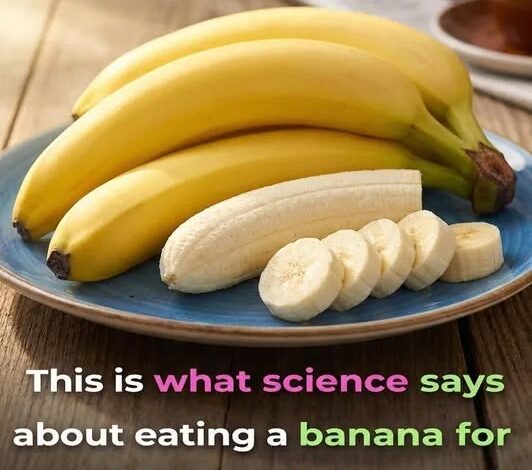
If your mornings are so rushed that breakfast usually becomes an afterthought, there may be one food that’s difficult to claim you don’t have time for: a banana.
There’s nothing to cook, pour, toast, or prepare. You can grab one on your way out the door, carry it in a bag, or eat it before work, school, or a morning workout. Yet behind that convenience is a surprisingly useful combination of carbohydrates, fiber, vitamins, and minerals that can help turn an empty-stomach morning into a more nourishing start.
One of the first things you may notice after eating a banana is a quick lift in energy.
Bananas naturally contain carbohydrates, including sugars such as glucose, fructose, and sucrose. Your body can use these carbohydrates as fuel, making a banana especially convenient when you haven’t eaten since the night before.
That’s one reason bananas are so popular before exercise. They’re easy to carry, require no preparation, and generally don’t feel as heavy as a large breakfast.
But energy is only part of the story.
Bananas are famously associated with potassium, and for good reason. Potassium is an essential mineral involved in normal muscle and nerve function. It also plays an important role in fluid balance and healthy blood-pressure regulation.
Your heart is a muscle too, which makes maintaining an adequate intake of potassium an important part of overall cardiovascular nutrition.
Bananas aren’t the only source of potassium, and one fruit won’t transform your health overnight. Still, adding potassium-rich foods to an otherwise balanced diet is a practical habit that can contribute to meeting your body’s everyday nutritional needs.
Then there’s vitamin B6.
This nutrient doesn’t receive quite as much attention as potassium, but bananas provide a useful amount of it. Vitamin B6 participates in numerous processes throughout the body, including metabolism and normal nervous-system function.
In simpler terms, it helps your body make use of the nutrients you eat.
Bananas also provide some vitamin C and naturally occurring plant compounds with antioxidant activity. Vitamin C contributes to normal immune function and helps protect cells from oxidative stress.
So while a banana shouldn’t be treated as a miracle immune booster, it can certainly be one piece of a varied, nutrient-rich diet.
Where bananas become particularly interesting is digestion.
A banana’s nutritional characteristics change as it ripens.
A slightly green banana contains more resistant starch than a very ripe one. Resistant starch isn’t digested in exactly the same way as ordinary starch. Some reaches the large intestine, where it can serve as a substrate for beneficial gut microbes.
This is why less-ripe bananas are sometimes discussed as a prebiotic-friendly food.
As the banana ripens, much of that starch is converted into sugars.
The texture becomes softer.
The flavor becomes sweeter.
And for some people, a ripe banana can feel easier to eat and digest, particularly when they want something mild rather than a heavy meal.
Bananas also contain dietary fiber, which contributes to normal digestive function and can help with satiety.
That matters in the morning because one of the biggest problems with skipping breakfast isn’t necessarily the missed meal itself—it’s what may happen afterward.
You leave home hungry.
Your energy drops.
Suddenly whatever pastry, vending-machine snack, or oversized coffee drink is closest becomes extremely tempting.
Having something simple available can make healthier choices easier.
Still, there’s an important catch.
A banana by itself isn’t necessarily a complete breakfast.
Although it provides carbohydrates and valuable micronutrients, it doesn’t offer as much protein or fat as many people need for a satisfying meal. Depending on your appetite and activity level, eating only a banana may leave you hungry again relatively quickly.
Fortunately, this is easy to fix.
Pair the banana with protein or healthy fats.
A banana with plain yogurt creates a more substantial breakfast.
Slice one over oatmeal and add nuts or seeds.
Eat it alongside eggs.
Spread peanut or another nut butter over banana slices.
Blend it into a smoothie containing yogurt, milk, or another protein source.
These combinations slow down the experience of eating a carbohydrate-heavy breakfast and provide a broader mix of nutrients. Protein and fat can also increase fullness, helping your breakfast carry you further into the day.
This becomes especially useful for people who experience noticeable swings in hunger or energy after eating something sweet on its own.
Ripeness can also help you choose the banana that best suits what you’re looking for.
If you prefer more resistant starch and a firmer texture, choose one that’s slightly green.
If you want something sweeter, softer, and generally easier to chew, let it ripen until the peel turns yellow and begins developing brown spots.
Neither stage is universally “better.”
They’re simply different versions of the same fruit.
And that’s perhaps the strongest argument for bananas at breakfast: they don’t need to be extraordinary to be useful.
Nutrition advice often becomes complicated enough to make people feel as though a healthy breakfast requires expensive powders, elaborate recipes, or twenty minutes of preparation.
It doesn’t.
Sometimes improving breakfast means making one realistic choice that you can repeat consistently.
A banana takes seconds.
Pair it with a handful of nuts, yogurt, eggs, peanut butter, or another source of protein, and those few seconds can become a much more balanced meal.
No single fruit can guarantee better digestion, perfect blood pressure, endless energy, or a stronger immune system. Health doesn’t work that way.
But a banana can provide carbohydrates for fuel, fiber for digestion, potassium for normal muscle and cardiovascular function, vitamin B6 for metabolism and nervous-system function, and several other useful nutrients—all wrapped in its own portable packaging.
So the next time you’re rushing through the kitchen thinking there’s no time for breakfast, grab the banana.
Better yet, grab something with protein to eat alongside it.
Your morning doesn’t need to become slower to become healthier.
Sometimes it just needs a better first bite.