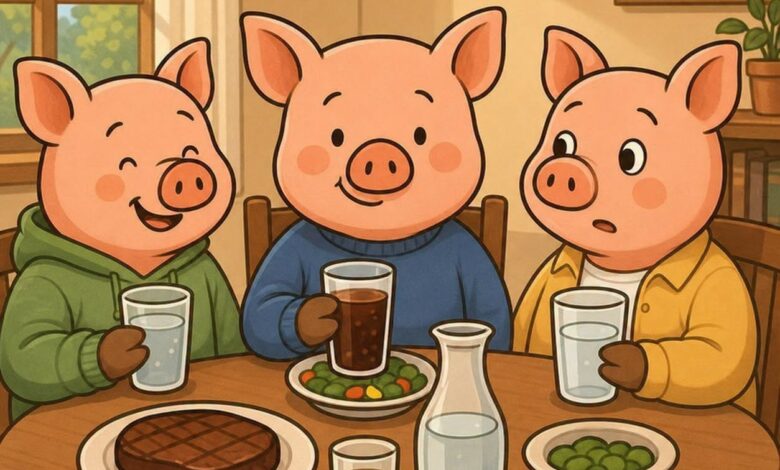
Three pigs walked into a restaurant for dinner.
That sentence alone should have warned the waiter that his evening was about to become complicated.
Still, he had worked long enough in customer service to know the first rule of the job: don’t ask unnecessary questions.
If three pigs wanted a table, three pigs were getting a table.
“Good evening,” he said, reaching for his order pad. “What can I get you?”
The first pig studied the menu.
“I’ll have the steak, mashed potatoes, and a soda.”
The waiter wrote it down.
Perfectly reasonable.
He turned to the second pig.
“And for you?”
“I’ll have the chicken, fries, and lemonade.”
Again, nothing unusual.
The waiter nodded and turned toward the third pig.
“And what would you like?”
The third pig didn’t even glance at the menu.
“Water.”
The waiter paused.
“Just water?”
“Yes.”
“Still or sparkling?”
“Regular water.”
“All right.”
The waiter started writing.
Then the pig added:
“Lots and lots of water.”
The waiter looked up.
“Lots?”
“Lots.”
There was something about the way the pig said it that made the waiter hesitate.
But he had customers waiting.
So he simply wrote LOTS OF WATER on his pad and walked away.
A few minutes later, the drinks arrived.
The first pig happily sipped his soda.
The second enjoyed his lemonade.
The third pig emptied his entire glass of water almost immediately.
Then he raised a hoof.
“Excuse me!”
The waiter returned.
“Yes?”
“More water, please.”
“Of course.”
“And lots and lots of it.”
The waiter refilled the glass.
The pig drank it.
Then another.
And another.
By the time the food arrived, the waiter had made so many trips with the water pitcher that he was beginning to wonder whether the third pig had crossed a desert before entering the restaurant.
The first pig ate enthusiastically.
The second pig devoured his fries.
The third pig barely seemed interested in dinner.
He just kept drinking.
“More water!”
The waiter refilled the glass.
“Anything else?”
“No.”
The waiter took two steps away.
“Actually…”
He stopped.
“Yes?”
“Could you bring another glass?”
The waiter stared.
“Of water?”
“Lots and lots of water.”
The first two pigs didn’t react.
Apparently this was completely normal behavior.
The waiter, however, was becoming obsessed.
Why?
Why did this pig need so much water?
Was he dehydrated?
Had he eaten something incredibly salty?
Was this some strange medical condition?
Was he preparing for something?
The waiter tried to remain professional, but every trip back to the table made the mystery worse.
Another pitcher disappeared.
Then another.
Finally, the pigs finished dinner.
The first pig leaned back contentedly.
“That was delicious.”
The second pig nodded.
“Excellent meal.”
The third pig drained the final glass.
The waiter brought the check.
But curiosity had defeated professionalism.
He had to know.
“Excuse me,” he said.
The third pig looked up.
“Yes?”
“I hope you don’t mind me asking…”
The waiter glanced at the mountain of empty glasses.
“Why did you drink so much water?”
The third pig smiled.
“Well, somebody has to go…”
He paused.
“…wee wee wee…”
The waiter stared at him.
“…all the way home.”
Silence.
The waiter closed his eyes.
All those glasses.
All those refills.
All those questions.
And the answer had been hiding inside a nursery rhyme the entire time.
The three pigs left the restaurant.
The first went home happily.
The second went home happily.
And the third?
Well…
We already know what he did all the way home.
Somewhere else, another group of pigs was creating an entirely different problem.
A farmer had spent years raising pigs.
He wasn’t rich.
He wasn’t famous.
He wasn’t trying to revolutionize agriculture.
He simply got up every morning, pulled on his boots, walked outside, and fed his animals.
One morning, he carried a bucket into the pen and scattered a modest amount of food.
The pigs immediately rushed toward it.
Snorting.
Shoving.
Eating.
The farmer watched them for a moment.
“That should do.”
Then he heard a voice behind him.
“Excuse me!”
He turned.
A woman was standing near the fence, staring at the pigs with horror.
“What?”
“Is that all you’re feeding them?”
The farmer looked at the trough.
“Yes.”
“That’s terrible!”
“Terrible?”
“Those poor pigs are starving!”
The farmer frowned.
“They’re not starving.”
“Look at them!”
The pigs were eating enthusiastically.
“They’re desperate!”
“They’re pigs,” the farmer said. “They’re always enthusiastic about food.”
The woman wasn’t convinced.
“You should be ashamed of yourself.”
The farmer watched her leave.
Then he looked at the pigs.
The pigs looked back.
One of them snorted.
“Fine,” the farmer muttered.
The following morning, he decided nobody was going to accuse him of underfeeding his animals again.
He filled the trough generously.
Very generously.
The pigs attacked breakfast as though they had just won the lottery.
The farmer smiled.
“There. Nobody can complain about that.”
Famous last words.
Later that morning, another visitor arrived.
The man took one look at the trough and gasped.
“Good grief!”
The farmer’s shoulders dropped.
“What now?”
“Do you always feed your pigs this much?”
The farmer blinked.
“Yesterday somebody told me I wasn’t feeding them enough.”
“Well, this is obviously too much!”
“Too much?”
“Absolutely. You’re overfeeding them!”
The farmer looked at the pigs.
Then at the man.
Then back at the pigs.
“They seem happy.”
“That’s not the point!”
“What is the point?”
“You have a responsibility to feed them properly.”
“I thought I was.”
“Clearly not.”
The farmer watched the man leave.
For several seconds, he said nothing.
Then he slowly turned toward the pigs.
They stared back at him.
Yesterday:
Not enough.
Today:
Too much.
Apparently there was some perfect, universally approved quantity of pig food, and everyone in the world knew exactly what it was except the man who actually owned the pigs.
The next morning, the farmer stood in the barn holding his feed bucket.
He hesitated.
If he gave them less, somebody would complain.
If he gave them more, somebody else would complain.
Maybe he should measure everything precisely.
But then someone would probably accuse him of being too rigid.
Maybe he should let the pigs eat naturally.
Someone would call him irresponsible.
Maybe he should consult an expert.
Then somebody would disagree with the expert.
The farmer looked down at the bucket.
“No.”
He put it away.
“I am done.”
He walked toward the pigpen.
The pigs gathered expectantly.
No bucket.
No breakfast.
Just the farmer.
He reached into his pocket.
“All right,” he said. “New system.”
The pigs watched carefully.
The farmer pulled out some money.
He handed the first pig five dollars.
Then the second.
Then the third.
One after another, every pig received a five-dollar bill.
The pigs stared at the money.
Finally, one looked up as if asking the obvious question.
What exactly are we supposed to do with this?
The farmer threw up his hands.
“Go buy whatever you want!”
And with that, he walked away.
Problem solved.
Or at least transferred to the pigs.
Of course, the joke is ridiculous.
Pigs don’t carry wallets.
They don’t visit grocery stores.
They don’t compare nutritional labels.
And five dollars probably isn’t going very far anyway.
But underneath the absurdity is something painfully familiar.
No matter what the farmer did, somebody was waiting to tell him he was wrong.
Too little.
Too much.
Too strict.
Too generous.
There are moments when life feels exactly like that.
Give someone advice and you’re interfering.
Stay silent and you don’t care.
Work constantly and you’re neglecting your personal life.
Slow down and you’re lazy.
Save money and you’re stingy.
Spend it and you’re irresponsible.
Protect your children and you’re controlling.
Give them independence and you’re careless.
Speak up and you’re difficult.
Stay quiet and you’re weak.
Whatever you choose, somebody somewhere seems prepared to explain why you should have chosen the opposite.
The farmer’s solution is funny because it takes that frustration to its most absurd conclusion.
Fine.
You decide.
Here’s five dollars.
Good luck.
The first joke works differently.
Its entire structure depends on anticipation.
Why does the third pig keep asking for water?
The repetition keeps making the question louder.
Water.
More water.
Lots and lots of water.
The waiter becomes increasingly curious, and so does the audience.
We expect the explanation to make sense.
Then the punch line reaches backward into childhood.
“This little piggy went to market…”
Suddenly, the third pig’s absurd drinking habit has a perfectly ridiculous purpose.
Somebody has to go “wee wee wee” all the way home.
That’s what makes the punch line satisfying.
The answer was familiar before the joke even began.
We simply didn’t know we knew it.
The farmer joke does almost the opposite.
Instead of resolving confusion with a familiar reference, it escalates frustration until logic itself collapses.
Feed less?
Wrong.
Feed more?
Also wrong.
The farmer finally realizes that if everyone else knows better, perhaps the pigs should simply become responsible for their own dinner.
Both jokes are silly.
They should be.
But good jokes often smuggle recognizable truths inside ridiculous situations.
The thirsty pig reminds us how easily context can transform familiar words into something unexpected.
The farmer reminds us that trying to satisfy everyone is a reliable way to lose your mind.
And perhaps that’s why pig jokes have survived for generations.
Pigs are perfect comic characters.
They’re expressive.
Hungry.
Messy.
Stubborn.
And once you give them human behavior, almost anything becomes possible.
They can eat in restaurants.
Argue.
Carry money.
Participate in nursery-rhyme logic.
Or stand silently while a farmer suffers an existential crisis over breakfast.
The situations are impossible.
The frustrations aren’t.
We’ve all been the waiter wondering what on earth someone is doing.
We’ve all been the farmer discovering that whatever choice we make will annoy somebody.
And occasionally, we’ve probably been the pig too—perfectly content while someone else desperately tries to understand our behavior.
Maybe that’s the real lesson.
Not every mystery needs a profound answer.
Not every critic needs to be satisfied.
Sometimes the explanation is simply ridiculous.
Sometimes there is no winning.
And sometimes, after being told you’re doing everything wrong, the only reasonable response is to hand the problem five dollars and say:
“Fine.
You figure it out.”
As for the three pigs at the restaurant?
They eventually reached home.
The first pig walked normally.
The second pig walked normally.
The third pig had drunk several pitchers of water.
So we’ll leave the rest of that journey to the nursery rhyme.
Some punch lines are better when childhood has already written the ending.