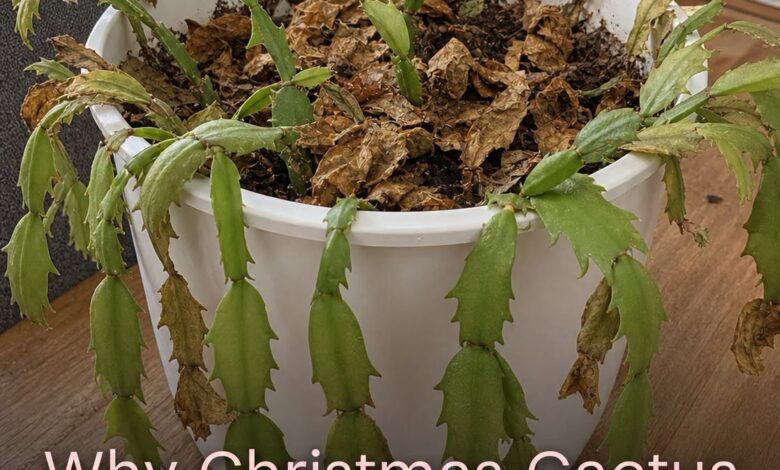
Your Christmas cactus looked perfectly healthy a few days ago.
Its segmented green stems were firm and glossy, arching gracefully over the edge of the pot. Maybe it had even begun forming the tiny buds that promised a spectacular holiday display.
Then something changed.
The stems went limp.
Segments began drooping.
The entire plant suddenly looked tired, soft, and defeated.
Your first instinct might be to reach for the watering can.
Don’t.
A limp Christmas cactus can be thirsty—but it can also look almost exactly the same when it has been given too much water.
And confusing those two problems is one of the fastest ways to turn a stressed plant into a dying one.
The first thing to understand is that a Christmas cactus isn’t a desert cactus in the traditional sense.
Plants commonly sold as Christmas cacti belong to the genus Schlumbergera, whose ancestors come from humid Brazilian forests. In nature, they can grow in organic material collected around trees and rocks rather than baking in dry desert sand.
That means they appreciate moisture.
But they also need air around their roots.
That distinction is everything.
A healthy root system requires both water and oxygen.
When potting mix remains saturated for too long, the spaces that normally contain air become filled with water.
The roots begin struggling.
Remain in that condition long enough and they can deteriorate.
Once roots are damaged, something seemingly contradictory happens:
A plant sitting in wet soil can begin looking dehydrated.
Why?
Because damaged roots can’t efficiently supply water to the rest of the plant.
So the owner sees limp stems and thinks:
It needs more water.
Another cup goes in.
The soil becomes wetter.
The roots suffer more.
The plant droops further.
More water follows.
What began as a manageable moisture problem becomes root rot.
That’s why the watering can should never be your first diagnostic tool.
Your finger should be.
Push it into the potting mix.
How does the soil actually feel?
If it is wet, heavy, and saturated despite the plant drooping, dehydration probably isn’t the immediate problem.
Check the drainage hole as well.
Is the bottom of the pot constantly wet?
Has water been sitting inside a decorative outer container or saucer?
Does the soil have a sour or unpleasant smell?
Those clues can point toward prolonged saturation and root trouble.
If overwatering appears to be the issue, stop watering.
Let the potting mix begin drying while keeping the plant in bright, indirect light.
Don’t respond by putting it in harsh direct sun in an attempt to “dry it faster.” A stressed Christmas cactus doesn’t need another shock.
If the problem is mild, allowing the mix to dry appropriately may be enough.
But if the soil remains waterlogged, smells bad, or the plant continues declining, you may need to inspect the roots.
Remove the plant carefully from its pot.
Healthy roots should generally feel firm rather than slimy or mushy.
Rotten sections may appear dark, soft, damaged, or foul-smelling.
Remove clearly decayed roots using clean cutting tools.
Then repot the plant into fresh, airy, well-draining potting mix.
The container needs drainage holes.
That part isn’t optional.
A beautiful ceramic pot with no way for excess water to escape can become a bathtub for roots.
If you love decorative containers, keep the plant in a properly draining inner pot and place that inside the decorative one. Just make sure excess water doesn’t remain pooled at the bottom.
Potting mix matters too.
Christmas cacti appreciate organic matter, but they don’t want to live indefinitely in dense mud.
A loose mix that holds some moisture while allowing excess water to drain and air to reach the roots is ideal.
Now suppose you check the soil and discover the opposite.
It’s bone-dry.
The mix has pulled away from the edges of the pot.
It feels dusty or crumbly.
The segments look wrinkled and limp rather than soft from rot.
Now thirst becomes a much stronger possibility.
In that case, water thoroughly.
Don’t merely splash a few spoonfuls across the surface.
Water the potting mix evenly until excess moisture drains from the bottom.
Then let it drain completely.
If the mix has become extremely dry, it can sometimes resist water, causing liquid to rush down gaps around the pot rather than soaking the root ball.
If that happens, water slowly and give the mix time to absorb moisture.
A badly dehydrated Christmas cactus may not recover its firmness instantly.
Give it time.
If the roots are healthy, the segments should gradually begin looking fuller as the plant rehydrates.
The goal afterward isn’t to follow an inflexible schedule like “water every Tuesday.”
Plants don’t use water according to calendars.
Temperature changes.
Light changes.
Humidity changes.
Plant size changes.
The growing medium changes.
A Christmas cactus may use moisture faster during active growth than during cooler, slower periods.
Instead, check the potting mix regularly and water according to its condition.
Allowing the upper portion of the mix to dry somewhat before watering again is generally safer than keeping the entire pot continuously soaked.
But there’s a third possibility that can confuse the diagnosis.
The plant may have outgrown its container.
Christmas cacti can tolerate being somewhat snug in their pots, so seeing roots doesn’t automatically mean an emergency repotting is required.
In fact, repeatedly moving a plant into oversized containers can create new problems.
A huge volume of unused potting mix stays wet much longer than a properly sized root ball can manage.
That brings you straight back to the danger of waterlogged roots.
But a severely rootbound plant can eventually struggle.
You might notice roots densely circling the inside of the container or emerging extensively from drainage holes.
Water may race through the pot unusually quickly.
The plant may dry out much faster than it once did.
Growth can slow.
And despite regular watering, the plant may repeatedly wilt because there simply isn’t enough functional potting medium around the roots to maintain a stable moisture supply.
If repotting is necessary, resist the urge to give your Christmas cactus a mansion.
Move up only modestly—roughly one pot size rather than several.
A container around an inch or two wider than the previous one is often plenty, depending on the size of the plant.
Gently inspect and loosen tightly circling roots where appropriate, remove obviously dead or rotten material, add fresh potting mix, and settle the plant at approximately the same depth it was growing before.
Then give it time to adjust.
Repotting itself is stressful.
Don’t combine it with unnecessary pruning, dramatic relocation, excessive fertilizer, and constantly changing watering routines all at once.
When a plant is struggling, more intervention isn’t always better.
Sometimes stability is treatment.
Temperature is another factor people overlook.
Christmas cacti generally appreciate relatively stable indoor conditions.
Extreme heat can increase moisture loss.
Cold drafts can stress the plant.
Placing one directly beside a radiator, heating vent, frequently opened freezing window, or other temperature extreme can cause trouble even when watering is otherwise reasonable.
Light matters as well.
These plants generally perform well with bright, indirect light.
Too little light can weaken growth.
Intense direct sunlight, particularly when a plant isn’t accustomed to it, can scorch segments and increase stress.
And if your goal is those famous holiday flowers, the plant’s environment becomes even more important.
Flower initiation in Schlumbergera is influenced by seasonal cues, particularly longer periods of uninterrupted darkness and appropriately cool conditions.
That means keeping a Christmas cactus alive and getting one to flower spectacularly are related but different challenges.
First, fix the health problem.
Then worry about the show.
A severely stressed plant doesn’t need to be forced into blooming.
It needs functioning roots.
Healthy stems.
Appropriate moisture.
Stable conditions.
Once those basics are restored, flowering becomes a much more realistic goal.
There is also one habit worth abandoning:
Fertilizing a sick plant because you think it needs “food.”
If roots are rotting or badly stressed, fertilizer isn’t medicine.
It can add additional stress.
Correct the underlying problem first.
Once the plant resumes healthy active growth, an appropriate feeding routine can be considered.
The same applies to pruning.
If individual segments are badly damaged, diseased, or rotting, removing affected material may make sense.
But don’t strip half the plant simply because it looks temporarily wilted.
Many limp segments can recover once the moisture problem is corrected.
Give living tissue the opportunity to respond.
The biggest challenge is patience.
Plant problems create an irresistible urge to do something.
Water it.
Move it.
Feed it.
Repot it.
Mist it.
Prune it.
Water it again.
Every few hours, the owner checks for improvement and changes another variable.
But plants operate on biological time.
Roots don’t regenerate because you’ve stared at them for twenty minutes.
A dehydrated plant needs time to take up water.
A recently repotted plant needs time to settle.
A plant recovering from root damage may require weeks before vigorous new growth becomes obvious.
Your job is to identify the most likely problem, correct it, and then provide consistent care.
So when your Christmas cactus suddenly goes limp, become a detective before becoming a rescuer.
Touch the soil.
Wet and heavy?
Think about excess moisture and root health.
Dry and crumbly?
Dehydration becomes more likely.
Roots packed tightly into nearly every available space?
Consider whether the plant genuinely needs a slightly larger container.
Check drainage.
Inspect the roots if symptoms justify it.
Think about temperature and light.
Ask what changed recently.
Did someone else water it?
Was it moved beside a heater?
Did you repot it into a container without drainage?
Did holiday travel leave it dry for weeks?
The plant’s recent history often contains the answer.
And don’t assume a drooping Christmas cactus is dead.
These plants can be remarkably resilient.
A specimen that looks exhausted and shriveled may still have plenty of life remaining in its roots and stems.
Correct the moisture problem, improve drainage when necessary, give it appropriate light, and stop constantly interfering with it.
Then watch.
One segment becomes firmer.
Another begins filling out.
Fresh growth appears at the tip.
The plant slowly lifts itself back over the edge of the pot.
And months later, perhaps just as winter approaches, tiny buds begin forming along those same stems you were once convinced were dying.
That’s the real secret to rescuing a Christmas cactus.
It isn’t pouring in more water.
It isn’t buying an expensive fertilizer.
And it isn’t immediately moving the plant into the biggest pot you can find.
It’s learning to distinguish thirst from drowning.
Because limp leaves aren’t a diagnosis.
They’re a message.
And once you learn how to read the soil, roots, and environment surrounding them, that sad-looking Christmas cactus may have a very different message waiting for you by the holidays:
I’m not finished yet.