At 2:17 in the morning, a seven-year-old girl called 911 from a dark apartment and whispered something the dispatcher would remember for years.
“My mom told me not to open the door for anyone. But she never came back, the lights are off, and my little brother won’t stop crying.”
The dispatcher immediately softened his voice.
“Okay, sweetheart. What’s your name?”
“Emma.”
“And your brother?”
“Noah.”
“How old is Noah?”
“Four.”
“All right, Emma. I need you to stay with him. Keep the door locked. Police officers are coming to help you.”
Emma’s voice trembled.
“Mom said not to open it.”
“You’re doing exactly the right thing.”
At first, the call sounded like a terrible case of two young children being left alone.
Then the details stopped making sense.
“Emma, can you look through the window for me without opening anything?”
She carried the phone across the apartment.
Outside, the rest of the building glowed normally. Hallway lights were on. Porch lamps lit the parking lot. Windows across the courtyard were bright.
“Everybody else has lights,” Emma whispered.
“Only ours is dark.”
The dispatcher added the detail immediately.
“When did you last see your mom?”
“Somebody knocked.”
“Who?”
“A man.”
Emma explained that her mother, Rachel, had become frightened the moment she heard the knock.
Rachel had rushed both children into the bedroom.
Then she crouched in front of Emma and made her repeat three instructions.
Don’t open the door.
Don’t leave the apartment.
Stay with Noah.
Then Rachel stepped into the hallway.
“She said she’d come right back,” Emma said.
She never did.
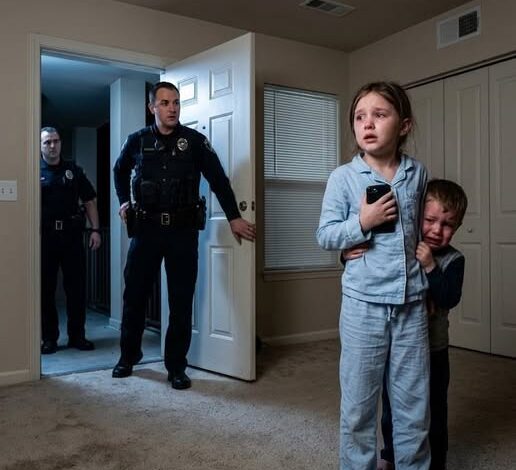
When officers arrived, Emma refused to unlock the door.
Even frightened, exhausted, and alone, she was still obeying her mother.
So the dispatcher remained on the line while officers obtained emergency access.
When they entered, their flashlights swept across a home that looked almost painfully ordinary.
A cereal box sat open on the kitchen counter.
A child’s cup rested beside the sink.
Two tiny pairs of shoes were lined near the door.
Rachel’s jacket hung over a chair.
Her purse was still there.
So was her wallet.
And her phone sat charging on the counter.
One officer stared at the scene.
“This doesn’t look like someone who planned to leave.”
His partner checked the electrical panel.
The building had power.
The neighboring apartments had power.
But the breaker for Rachel’s unit had been switched off manually.
He looked back.
“This wasn’t an outage.”
Someone had deliberately left two children sitting in darkness.
The officer restored the electricity.
When the lights flickered on, Emma appeared in the bedroom doorway with Noah behind her.
They were wrapped together in one blanket.
An officer crouched down.
“Does your mom ever leave without her phone?”
Emma shook her head.
“Without her purse?”
Another shake.
Then she remembered something.
“Mom was scared.”
The officer’s expression changed.
“How could you tell?”
“She kept looking behind her.”
That sentence changed everything.
Until then, some neighbors had assumed Rachel had simply walked away from her children.
One woman across the hall, Mrs. Palmer, had even complained earlier that some people should not become parents.
Now she watched police photograph Rachel’s untouched phone, wallet, jacket, and the deliberately switched breaker.
Slowly, Mrs. Palmer stepped into the hallway.
“I heard them arguing,” she said.
An officer turned.
“Rachel and who?”
“I don’t know his name.”
“Did you see him?”
Mrs. Palmer hesitated.
Then looked toward Emma.
“I recorded some of it.”
She explained that the man made her nervous, but she had been afraid to intervene directly. Instead, she cracked her door open and filmed the hallway with her phone.
The video was shaky.
Dark.
But clear enough.
Rachel stood outside her apartment wearing no shoes and no coat.
A man in a dark sweatshirt faced her.
Rachel repeatedly positioned herself between him and her front door.
Most of their words were muffled.
One sentence was unmistakable.
“My kids are inside. Not here.”
The man moved closer.
Rachel looked back toward the apartment.
Once.
Twice.
Then she followed him toward the stairwell.
Mrs. Palmer kept recording.
Six minutes later, the man returned.
Alone.
He checked the hallway.
Walked directly to the utility panel.
Opened it.
Reached inside.
And Rachel’s apartment went dark.
The officer replayed that moment several times.
Then he asked, “Have you seen this man before?”
Mrs. Palmer slowly raised one hand.
And pointed two doors down.
“He lives in 3C.”
Additional officers were called immediately.
Police knocked on apartment 3C.
No answer.
Again.
Nothing.
Then came movement from the stairwell.
Officers rushed down and found a man in a dark sweatshirt running toward the rear fence.
“Stop! Police!”
He kept going.
He made it halfway over the fence before officers pulled him down.
During the struggle, a car key fell from his pocket.
The key belonged to an older gray sedan parked behind the building.
The car was empty.
But Rachel’s shoe lay on the passenger floor.
And there was blood on the edge of the seat.
The missing-person investigation became an urgent search.
The man was identified as Eric Dalton.
Rachel knew him.
Months earlier, they had dated briefly.
Messages recovered from Rachel’s phone showed she ended the relationship after Eric became increasingly controlling.
She had repeatedly told him not to come to her apartment.
That night, he came anyway.
Investigators reconstructed what followed.
When Eric knocked, Rachel immediately feared he might frighten the children.
So she locked Emma and Noah inside and stepped into the hallway.
Eric pressured her into going downstairs by threatening to create a scene near the apartment.
In the parking lot, Rachel tried to leave.
Eric stopped her.
He forced her into his car.
Then he realized the children might look outside, turn on lights, or draw attention.
So he returned upstairs and deliberately cut power to the apartment.
He thought darkness would keep them quiet.
He underestimated Emma.
Rachel had spent years teaching her daughter what to do when something felt unsafe.
Lock the door.
Stay with Noah.
Call for help.
Through the night, officers searched every location connected to Eric.
Shortly after sunrise, one officer noticed an abandoned storage building behind a closed auto shop less than four miles away.
The padlock looked new.
He listened.
Nothing.
Then—
Three faint knocks.
The officer shouted, “Rachel?”
Silence.
Then three more knocks.
Police forced the door.
Rachel was inside.
Her wrists were bound.
She was bruised, exhausted, and severely dehydrated.
But alive.
Her first words were immediate.
“My children?”
“They’re safe.”
Rachel began crying.
“Emma?”
“She called us.”
For the first time since officers found her, Rachel smiled.
At the hospital, doctors treated her injuries while detectives continued building the case.
They had Mrs. Palmer’s video.
Rachel’s messages.
The car.
Physical evidence.
And the timeline established by Emma’s 911 call.
Eric eventually pleaded guilty to charges connected to the abduction and assault.
But months later, people in the apartment building rarely spoke about him.
They spoke about Emma.
Mrs. Palmer eventually apologized to Rachel.
“I thought you had left them,” she admitted.
Rachel nodded.
Then said something Mrs. Palmer never forgot.
“Next time you think somebody might be in danger, don’t wait until you understand everything.”
Weeks later, Rachel moved with the children to another home.
On their final evening in the apartment, movers carried boxes through the hallway while Emma stood beside her mother.
At the front door, Emma suddenly stopped.
“Mom?”
Rachel crouched.
“What is it?”
“Did I do what you told me?”
Rachel’s eyes filled immediately.
“Yes.”
“I didn’t open the door.”
“I know.”
“And I stayed with Noah.”
“You did.”
Emma looked down.
Then asked the question she had apparently carried for weeks.
“Did I help you come home?”
Rachel pulled both children into her arms.
“Yes,” she whispered. “You helped me come home.”
Police had found the car.
Mrs. Palmer had recorded the hallway.
Detectives had located the storage building.
But none of that investigation would have begun when it did without a terrified seven-year-old sitting in a dark apartment and remembering three simple instructions.
Don’t open the door.
Don’t leave.
Stay with your brother.
Rachel had given those rules to protect her children.
She never imagined that, hours later, her daughter’s courage in following them would help save her too.