My Father Threw Me Out While I Was 8 Months Pregnant—Then My Late Husband’s Final Plan Took Everything Out of His Hands

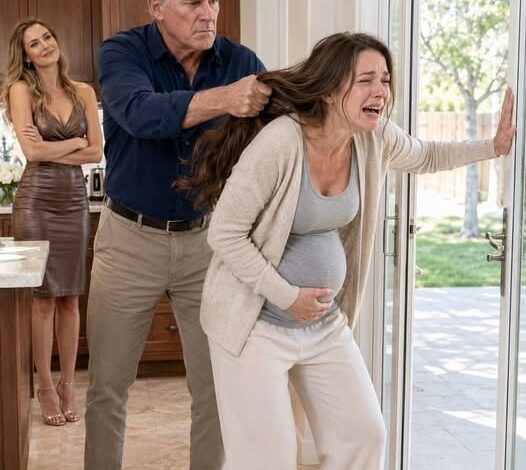
Three weeks after my husband died, my father dragged me out of my own house by the hair.
I was eight months pregnant.
Still grieving.
Still sleeping with one of Daniel’s shirts beside me because the faint trace of his cologne was the only thing that made the bed feel less empty.
At 10:12 on a Tuesday morning, my father, Robert, walked into my kitchen with his young wife, Alyssa, and dropped a folder onto the table.
“You need to pack.”
I stared at him.
“What?”
“This house has to be sold. Daniel left financial problems behind. I’m handling the estate before you make things worse.”
For several seconds, I genuinely wondered whether grief had affected my hearing.
“This is my house.”
Robert laughed.
“Daniel bought it before he married you.”
“He added me to the deed years ago.”
His expression changed.
Only slightly.
But I saw it.
Alyssa leaned against my counter with her arms folded.
“Robert’s trying to help you. You have a baby coming. You can’t manage all this by yourself.”
I stood carefully.
“I’m not asking either of you to manage anything.”
Then I pointed toward the door.
“Leave.”
My father had always treated disagreement as defiance.
This time was no different.
He grabbed my arm.
I pulled away.
“Don’t touch me.”
His hand caught in my hair.
The pain came so suddenly that I screamed.
He dragged me across the kitchen while I fought to keep my balance and protect my stomach.
Alyssa laughed behind us.
That sound stayed with me.
Not because it was loud.
Because it was casual.
As though watching a pregnant widow being dragged through her own home was somehow funny.
Robert pulled open the front door and shoved me onto the porch.
I landed hard on one knee.
Then warmth spread down my legs.
I froze.
My water had broken.
Alyssa covered her mouth.
For one second, I thought she had finally understood how serious this was.
Then she laughed again.
Robert threw my purse outside.
“Call whoever you want.”
So I did.
Just not him.
I called Daniel’s attorney.
Samantha Reed answered immediately.
“Victoria?”
“My father threw me out of my house.”
“What?”
“My water broke. He says he’s selling Daniel’s estate.”
Her voice changed instantly.
“Do not go back inside.”
I looked through the doorway.
Robert was already opening drawers in Daniel’s desk.
“Samantha—”
“Listen to me. Call an ambulance as soon as we hang up. I’m contacting the bank and the county recorder.”
“The bank?”
There was a pause.
“Daniel created protections for you before he died.”
I stopped breathing for a second.
“What protections?”
“The house. His investments. And his ownership interest in the logistics company.”
My father had always called it his company.
Not a company he ran.
Not a company in which he had an interest.
His.
Samantha continued.
“Robert contacted my office yesterday claiming you had authorized him to control the estate.”
“I never authorized anything.”
“I know.”
Then she said the sentence that changed the entire morning.
“If he submitted documents using your signature, he may have triggered the fraud provisions Daniel built into the trust.”
Inside, Robert’s phone rang.
He answered confidently.
That confidence lasted less than thirty seconds.
“What do you mean the accounts are frozen?”
Alyssa stopped laughing.
And ambulance sirens grew louder outside.
I stayed on the porch.
Every instinct told me to go back inside.
My father was searching through my dead husband’s papers.
Touching his things.
Opening drawers Daniel had closed for the last time only weeks earlier.
But Samantha told me not to move.
“Let him leave everything exactly where it is.”
So I waited.
Robert paced through the living room.
“Who authorized this hold?”
Another contraction built.
I gripped the porch railing.
Samantha was still on speaker.
“The bank has temporarily restricted movement from protected accounts,” she said. “And I’ve confirmed that you remain the recorded owner of the house.”
I closed my eyes.
The house was still mine.
Daniel had made sure of it.
Inside, Robert’s voice grew louder.
Then I heard him shout:
“I never forged my daughter’s signature!”
I looked down at the phone.
Samantha had heard it too.
“Do not respond.”
For once in my life, I did exactly that.
I didn’t argue.
I didn’t defend myself.
I let him keep talking.
The paramedics arrived moments later.
One examined me while another asked what happened.
I told them everything.
The hair pulling.
The shove.
The fall.
My water breaking.
Robert tried stepping onto the porch.
A paramedic moved between us.
“You need to stay back.”
“My daughter is hysterical.”
“I’m not hysterical,” I said.
It was the calmest sentence I had spoken all morning.
Police arrived shortly afterward.
Samantha reached the house before the ambulance left.
She walked inside with an officer.
When she returned, she was carrying the folder Robert had brought.
Her face told me there was more.
“What?”
“He submitted paperwork.”
“With my signature?”
“A signature claiming to be yours.”
My stomach tightened.
The documents attempted to transfer authority over assets Daniel had placed into trust.
Robert started shouting from the doorway.
Samantha didn’t even turn around.
“Until this is investigated, nobody moves anything.”
“The company is mine!” Robert yelled.
Samantha finally looked at him.
“No, Robert. That was the problem.”
He stopped.
Daniel had quietly accumulated a controlling ownership position during years of expansion and restructuring.
My father remained president.
He remained the loudest person in every meeting.
He remained the man who acted as though every employee and every building existed because he allowed it.
But legally, he did not own the control he claimed.
Daniel did.
And after his death, those shares passed into the trust for me and our child.
My father had come to take my house.
Instead, he exposed exactly why my husband had planned for him.
The ambulance doors closed.
The last thing I saw was Alyssa standing beside Robert.
She wasn’t laughing anymore.
My son was born that evening.
Six weeks early.
Tiny.
Furious.
Alive.
The first time I saw him, he was under neonatal lights with wires attached to his chest.
I touched one finger against his hand.
He closed his fingers around it.
“Hi,” I whispered.
My voice broke.
I named him Daniel James.
After his father.
The next afternoon, Samantha visited.
She brought paperwork instead of comforting speeches.
That was her way.
“The house is secure.”
I nodded.
“The trust is intact.”
Another nod.
“The attempted transfers are under investigation.”
I looked toward the neonatal unit.
“And my father?”
“He cannot enter the property.”
Then Samantha placed an envelope on my bed.
“Daniel left this with the trust documents.”
I knew his handwriting before I touched it.
My hands started shaking.
Inside was a short letter.
Daniel had written it months earlier.
He said he knew I hated conversations about death.
I always told him estate planning was morbid.
He would laugh and say planning for bad possibilities was how you protected good ones.
Then the letter became more personal.
He wrote that he knew my father.
He knew how Robert reacted when someone told him no.
And he knew something about me too.
When people became louder, I became quieter.
Not because I agreed.
Because I had learned silence was the fastest way to survive an argument.
Daniel wrote that he never wanted grief to make me vulnerable to someone else’s decisions.
At the bottom was one final sentence:
If I’m not there to stand beside you, remember that you can still stand without me.
I cried harder over that line than I had over the house.
Robert eventually faced consequences for the documents and for what he had done to me.
But the business investigation uncovered something larger.
Daniel had apparently been questioning transactions before his death.
Unexplained transfers.
Contracts routed through companies connected to Robert.
Expenses buried inside expansion budgets.
For years, my father had assumed nobody would challenge him because he was the founder.
Daniel had begun doing exactly that.
The board suspended Robert while the records were reviewed.
Several directors who had spent years nodding whenever he spoke suddenly discovered the value of independent counsel.
Alyssa disappeared from his side within months.
Apparently the life she found so amusing from my kitchen doorway became less entertaining once the money, status, and certainty began collapsing around it.
I never invited either of them back.
Months later, I brought my son home.
The crib Daniel had assembled still stood against the nursery wall.
One screw was slightly crooked because he had insisted he didn’t need instructions.
I left it that way.
The first morning home, I carried little Daniel onto the porch.
The same porch where my father had shoved me.
The concrete was clean now.
No trace of that morning remained.
I sat in Daniel’s old chair with our son against my chest and watched sunlight move through the trees.
For years, Robert had taught me that whoever shouted loudest controlled the outcome.
Daniel had taught me something different.
Ownership did not come from intimidation.
Family did not mean obedience.
And silence did not always mean surrender.
Sometimes silence meant stepping aside and letting evidence speak.
The legal fight took months.
My father insisted everything had been a misunderstanding.
He said he believed I was too emotional to manage the estate.
He said he only wanted to protect family assets.
He said Daniel had turned me against him before he died.
For once, none of his explanations mattered more than documents.
The deed.
The trust.
The bank records.
The attempted authorization bearing a signature I had not written.
And the police report from the morning he dragged his pregnant daughter through her own kitchen.
Facts do not become disrespect simply because an angry person dislikes them.
That was another thing I had to learn.
My father had spent my entire childhood teaching me that disagreeing with him was betrayal.
By the time I became an adult, I knew how to become invisible in a room without physically leaving it.
Daniel had seen that.
He was the first person who ever asked why I apologized after arguments I hadn’t started.
At the time, I thought he was overthinking it.
After he died, I understood he had been paying attention.
That was what the trust really was.
Not a financial trick.
Not revenge prepared in advance.
Attention.
He knew exactly where I might be vulnerable.
So he built a barrier there.
Eventually, Robert lost his leadership position.
Some of the financial questions surrounding his management became separate legal matters.
Those outcomes belonged to investigators, attorneys, and the board.
I did not make them my life’s purpose.
I had a newborn.
I had grief.
I had a company interest I suddenly had to understand.
I had a house filled with memories that hurt and comforted me at the same time.
Most importantly, I had to learn something I should have learned years earlier.
How to make decisions without asking myself whether my father would approve.
The first decisions were small.
I changed the locks.
I replaced every access code.
I moved my personal accounts to a bank Robert had never used.
I hired an independent financial adviser.
I told Samantha never to soften legal language simply because the person on the other side shared my last name.
Then came larger decisions.
I joined board meetings.
I learned what Daniel had owned.
I asked questions even when people looked surprised that I was asking them.
Sometimes my voice shook.
I asked anyway.
The first time someone interrupted me and I said, “I wasn’t finished,” I thought about Daniel for the rest of the day.
That sentence would have made him smile.
A year after his death, I stood in the nursery while little Daniel pulled himself upright against the crib.
He wobbled.
I moved forward instinctively.
Then stopped.
He steadied himself.
Looked at me.
And grinned.
I laughed.
“Okay,” I whispered. “You can stand.”
The words caught in my throat.
That night, after he was asleep, I opened Daniel’s letter again.
You can still stand without me.
I finally understood what he had meant.
He had not expected me never to fall.
He knew better than that.
He meant I did not need another person’s permission to get back up.
My father tried to take everything from me on the worst morning of my life.
My home.
My authority.
My confidence.
Even the belief that I had the right to decide what happened next.
Instead, he gave me the final reason I needed to stop being afraid of him.
And Daniel, even after death, left me something far more important than property or controlling shares.
He left me protection long enough for me to remember that protection was not supposed to become another cage.
Eventually, the trust would belong to our son.
The house might be sold one day.
The company might change.
Money would move.
Documents would age.
None of that was the real inheritance.
One morning, years later, Daniel James asked me why his grandfather was not part of our lives.
I did not tell him every ugly detail.
He was too young.
I simply said:
“Because being family does not give someone permission to hurt you.”
He thought about that.
Then asked, “Even if they love you?”
I looked at him.
“Especially then.”
He nodded and went back to his toys.
I sat there for a long time.
Because that was the lesson I had spent most of my life learning backward.
Love without respect is not protection.
Authority without consent is not care.
And grief does not make your future available for somebody else to claim.
Three weeks after losing my husband, I thought I had become too broken to protect anything.
My father believed the same thing.
He was wrong.
The house remained mine.
The trust remained intact.
My son came home.
And eventually, I stopped sleeping with Daniel’s shirt beside me every night.
Not because I loved him less.
Because grief had finally stopped feeling like the only thing holding us together.
One morning, I folded the shirt and placed it inside a drawer.
Then I carried our son downstairs.
The sunlight was pouring through the front windows.
The house was quiet.
Mine.
Ours.
Safe.
For the first time since Daniel died, I did not feel as though I was merely guarding what he had left behind.
I felt like I was building what came next.