Diane removed the brass key from her ring and dropped it into Mark’s open palm.
He closed his fingers around it.
Nobody shouted.
Nobody needed to.
On the table between us sat the antihistamine bottle beside the toxicology report. In another hospital room, our eight-month-old son was recovering from something his grandmother had secretly given him.
Dr. Patel looked at Diane.
“When was the last time you gave Noah this?”
“Tonight.”
“Any other time?”
Diane glanced at Mark instead of me.
Mark opened his fist and stared at our house key.
“Answer him.”
She sighed. “Maybe twice before.”
Everything inside me went still.
“Maybe?”
“I don’t keep records of every little thing I do while helping you.”
But I did have records.
Not medical records. Messages.
There had only been a handful of evenings when Diane had put Noah to bed alone. I remembered them because each time I had been grateful.
I opened our old texts.
He’s out like a light.
Finally got that boy to settle.
And three weeks earlier:
See? Grandma knows what she’s doing.
I turned the phone toward Mark.
He read the messages and dropped into a chair.
Diane folded her arms.
“It wasn’t every time.”
That was her defense.
Not that she hadn’t done it.
That she hadn’t done it every time.
Before I could respond, a nurse entered.
“Noah’s numbers are improving. We’re continuing to monitor him, but he’s responding well.”
I was already moving.
Nothing Diane could say mattered more than that.
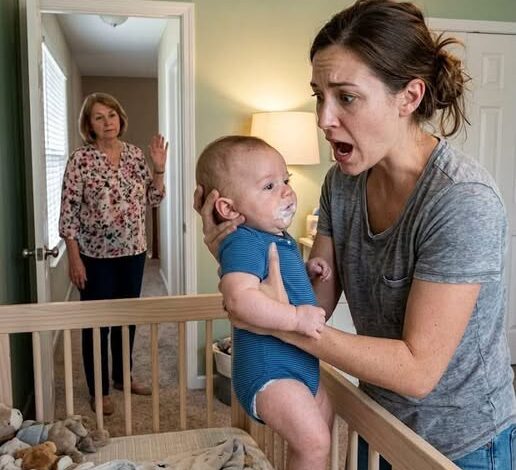
Noah was awake when I reached him. The sensor taped around his foot irritated him enough that he was weakly trying to kick it loose.
I leaned over the bed.
He grabbed my finger.
His grip wasn’t strong.
But it was there.
I stayed beside him, unable to stop remembering how I had found him earlier.
Too limp.
Too heavy in my arms.
His breathing wrong.
Foam at the corner of his mouth.
Improving didn’t erase that image.
Mark entered quietly.
After several minutes, he said, “She used to give me things when I was little.”
I looked up.
“What?”
“She always said I was a terrible sleeper. She joked that she knew how to knock me out.”
“You think she medicated you?”
“I don’t know.”
He rubbed his face.
“I always thought she meant driving me around or rocking me.”
Whatever had happened decades earlier could wait.
“What are you doing about Noah?”
Mark answered immediately.
“She doesn’t babysit anymore. She doesn’t take him anywhere. She’s never alone with him. She doesn’t have a key. She doesn’t enter our house unless we invite her.”
“Tell her.”
“I will.”
“Before we leave.”
He did.
Diane returned to the consultation room carrying her purse.
Mark placed the brass key on the table.
“I’m not giving this back.”
Her expression hardened.
“You’re letting panic make decisions for your family.”
Then she began talking about me.
How exhausted I had been.
How much I worried.
How anxious I became over Noah’s sleep.
For one terrible second, I wondered whether Mark would let her redirect the conversation.
Instead, he said, “You gave our baby medicine without telling us.”
“I helped him sleep.”
“You hid it.”
“I carry medicine in my purse.”
“For yourself?”
She hesitated.
Then she looked at me.
“You left him with me. If you thought I was dangerous, why did you hand me your baby and go downstairs?”
That hurt because there was truth buried inside it.
I had handed her my baby.
I had trusted her.
I had thanked her for helping.
I picked up the bottle and placed it directly beside the toxicology report.
“I trusted you because you’re his grandmother.”
She started to answer.
“You used that trust to give him medication we never approved.”
Her eyes moved toward Mark.
This time, he didn’t rescue her.
He moved his chair beside mine.
It was only a few feet.
It changed everything.
“You’re really going to destroy this family over one mistake?” Diane asked.
I unlocked my phone.
“Which mistake?”
She had no answer.
Soon afterward, a hospital social worker arrived. Because Noah had received medication without our knowledge and required emergency treatment, the incident needed to be documented.
I gave her facts.
Dinner.
Bedtime.
The unnatural silence upstairs.
Finding Noah unresponsive.
Calling 911.
The bottle.
Diane’s admission that it had happened before.
I didn’t call Diane reckless or malicious.
Facts were enough.
“Does she have access to your home?” the social worker asked.
I looked at the brass key.
“Not anymore.”
Mark put it in his pocket.
Near midnight, my phone began vibrating.
Family group chat.
Diane had posted that there had been a “misunderstanding.” Noah had become sleepy, everyone had panicked, and the hospital was merely being cautious.
Then another message appeared.
She had spent months helping us, she wrote, and now she was being treated like a criminal for soothing her grandson.
Mark took my phone.
He typed:
Mom gave Noah antihistamine without our knowledge. She admitted tonight that she has done it before. The hospital documented what happened. She no longer has unsupervised access to Noah or our home.
He pressed send.
No softening.
No negotiation.
By morning, Noah was furious enough about a nurse touching his foot to release a loud, angry cry.
It was the best sound I’d heard all night.
Before we left the hospital, we scheduled a locksmith.
At home, the remains of the previous evening were still waiting for us: a bowl in the sink, an open cabinet, the baby monitor on the counter.
The locksmith arrived before lunch.
I watched him replace the cylinder.
Screwdriver.
Metal pieces.
New keys.
Nothing dramatic.
I loved every boring second.
When he finished, Mark handed me the first new key.
Six hours later, the doorbell rang.
Diane stood on the porch.
No key.
For the first time, she had to wait outside.
She held Noah’s blue sleep sack and a bag of his things.
“I need to speak to you without her controlling everything,” she told Mark through the closed door.
“No.”
“She is separating you from your mother.”
“No.”
“She turned one mistake into punishment.”
“You gave my eight-month-old son medicine without telling us. More than once.”
Diane kept arguing.
Mark eventually said, “I understand what being his father is like.”
Then he walked away.
We both did.
The knocking eventually stopped.
Over the following days, Noah became himself again.
Eating.
Smiling.
Fighting naps.
Complaining through diaper changes.
Every ordinary inconvenience felt miraculous.
Diane eventually apologized.
Months later, after considerable distance, we agreed she could see Noah again under one condition:
We would both be there.
No babysitting.
No medication.
No key.
We met at a public park.
For several minutes, Diane barely spoke.
Finally, she looked at me.
“I thought I knew better.”
I waited.
“I thought because I’d raised Mark, I knew what babies could handle.”
Another pause.
“And I thought if I told you, you’d overreact.”
“That is why you hid it.”
She lowered her eyes.
“Yes.”
For once, nothing followed the word.
No but.
No excuse.
“I’m sorry.”
I believed she was sorry.
I did not trust her.
Those were different things.
Eventually, we allowed her to hold Noah while we sat beside them.
She cried.
Noah grabbed her necklace.
Life moved forward, but it did not return to what it had been.
That was intentional.
An apology could reopen conversation.
It did not automatically restore access.
Years later, Noah found the old brass key in our junk drawer.
By then it was buried beneath dead batteries, takeout menus, and pens that barely worked.
“What does this open?” he asked.
I looked at it.
“Nothing anymore.”
“Why do you keep it?”
I thought about the hospital.
The bottle beside the toxicology report.
Mark moving his chair beside mine.
The locksmith replacing the lock.
Diane standing on the porch, forced for the first time to knock.
“Because it reminds me that access to someone’s home is something they give you,” I said. “It isn’t something you own.”
Noah had already lost interest.
He tossed the key back into the drawer and ran outside.
I left it there.
The key itself had never been dangerous.
Once, it represented help.
Diane used it to bring groceries, let herself in when we were exhausted, and make our lives easier.
But somewhere along the way, access had become authority.
Help had become permission she believed she no longer needed to ask for.
That was what changed.
Noah remained a terrible sleeper, by the way.
For years.
Some nights Mark and I walked the hallway with him while dinner went cold downstairs.
Sometimes he cried because he didn’t want to sleep.
Sometimes he screamed simply because he was tired.
We let him.
If he was safe, fed, clean, and healthy, he was allowed to be inconvenient.
Nobody needed to make him quiet.
And nobody who loved him was entitled to override us simply because they believed they knew better.
The old brass key is still somewhere in that junk drawer.
It doesn’t fit our front door.
It doesn’t fit the back door.
It doesn’t open anything belonging to us.
But I never threw it away.
Because forgiveness can change how much anger you carry.
Trust requires something else.
Changed behavior.
Respect.
Permission.
Love does not require unlimited access, and an apology does not automatically restore what someone’s choices destroyed.
Sometimes the most important boundary is surprisingly ordinary.
A changed lock.
A closed door.
And an old brass key that no longer opens anything.
Exactly as it should be.