Two days before my wedding, my fiancé forgot to end our call. I heard his mother ask, “Did she sign the property agreement?”

Two days before my wedding, my fiancé forgot to end our phone call.
I was folding my twelve-year-old son’s white dress shirt when I heard Grant’s mother ask:
“Did she sign the property agreement?”
There was a pause.
Then Grant laughed.
“Not yet. Once she does, the house and savings are ours.”
My hands stopped moving.
The washing machine hummed beside me. Upstairs, one of my nieces was practicing the same three piano measures she had butchered all week. Caleb was outside repairing his bicycle chain.
Everything around me looked normal.
That was the terrifying part.
Our wedding was in forty-eight hours.
My dress hung upstairs.
Place cards covered the dining room table.
My mother had stocked the refrigerator because she was convinced brides forgot to eat.
And the man I was about to marry was calmly discussing my life as though it were an asset package.
Grant still thought the call had ended.
His mother, Colleen, lowered her voice.
“Why did she bring Rebecca into it?”
Rebecca was my attorney.
I owned an architecture firm. I did not sign legal documents without understanding them.
Apparently, Grant had been counting on exactly the opposite.
“She’s cautious,” he said.
“Cautious women don’t build companies.”
Grant laughed again.
“She wants the family more than she wants to argue about paperwork.”
My stomach tightened.
The agreement had been presented to me as simple planning before marriage.
Grant had said it would “bring everything together.”
Now Colleen asked what would happen after I signed.
“We restructure.”
My house was worth nearly nine hundred thousand dollars and almost paid off.
I had investments inherited from my grandparents.
Grant apparently had more business debt than he had admitted.
“A line against the house would solve most of it,” Colleen said.
“Exactly.”
I sat down slowly.
There was the life I thought I was entering on Saturday.
And there was this one.
Then they started discussing the children.
Caleb was twelve.
Maisie and June were nine-year-old twins I had raised since my sister Lily died.
Grant had spent three years acting like they mattered to him.
Homework.
Recitals.
Birthday parties.
School pickups.
He once brought Maisie flowers because she had spent only four minutes onstage and insisted that four minutes still deserved flowers.
Now Colleen mentioned the twins’ trust.
Grant sounded irritated.
“Rebecca kept it separate.”
“So?”
“I’ll work on Mara.”
“How?”
He laughed.
“She’s sentimental. Sentimental people are easy once you know which promise they need to hear.”
That hurt.
But it still wasn’t the sentence that ended us.
Then Colleen asked:
“You’re sure you can tolerate living there?”
Grant sighed.
The kind of tired sigh people make when they finally stop performing.
“Honestly? I’m tired of pretending I enjoy that noisy little household. I just need to get through Saturday.”
I stared at Caleb’s shirt in my lap.
For three years, Grant had hugged those children.
Told Caleb he was proud of him.
Sat through dance recitals.
Helped June make a sea turtle poster.
Told friends he loved our “chaotic little crew.”
Apparently, he was just getting through Saturday.
The call finally ended after nine minutes and twenty-seven seconds.
My phone had recorded it automatically.
I copied the file three times.
Then I emailed it to Rebecca.
Five words:
Call me as soon as possible.
Twelve minutes later, she did.
“Did you listen?” I asked.
“Yes.”
“What does that agreement actually do?”
“First, do not sign it.”
“I won’t.”
“Second, it does not magically hand Grant your house. But parts of it make me even more uncomfortable now.”
She explained that the agreement encouraged financial consolidation after marriage.
My house would not automatically become his.
The twins’ trust would not suddenly become accessible.
But Grant clearly expected marriage itself to become leverage.
“He needs your cooperation,” Rebecca said.
That sentence mattered.
He did not own my life.
He planned to persuade me to hand pieces of it over once leaving became emotionally harder.
I looked at our wedding schedule.
Rehearsal Friday.
Ceremony Saturday at four.
Dinner at six.
Cake at seven.
“I’m still going to the wedding,” I said.
Rebecca went quiet.
“There will not be a marriage.”
“That improves the plan considerably.”
“I want him to hear himself.”
“Mara.”
“I’m not going to hurt him.”
“That was not my main concern.”
Despite everything, I laughed.
Then I cried.
“He used the kids.”
“I know.”
“I could almost forgive the money first.”
“You do not have to rank the betrayals.”
That night, I secured everything.
Passwords.
Business accounts.
Investment access.
Home security.
The children’s financial protections.
No frantic transfers.
No revenge.
Just boundaries.
Grant had no ownership in my firm.
No title interest in my house.
No authority over the twins’ trust.
No access to Caleb’s education account.
The danger was not that he had already stolen my life.
It was that I had almost legally joined mine to his while trusting intentions he deliberately hid.
Grant came home after one in the morning.
He kissed my forehead.
“You nervous?”
“Yes.”
“Don’t be.”
I looked at him and almost asked everything.
Did you ever love the children?
Was all of it performance?
Did you love me, or only what came with me?
Instead, I stayed quiet.
Sometimes betrayal does not create immediate rage.
Sometimes it creates observation.
You watch someone brush his teeth.
Take off his watch.
Complain about traffic.
And every ordinary movement becomes surreal because you now know another conversation has been running underneath your entire relationship.
Friday, Rebecca confirmed Grant’s debt was worse than he had disclosed.
Not criminal.
Not proof of theft.
Just hidden.
That distinction mattered.
“He has not stolen from you,” she said.
“He expected marriage to make me easier to persuade.”
“Yes.”
That was enough.
For the ceremony, I made one decision that mattered more than anything else.
The children would not hear the recording.
Our venue had a side room.
My cousin Leah agreed to take all the kids there before anything played.
Saturday morning was offensively beautiful.
Blue sky.
Cool air.
Perfect wedding weather.
My mother arrived early.
One look at me and she knew something was wrong.
I handed her my phone.
“Listen.”
She did.
By the time Grant said he just needed to get through Saturday, she had tears in her eyes.
“You’re not marrying him.”
“No.”
“But you’re going.”
“Yes.”
She sighed.
“You are your father’s daughter.”
“I’m choosing to take that as support.”
“It was not entirely support.”
Then she hugged me.
At noon, I put on the dress.
Ivory.
Simple.
Elegant.
The dress I had chosen because I felt like myself in it.
Then Caleb knocked.
He wore a navy suit and looked far too grown up.
“You look expensive,” he said.
“That is the correct response.”
His expression softened.
“You look really pretty, Mom.”
“Thank you.”
Then he asked:
“Are you scared?”
“Yes.”
He nodded.
“Good.”
I stared at him.
He shrugged.
“You always say courage isn’t not being scared.”
I nearly broke.
My own words had come back to me through my son at exactly the moment I needed them.
So I took his arm.
Maisie and June waited outside in green flower-girl dresses.
Grant stood beneath the wooden arch.
Nearly one hundred guests turned as the music started.
And suddenly every old instinct in me screamed:
Do not embarrass anyone.
Handle this privately.
Everyone is already here.
The money is spent.
Maybe he can explain.
Maybe Colleen pressured him.
Maybe the comment about the children was just frustration.
That is how people stay too long.
Not because they cannot see the exit.
Because staying one more hour feels easier than making everyone uncomfortable.
Caleb tightened his arm.
“You okay?”
“Yes.”
We walked.
Grant smiled when I reached him.
“You look incredible.”
“Thank you.”
The minister began.
He spoke about truth.
Responsibility.
Family.
Grant nodded solemnly.
Then the minister closed his book.
Grant frowned.
“You skipped the vows.”
The minister looked at me.
“Mara has something she needs to say first.”
I looked toward Leah.
She understood immediately.
“Kids, come with me.”
Caleb hesitated.
“Mom?”
“I’m okay.”
He knew that wasn’t completely true.
But he followed.
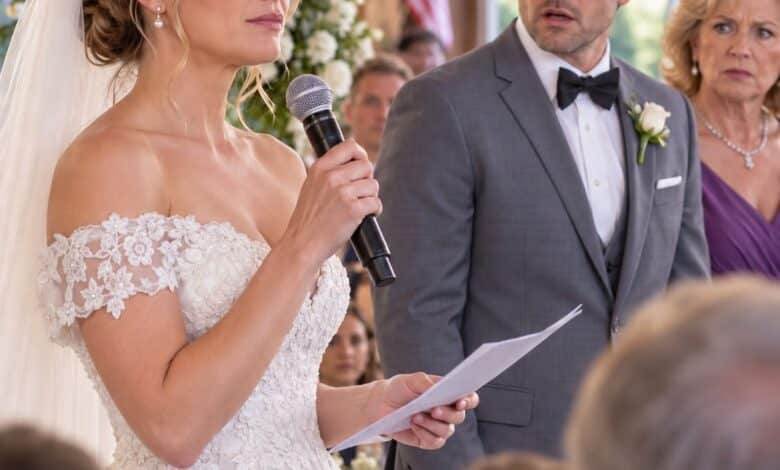
When the side door closed, I stepped to the microphone.
My hands were shaking.
“There will still be dinner.”
A few nervous laughs.
“There will definitely still be cake.”
More uneasy laughter.
“But there will not be a wedding.”
Silence.
Grant’s smile vanished.
“Mara.”
“We are not getting married today.”
He reached toward me.
“Can we talk privately?”
“No.”
Colleen stood from the front row.
“Mara, what is this?”
I looked directly at her.
“You know.”
Her face changed.
Grant said, “Whatever you think happened, we can discuss it.”
“I know what happened.”
“No, you clearly don’t.”
Interesting.
His first instinct was not apology.
It was control over my interpretation.
“I heard your phone call Thursday.”
Grant froze.
“What call?”
“The one you forgot to end.”
He looked at his mother.
That glance told the room plenty.
Colleen said, “This is not appropriate.”
Of course.
The problem was my timing.
Not their plan.
The lights dimmed.
The speakers came alive.
Then Colleen’s own voice filled the barn.
“Did she sign the property agreement?”
Grant went completely still.
His recorded voice answered:
“Not yet. Once she does, the house and savings are ours.”
Someone gasped.
Grant whispered:
“Turn it off.”
I didn’t.
The recording continued.
My house.
His debt.
The plan to restructure.
My investments.
Then the twins.
“I’ll work on Mara.”
Grant started toward the sound system.
My brother quietly stepped into his path.
“Don’t.”
Then came the final sentence.
“I’m tired of pretending I enjoy that noisy little household. I just need to get through Saturday.”
I stopped the audio.
The silence afterward was absolute.
Grant looked at me.
“That was taken out of context.”
“Which part?”
He said nothing.
“The house?”
“We were talking about our future.”
“The twins’ trust?”
“I never said I wanted to take their money.”
“You said you would work on me.”
“That is not the same thing.”
“Then explain it.”
He couldn’t.
Colleen stepped forward.
“You humiliated my son.”
I looked at her.
“My wedding just ended. My children are about to learn that someone they trusted was not who they thought he was. Do you honestly think this feels like winning?”
She said nothing.
Grant rubbed his face.
“I was venting about the kids.”
“You told your mother you were pretending to enjoy them.”
“I do love them.”
“Then why say it?”
“I was stressed.”
I shook my head.
“That explanation is not as comforting as you think.”
Then I removed my engagement ring.
I placed it in his palm.
“You treated my love for my family like leverage.”
His hand closed around the ring.
“You’re throwing away three years.”
“No.”
I looked toward the side room.
“I’m protecting what those three years taught me not to lose.”
Grant’s father finally stood.
He placed one hand on his son’s shoulder.
“Come on.”
Grant resisted.
Then something in him gave way.
Before leaving, he looked at me.
“Did you ever love me?”
The question shocked me.
“Yes.”
For a second, relief crossed his face.
“That is why this hurts.”
Then he left.
The barn doors closed.
My mother reached me first.
“Breathe.”
“I am breathing.”
“Not correctly.”
I laughed and cried at the same time.
Then I remembered Caleb.
I found him sitting alone near the window in the side room.
“Grant left?”
“Yes.”
“So you’re not getting married.”
“No.”
“Did he cheat?”
“Not that I know of.”
He frowned.
“Then what?”
“Grant made financial plans and said things that showed me he wasn’t someone I could safely marry.”
“That sounds boring.”
“Parts of betrayal are extremely boring.”
He almost smiled.
Then he asked the question I had feared.
“Did it have anything to do with us?”
I could have lied.
Instead, I said, “Some of it did.”
His jaw tightened.
“Did he say he doesn’t want us?”
I reached for his hand.
“He said something unkind about living in our house.”
“What?”
“I am not repeating it to you.”
“Why?”
“Because you do not need to carry every ugly sentence an adult says when he is showing bad judgment.”
Caleb looked down.
“He lied to me.”
That broke my heart more than anything at the altar.
“I think he cared about you.”
“That’s not what I said.”
He was right.
“He presented himself as more committed to us than he was actually prepared to be.”
Caleb wiped at his eyes.
“That’s just a fancy way to say he lied.”
“Yes.”
Then he cried.
So did I.
Later, June asked if they were still flower girls.
“No.”
“But we have the dresses.”
“You can wear them to dinner.”
That solved her problem immediately.
Then Maisie asked the important question.
“Can we still have cake?”
“Yes.”
So we did.
I changed into a navy dress.
The twins ate barbecue in their green flower-girl dresses.
Caleb loosened his tie.
At first, nobody knew how to behave.
Then my mother walked onto the dance floor and held out her hand.
“What are you doing?”
“You paid for a band.”
“Mama.”
“Do not waste money.”
I laughed.
Then I danced with my mother at the reception for the wedding that never happened.
Eventually everyone joined.
It wasn’t joyful in the way we had planned.
But it was alive.
That mattered.
The aftermath was remarkably uncinematic.
Invoices.
Possessions.
Keys.
A coffee maker Grant loved.
Tools in my garage.
His golf clubs.
We arranged pickups through a third party so he would not come to the house while the children were home.
The engagement ring went back through Rebecca.
The property agreement was never signed.
The house stayed mine.
My business stayed mine.
The twins’ trust stayed untouched.
Not because I defeated Grant in some brilliant legal battle.
Because I never gave consent.
That distinction mattered.
A few days later, Grant emailed me.
He apologized.
Then explained.
Then apologized again.
His business debt had worsened quickly.
He was ashamed.
Colleen knew.
She had encouraged him to think of marriage as financial security.
Grant insisted he never intended to “take” my house.
He thought we would borrow against it together.
Together.
That word had apparently carried a lot of moral weight for him.
He wrote:
I thought once we were married, you would understand that solving my problem would protect our family too.
That was probably true.
And that was exactly the problem.
He had already decided his hidden debt would become our shared responsibility before giving me the chance to choose.
His apology about the children hurt even more.
He said he had been venting.
He insisted he loved them.
And I believed he probably did.
That made things more complicated, not less.
People can love you and still manipulate you.
Love does not automatically produce honorable behavior.
Months later, Grant and I met once at a coffee shop.
He looked tired.
“I really did love you.”
“I know.”
“I loved the kids.”
“I think you did.”
“Then why does everyone act like the whole relationship was fake?”
“I don’t.”
He looked surprised.
“I think the relationship was real. I think the future you were promising me was dishonest.”
He stared into his coffee.
Then he asked:
“Would you have helped me with the debt if I’d told you?”
That question hurt because I knew the answer.
“Probably.”
His head snapped up.
“I would not have blindly mortgaged my house. I would never have touched the twins’ money. But I would have sat down with Rebecca and looked at every option.”
Grant looked devastated.
“So I destroyed us because I was afraid to ask.”
“Not exactly.”
“What then?”
“You decided persuasion was safer than honesty.”
He nodded slowly.
“That’s fair.”
There was no reconciliation.
No dramatic kiss.
Just clarity.
Nearly two years later, I came home late one Friday.
The house was chaos.
Caleb and two friends were in the kitchen.
Maisie and June had frosting all over the counter.
My mother was yelling because someone had left a soccer cleat on her chair.
The dog was barking.
Music played upstairs.
Someone had burned toast.
I stood in the doorway smiling.
Caleb noticed.
“Why are you smiling?”
“No reason.”
“That’s creepy.”
Then June yelled:
“Mom! Maisie got frosting in my hair!”
“I did not!”
“She did!”
I put down my bag.
Home.
That was all.
Noisy.
Imperfect.
Mine.
Grant had once called me sentimental as though that made me weak.
He was right about one thing.
I am sentimental.
I save birthday cards.
I cry at school concerts.
I still keep one of Lily’s sweaters in my closet.
I believe family dinners matter.
I believe promises should mean something.
I believe children deserve adults who show up when they say they will.
None of that makes me easy.
Sentiment without boundaries can make a person vulnerable.
Sentiment with judgment gives you something worth protecting.
Grant thought my desire for family would keep me walking toward him no matter what I knew.
He was right about one part.
I did walk down the aisle.
My son held my arm.
My nieces scattered flowers.
Nearly one hundred people watched.
Grant smiled because he believed I was walking toward him.
He misunderstood.
I was walking toward my children.
My home.
My judgment.
My dignity.
And when I reached the altar, I finally chose all of them without him.