The handwritten note was only three lines long.
But the last one made my stomach twist.
Claire — 8:00 a.m.
Blue tablet after breakfast.
Do NOT let Ethan handle the medication.
Claire was my wife.
Marlene was her mother.
And I had never seen those instructions before.
I looked up.
“What does this mean?”
Marlene folded her arms as though I were the one creating trouble.
“It means exactly what it says.”
“Why would you write that?”
“Because Claire has been confused lately.”
“That isn’t what I asked.”
Behind me, Lily shifted against the wall.
Marlene glanced toward her.
It lasted less than a second, but I saw it clearly.
A warning.
My nine-year-old immediately dropped her eyes.
I stepped sideways until Marlene could no longer see her.
“Look at me.”
She did.
“Why did you write that I wasn’t supposed to handle my wife’s medication?”
Her expression hardened.
“Because you don’t know everything about Claire.”
“Then tell me.”
“This isn’t a conversation for a child.”
I stared at her.
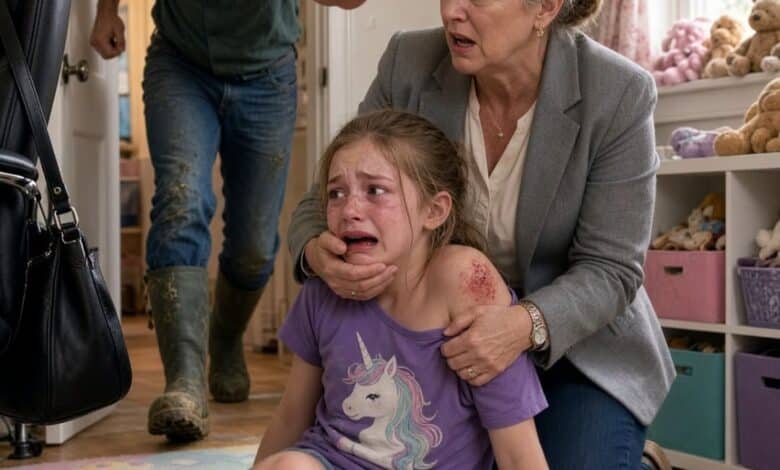
“You seemed perfectly comfortable having a conversation with Lily when your hand was clamped over her mouth.”
Marlene’s lips tightened.
I pulled out my phone.
That was the first moment her confidence cracked.
“What are you doing?”
“Calling Claire.”
“She’s sleeping.”
I stopped.
Slowly, I looked at her.
“How do you know that?”
Marlene blinked.
Once.
That morning, Claire had gone to urgent care after several days of nausea and dizziness.
At 10:32, she texted me that the doctor wanted to observe her.
At 11:48, another message arrived.
Mom is driving me home. I’m exhausted. Going to sleep when I get there.
I had assumed she meant our house.
But Claire wasn’t home.
Her car wasn’t outside.
I had checked upstairs before mowing.
“Where is my wife?”
“At my house.”
“Why?”
“She needed quiet.”
“Why didn’t she come home?”
“She didn’t want Lily bothering her.”
Behind me came a tiny voice.
“That’s not true.”
Marlene’s head snapped toward Lily.
I raised my hand.
“Don’t look at her.”
“Ethan, this is ridiculous.”
“Lily, what isn’t true?”
My daughter swallowed.
“Mom wanted to come home.”
Marlene moved forward.
“That’s enough.”
I blocked her.
“No. It isn’t.”
Lily wiped her cheeks.
“Grandma told her she couldn’t.”
“When?”
“At the hospital.”
Marlene laughed.
Actually laughed.
“She wasn’t even there.”
Silence.
Her face changed.
Too late.
“You just told me she misunderstood a private conversation.”
Marlene said nothing.
I turned toward Lily.
“Were you at the hospital?”
She nodded.
“Grandma picked me up from Aunt Rachel’s.”
I hadn’t known that.
Rachel had been watching Lily that morning.
Around noon she had texted:
Marlene grabbed Lily. Said Claire asked for her.
At the time, nothing seemed strange.
Now everything did.
“What happened?”
Lily squeezed her knees tighter.
“Grandma told me not to tell.”
“She can’t stop you now.”
My daughter looked toward the purse in my hand.
“She gave Mom something.”
The room suddenly felt too small.
“A pill?”
Lily nodded.
Marlene stepped closer.
“It was prescribed medication.”
I lifted the note.
“Then why hide this?”
“I didn’t hide anything.”
“It was folded in your purse.”
“That’s where I keep papers.”
“Then why were you holding Lily on the floor?”
“I already explained—”
“No.”
My voice came out too loud.
Lily flinched.
I lowered it immediately.
“No more explanations from you.”
I called Claire.
Once.
Twice.
Three times.
No answer.
I called again.
Nothing.
Then I dialed Marlene’s house phone.
A ringtone started.
Not through my phone.
Inside Lily’s bedroom.
All three of us looked toward Marlene’s purse.
Her face went white.
I opened the inner zipper.
Claire’s phone was inside.
For several seconds, nobody spoke.
I held it up.
“Why do you have my wife’s phone?”
“She asked me to keep it.”
“Why?”
“She needed rest.”
“You left her alone at your house without it?”
“She needed peace.”
I turned toward Lily.
“Shoes. Now.”
Marlene stepped into the doorway.
“Where are you going?”
“To get Claire.”
“You’re making a mistake.”
“Move.”
“She is finally sleeping.”
“Move.”
For the first time, uncertainty appeared in her face.
She stepped aside.
Lily and I made it halfway down the hall before Marlene spoke again.
“If you wake her too quickly, don’t blame me for what happens.”
I stopped.
Every instinct told me to turn around.
Instead, I looked down at Lily.
She was terrified.
And suddenly I understood this was no longer a family argument.
I called 911.
Marlene heard the dispatcher answer.
Her composure vanished.
“Ethan, hang up.”
I kept walking.
“My wife may be medically vulnerable. Her phone has been taken, and the person who brought her home was just physically restraining my nine-year-old daughter.”
The dispatcher’s tone changed.
“Is the child safe with you?”
“Yes.”
“Can you move her somewhere secure?”
My neighbor, Tom Alvarez, was already standing by his mailbox, looking toward our house.
I waved him over.
“Tom, can Lily stay with you?”
He saw her face.
Then Marlene.
Then me.
“What happened?”
“Police are coming.”
That was enough.
Lily grabbed my wrist.
“Dad.”
I crouched.
“What?”
“There’s more.”
Cold moved through me.
“What?”
“She put something in Mom’s orange juice.”
Behind me, Marlene shouted.
“She is lying!”
Lily jumped.
Tom immediately stepped between her and the porch.
I kept my voice steady.
“When?”
“This morning.”
“Where?”
“Grandma’s house.”
“What did you see?”
“Mom was lying on the couch. Grandma went into the kitchen. I followed because I wanted water.”
Marlene shook her head.
“No.”
“She opened a little brown bottle.”
My eyes went to the purse.
Marlene lunged for it.
I got there first.
The front zipper had not been checked.
Inside was a small amber prescription bottle.
Part of the label had been peeled away.
I did not open it.
I did not touch the tablets.
I placed the purse on the porch table.
Marlene stared at it.
Then slowly sat down.
Sirens were getting closer.
For the first time, she looked tired instead of angry.
“You have no idea what your wife has put me through.”
I looked at her.
“What are you talking about?”
“She was going to destroy everything.”
I stayed silent.
Marlene filled it.
“She was going to tell you.”
“Tell me what?”
She looked toward the approaching police cruiser and smiled bitterly.
“Ask Claire.”
Two officers separated us.
I gave them the note, the purse, Claire’s phone, and the prescription bottle.
Then I told them exactly what I had heard Marlene say to Lily before I entered the bedroom.
If you tell Daddy, your mother won’t wake up next time.
Within minutes, another unit and paramedics were sent to Marlene’s house.
I wanted to go.
They told me to stay.
Those twelve minutes felt endless.
Then the radio crackled.
Female located. Unresponsive but breathing. EMS requesting immediate transport.
My legs nearly buckled.
“Is she alive?”
The officer listened.
Then nodded.
“She’s alive.”
I barely heard anything after that.
At the hospital, Claire lay beneath a white blanket surrounded by monitors.
A doctor told me she was stable.
Stable became the most beautiful word I had ever heard.
Almost two hours later, Claire opened her eyes.
“Ethan?”
“I’m here.”
“Lily?”
“She’s safe.”
Claire began crying.
“She saw.”
My chest tightened.
“Saw what?”
“My mother.”
Claire told me everything slowly.
Months earlier, she had discovered Marlene had been using her identity.
Credit cards.
Loans.
Old bank accounts.
Transfers hidden behind variations of Claire’s name.
Claire confronted her.
Marlene begged her to stay quiet.
Claire refused.
That morning, she was supposed to meet with a bank investigator after urgent care.
Marlene knew.
“She came because she knew I was sick,” Claire whispered. “She said she’d drive me.”
The clinic had instructed Claire not to take any additional medication until they understood her dizziness.
Marlene had heard those instructions.
Instead of bringing Claire home, she drove to her own house.
There, she gave Claire orange juice.
Lily saw her add something.
Claire became increasingly sleepy.
Then Marlene took her phone.
Lily wanted to call me.
That was why Marlene had brought Lily back to our house.
And when Lily refused to stay silent, Marlene pinned her to the carpet.
The investigation lasted months.
There was no single magical confession.
There were records.
Medical tests.
Pharmacy logs.
Financial accounts.
Surveillance footage from Marlene’s own kitchen camera.
It showed her handling the small bottle shortly before giving Claire the orange juice.
Toxicology later showed Claire had a sedating medication in her system that had not been part of her treatment plan that morning.
Marlene’s story changed repeatedly.
Lily’s never did.
My daughter never pretended to know what she couldn’t know.
She simply told investigators:
Grandma opened the bottle.
Grandma put something in Mom’s drink.
Mom became very sleepy.
Grandma took Mom’s phone.
Grandma told me not to tell Dad.
Facts.
Simple enough to check.
And they did.
Claire recovered physically.
Emotionally took longer.
Lily started therapy too.
For several weeks, she checked the front window whenever a car slowed down.
Then, little by little, her questions became normal again.
Could she paint her room yellow?
Could Sophie sleep over?
Could she quit soccer and try theater?
Could we get pancakes Saturday morning?
Those questions felt like miracles.
Months later, I finally started mowing the lawn again.
The engine had barely been running thirty seconds when Lily tapped my arm.
I shut it off instantly.
“What?”
She pointed toward the porch.
Claire stood there holding lemonade.
“Mom says break.”
“I literally just started.”
“She said break.”
We sat together on the porch.
After a minute, Lily looked at me.
“Dad?”
“Yeah?”
“Remember when I told you to check Grandma’s purse?”
“Of course.”
“I thought you wouldn’t.”
That hurt.
“Why?”
“Grandma said adults believe other adults.”
I put down my glass.
“Sometimes they do.”
“She said kids get confused.”
“Kids can misunderstand things. Adults can too. That’s why we ask questions and check facts.”
“So you didn’t believe me just because I’m your daughter?”
“I took you seriously because you were scared and because what you said mattered.”
She thought about that.
Then nodded.
A year later, Lily gave a presentation at school.
Her topic was speaking up.
She stood in front of the class, nervous but steady.
“Sometimes people think being brave means you aren’t scared,” she said.
Then she paused.
“I think being brave can mean you’re really scared, but you tell somebody anyway.”
Claire squeezed my hand.
Lily never mentioned Marlene.
She didn’t need to.
She told the class that if someone made them feel unsafe or confused, they should tell a trusted adult.
And if the first person didn’t listen?
Tell another.
Then another.
Until somebody did.
When she finished, the classroom applauded.
Afterward, in the parking lot, Lily asked me whether her presentation had been good.
For a second, I saw the frightened nine-year-old backed against her bedroom wall, barely able to whisper three words.
Check her purse.
Now she had spoken in front of an entire room.
“Yeah,” I said.
“It was really good.”
She smiled and ran toward the car.
And for the first time when I remembered that afternoon, I did not hear Marlene’s voice.
I heard Lily’s.
Clear.
Steady.
Unhidden.
And nobody was covering her mouth anymore.