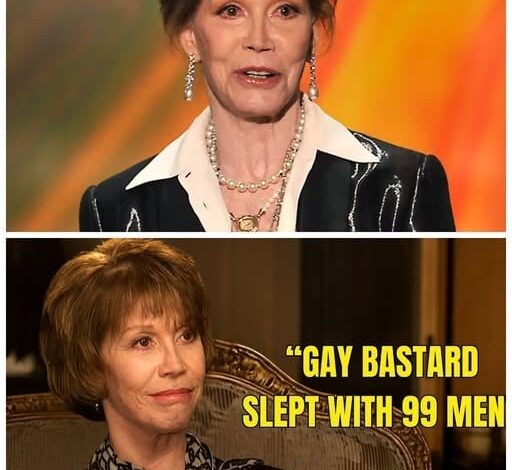
Mary Tyler Moore never needed to shout to change television.
That may be the most remarkable thing about her legacy.
In an industry built on spectacle, ego, and carefully manufactured personas, Moore altered the emotional architecture of television almost quietly. No grand declarations. No public crusades announcing revolution. No performative reinvention designed to shock audiences into attention. Instead, she changed expectations through consistency, intelligence, and an almost radical commitment to portraying women as fully human long before Hollywood knew what to do with that idea.
By the time The Mary Tyler Moore Show arrived in 1970, American television still largely imagined women through narrow frameworks. They could be glamorous wives, supportive girlfriends, comic distractions, or symbols of domestic perfection, but ambition itself often remained coded as masculine territory. Independent women existed on-screen mostly as caricatures — lonely, brittle, selfish, or emotionally incomplete unless eventually softened back into traditional roles.
Then Mary Richards walked into a Minneapolis newsroom carrying uncertainty, intelligence, and quiet determination instead of dramatic rebellion.
And audiences immediately recognized something different.
What made the character revolutionary was not that she loudly rejected tradition. It was that the show treated her independence as normal. Mary was single without being tragic. Professional without becoming cold. Feminine without surrendering competence. She wasn’t written as a fantasy of perfection or as punishment for choosing career over marriage. She was simply a woman building a life — messy, funny, vulnerable, ambitious, lonely sometimes, fulfilled other times.
That nuance mattered enormously.
Television had shown audiences women before.
Mary Tyler Moore showed them interiority.
She allowed female characters to exist beyond simplistic categories. Her performances carried emotional intelligence rarely afforded to women in sitcoms at the time. A single glance or carefully underplayed line delivery often revealed more complexity than pages of dialogue could have. Moore understood instinctively that subtlety creates credibility. Rather than forcing emotion outward theatrically, she let audiences discover it gradually beneath expressions, pauses, and restraint.
That restraint became its own form of rebellion.
Because Hollywood frequently rewards women for emotional excess while punishing them for composure. Moore refused both extremes. She did not perform fragility for sympathy or aggression for authority. Instead, she built characters grounded in capability and humanity simultaneously.
And perhaps that balance unsettled people precisely because it felt real.
Viewers recognized women they knew inside her performances:
friends,
coworkers,
sisters,
themselves.
Not idealized fantasies.
Not cautionary tales.
Actual people.
That authenticity expanded what television considered possible for women permanently.
Behind the scenes, Moore’s influence stretched even further.
Television sets during that era often operated through rigid hierarchies dominated almost entirely by men. Women were expected to remain agreeable, attractive, and grateful for visibility itself. But Moore approached her work differently. Colleagues repeatedly described her preparation as meticulous. She arrived understanding scripts deeply, thinking critically about scenes, timing, emotional rhythm, and character consistency.
She treated comedy seriously.
That distinction matters because comedy has historically been one of the hardest industries for women to navigate professionally. Funny women were often underestimated intellectually even while carrying enormous creative responsibility. Moore dismantled that assumption repeatedly through discipline rather than confrontation. She didn’t demand authority theatrically; she embodied competence so consistently it became undeniable.
And unlike many powerful figures inside entertainment, she reportedly managed leadership without cruelty.
That detail echoes constantly through stories told by younger performers who worked alongside or admired her. Moore represented a version of success rarely modeled publicly in Hollywood — ambitious but not destructive, commanding without humiliation, influential without emotional chaos.
The entertainment industry often romanticizes suffering as proof of artistic seriousness. Tyrannical directors become “geniuses.” Emotional instability becomes “passion.” Public self-destruction becomes branding. Women especially receive conflicting messages constantly: be powerful, but likable; visible, but not threatening; successful, but never demanding enough to make others uncomfortable.
Mary Tyler Moore navigated those contradictions with unusual integrity.
She remained ambitious openly.
Professional consistently.
Kind intentionally.
And she did so without apologizing for excellence or weaponizing it against others.
That integrity extended into the roles she chose.
Moore understood visibility carries responsibility. Not moral perfection — she never pretended public figures should become flawless symbols — but responsibility toward how women are imagined culturally. Her characters frequently balanced vulnerability with competence in ways still surprisingly rare today. They could fail without becoming weak. Struggle without becoming pathetic. Succeed without surrendering softness entirely.
That emotional complexity altered audience expectations slowly but permanently.
After Mary Tyler Moore, it became harder to reduce women on television into decorative side characters alone because viewers had already experienced something richer.
A woman could lead.
Could work.
Could hesitate.
Could laugh.
Could make mistakes.
Could remain emotionally layered without requiring punishment or rescue by the final episode.
Younger actresses noticed all of this immediately.
Many later described Moore not merely as an inspiration, but as proof of possibility itself. She demonstrated that female performers did not need to choose between dignity and ambition. You could protect your professionalism without sacrificing empathy. You could maintain standards without becoming feared. You could remain decent inside an industry that often rewarded emotional compromise.
That example mattered profoundly because Hollywood can distort identity quickly. Fame encourages performance beyond cameras. Public approval becomes addictive. Many performers eventually reshape themselves entirely around survival inside systems demanding constant reinvention and emotional accessibility.
Moore resisted that erosion more successfully than most.
Not perfectly.
But intentionally.
And her personal life carried hardship invisible to audiences much of the time.
Diabetes.
Alcohol struggles.
Loss.
The devastating death of her son.
The emotional exhaustion that accompanies decades spent beneath relentless public attention.
Yet even through profound grief and physical decline, people close to her often described remarkable steadiness. Not denial. Not emotional suppression. Steadiness.
She continued showing up.
Continued preparing.
Continued working thoughtfully.
That perseverance deepened public respect because audiences gradually understood the warmth she projected professionally wasn’t superficial charm. It reflected discipline — the daily choice to remain present and gracious even while carrying private pain.
And perhaps that explains why her legacy feels unusually enduring compared to many television icons.
Nostalgia alone cannot sustain admiration across generations.
Integrity can.
Younger viewers discovering her work today often react with surprise at how modern it still feels emotionally. Not because the clothing or production styles aged perfectly, but because the emotional honesty underneath the performances remains recognizable. Mary Richards still feels like a real person navigating adulthood rather than a dated cultural artifact trapped inside old sitcom formulas.
That humanity keeps the work alive.
And ultimately, Mary Tyler Moore’s greatest achievement may not be any single performance at all.
It may be the cumulative effect of a career spent refusing false choices.
Refusing to become smaller in order to appear acceptable.
Refusing to confuse kindness with weakness.
Refusing to sacrifice intelligence for likability.
Refusing to betray herself simply to fit the emotional limitations television once imposed on women.
She expanded possibility quietly enough that many people barely noticed the revolution happening while it unfolded.
Until suddenly television looked different afterward.
Women looked different afterward.
And audiences themselves had changed too.
Because once someone demonstrates a fuller version of humanity on-screen, it becomes difficult to settle comfortably for caricature again.
Mary Tyler Moore understood that instinctively.
So she gave audiences something subtler and ultimately more powerful than spectacle:
a woman who felt real enough to change the culture simply by insisting on being fully herself.