The moment I realized my necklace was gone, something inside me tightened in a way I couldn’t explain. At first, it felt small—just a missing piece of jewelry. But standing barefoot in the dim light of our apartment, staring at the empty spot on the vanity where it always rested, I felt an unease settle deep beneath my ribs. The necklace wasn’t expensive. It was old copper with a rough green stone at its center, worn smooth by years against my skin. My father had given it to me after my mother died, and I never took it off. Never.
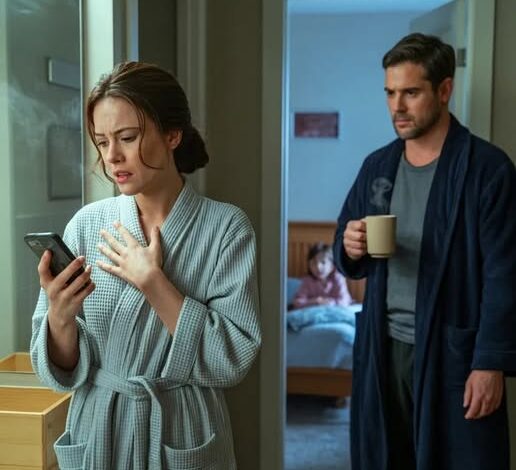
Across the hall, Ivy’s bedroom door was cracked open the way I always left it. Her nightlight cast a warm amber glow across the floor, and I could hear the slow, peaceful rhythm of her breathing. Five years old. Safe. Completely unaware that the world around her was already beginning to fracture.
Then I heard Caleb’s footsteps.
He came down the hallway carrying a tray with my tea balanced carefully in his hands, moving with the calm confidence of someone who believed the evening belonged to him. Steam curled upward from my chipped ceramic mug—the same mug he used every night when he made honey tea for me before bed. For years I had believed those tiny rituals meant love. The tea. The gentle touch on my shoulders. The way he remembered every preference I ever mentioned.
Now, watching him smile at me in the half-light, I realized how terrifying it is when kindness becomes camouflage.
“My necklace is missing,” I told him.
He paused just long enough for me to notice.
Then came the performance.
Concern crossed his face in perfectly measured pieces. He searched the bathroom too carefully, glanced beneath the sink too quickly, asked if I might have left it somewhere else. But he wasn’t looking for the necklace. He was looking at me. Watching my reaction. Measuring how much I knew.
I had spent years restoring damaged paintings and ancient artifacts. I understood stress fractures, hidden repairs, invisible damage buried beneath polished surfaces. And suddenly I saw my husband the same way: not as a loving man searching for something lost, but as a structure cracking under pressure.
“It’s just a necklace,” he said softly, placing his hands on my shoulders in the exact comforting way he always did. “We’ll replace it if we need to.”
Replace it.
The word lingered.
Because that was what Caleb always did—replace, reshape, reposition. Slowly and carefully, over years, until I no longer recognized which thoughts had originally belonged to me.
I smiled and pretended to believe him.
Then, the moment he left the room, I called my father.
Arthur Vance answered before the first ring had finished. The sound of his voice terrified me instantly. My father was a man who had survived financial collapses, scandals, funerals, and betrayals without ever sounding shaken. But now his voice trembled.
“The necklace did its job,” he said.
The room tilted around me.
Inside the necklace had been a concealed security system—something my father secretly designed years ago after my mother died. When the signal was interrupted, it activated a hidden microphone and transmitted everything nearby directly to his servers.
Then he played the recording.
At first I heard Caleb’s voice, familiar and devastatingly ordinary. But all warmth had vanished from it. There was no tenderness left, no affection, no softness. Only calculation.
“The sedative needs to be at full dose by morning,” he said calmly. “She never questions the tea.”
My entire body went cold.
Then another voice entered the recording.
My mother-in-law.
The same woman who cried at my wedding and called me her daughter.
“Make sure she can’t resist when they move her,” she said briskly. “And the trust paperwork needs to be signed before she fully comes around.”
Then came the sentence that shattered me completely.
“And the little girl?”
Caleb answered without hesitation.
“She stays. She’s leverage if necessary.”
Leverage.
That was how my husband spoke about our daughter.
Not Ivy. Not his child. Leverage.
Something inside me died in that moment, but something else was born alongside it—something colder, sharper, far more dangerous than fear. The grief and panic fused together into a kind of clarity I had never felt before.
My father told me not to pack. Not to confront him. Not to let Caleb suspect I knew anything.
“Get Ivy,” he whispered. “And leave now.”
Then came three soft knocks on the closet door.
“Brier?” Caleb called warmly. “Your tea is getting cold, sweetheart.”
Sweetheart.
The same voice that had just discussed drugging me like a logistics problem.
I closed my eyes for one second and found the stillest part of myself—the place I used to go during delicate restorations when one wrong movement could destroy centuries-old art forever.
Then I opened the door and smiled at my husband.
It was the best performance of my life.
I told him I needed fresh air. I moved calmly through the apartment while my pulse hammered so violently I thought it might expose me. The television turned on in the living room. That was my signal.
I slipped into Ivy’s room.
She was curled around her stuffed rabbit, completely asleep, her dark hair spread across the pillow in soft waves. Looking at her nearly broke me. She trusted this house. Trusted her father. Trusted me.
And I was about to destroy the world she thought she knew.
I lifted her carefully into my arms.
“Mommy?” she whispered sleepily.
“We’re going on an adventure,” I whispered back. “A secret one.”
She smiled instantly and closed her eyes again.
That trust almost destroyed me.
I carried her through the guest room and out onto the iron trellis attached to the balcony. The November air hit my skin like ice. Ivy’s warm breath rested against my neck as I climbed downward one rung at a time, balancing her weight against my chest while the city stretched dark and silent around us.
When my feet finally touched the wet grass below, I nearly collapsed from relief.
Then the bedroom light above us snapped on.
I ran.
Not gracefully. Not carefully. Pure instinct carried me across the garden toward the waiting Bentley hidden near the drive. Dominic had the back door open before I reached him.
“Get in,” he said.
The car sped away just as the upstairs windows flooded with light behind us.
I buried my face in Ivy’s hair and finally let myself cry.
Four years.
Four years of tea and smiles and soft hands and careful lies.
But somewhere beneath the grief, beneath the horror, another feeling began to rise.
Resolve.
Because Caleb thought I was weak. He thought I was confused, dependent, easy to manipulate. He believed he had already won.
What he didn’t understand was that I came from people who survived disasters by becoming sharper than the disaster itself.
And I was done being the woman who mistook comfort for safety.
By the time dawn arrived, Caleb still believed I was running.
He had no idea I was preparing to destroy him.