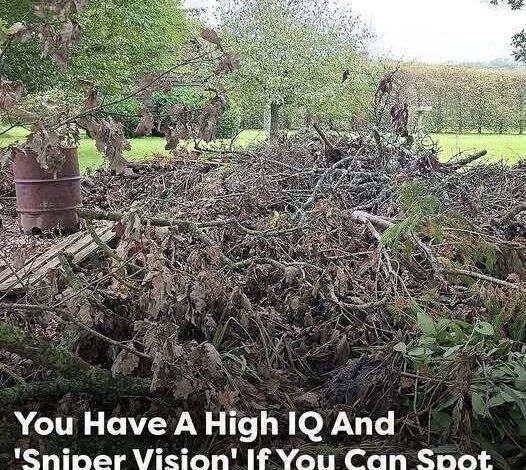
At first glance, the image looks completely ordinary.
A tangled patch of woodland. Fallen branches. Twisted limbs. Dry leaves scattered across the forest floor.
Nothing unusual.
Nothing remarkable.
And yet thousands of people across the internet have spent far longer than they expected staring at this photograph, convinced they must be missing something obvious.
Because hidden somewhere within the chaotic maze of branches is a spaniel.
The challenge sounds simple.
Find the dog.
But what begins as a quick visual puzzle often turns into a surprisingly frustrating search that leaves viewers questioning their own eyesight.
Many people spend several minutes scanning every corner of the image without success.
Others become so convinced there is no dog at all that they assume the entire challenge is some kind of joke.
Then suddenly, everything changes.
Once the hidden animal is spotted, it becomes impossible to unsee.
And that moment of discovery is exactly why the image has become the latest viral obsession among puzzle lovers and optical illusion enthusiasts.
A Puzzle That Refuses to Give Up Its Secret
The photograph first gained attention through online communities dedicated to visual challenges and hidden-object puzzles.
At first, users shared it casually, challenging friends and family to find the concealed spaniel.
Within days, thousands of people were attempting the puzzle themselves.
The reactions were remarkably similar.
Confusion.
Frustration.
Determination.
Then, eventually, satisfaction.
Comment sections quickly filled with people sharing their experiences.
Some claimed they found the dog immediately.
Others admitted they spent ten minutes or more searching before finally seeing it.
A surprising number of viewers confessed they needed hints because they simply could not locate the animal on their own.
The challenge became less about finding a dog and more about testing how the human brain processes visual information.
Why Is It So Difficult?
The answer lies in the way our brains interpret the world.
Human vision is incredibly powerful, but it is also surprisingly selective.
Every second, the brain receives enormous amounts of visual information. To process it efficiently, it relies on shortcuts.
It searches for familiar patterns.
Recognizable shapes.
Predictable outlines.
When an object clearly stands apart from its surroundings, identification happens almost instantly.
But when an object blends perfectly into its environment, the brain struggles.
That is exactly what happens in this photograph.
The spaniel’s fur closely matches the colors and textures surrounding it. The browns, grays, and muted tones of the dog’s coat merge almost seamlessly with the branches, bark, and leaves around it.
Instead of seeing a distinct animal, the brain initially interprets everything as part of the same background.
The dog effectively disappears into the scenery.
Nature’s Original Optical Illusion
What makes the image especially fascinating is that it demonstrates one of nature’s most effective survival tools: camouflage.
In the wild, countless animals rely on camouflage to avoid predators or remain hidden from prey.
Foxes blend into autumn landscapes.
Owls disappear against tree bark.
Leopards vanish among rocks and shadows.
The spaniel in this photograph unintentionally demonstrates the same principle.
Its coloring, combined with the dense woodland setting, creates a near-perfect visual disguise.
The result is an image that tricks even attentive viewers.
Even after being told there is a dog present, many people still overlook it repeatedly before finally recognizing the correct shape.
How to Spot the Hidden Spaniel
For those attempting the challenge, patience is essential.
Randomly scanning the image often leads nowhere.
Instead, many successful viewers recommend focusing near the center of the photograph before gradually working outward.
Look for shapes that appear softer than the surrounding branches.
Pay attention to curved forms rather than straight lines.
Search for subtle differences in texture.
The dog’s face and ears create a recognizable pattern once the brain locks onto the correct visual clues.
Interestingly, the hardest part is not finding the dog itself.
The hardest part is convincing your brain to stop seeing branches and start seeing an animal.
Once that mental shift occurs, the hidden spaniel suddenly appears obvious.
What seemed invisible moments before becomes impossible to miss.
The “Aha!” Moment
Psychologists often refer to this experience as perceptual reorganization.
The brain spends time processing scattered visual information without finding a meaningful pattern.
Then, in an instant, the pieces connect.
The hidden image emerges.
This sudden recognition produces a small burst of satisfaction and reward.
It is the same feeling people experience when solving a difficult riddle, completing a puzzle, or remembering a word that was temporarily forgotten.
That rewarding sensation is one reason hidden-object challenges are so addictive.
The struggle makes the solution feel more valuable.
A Growing Internet Phenomenon
The spaniel puzzle belongs to a larger family of viral visual challenges that have become increasingly popular online.
These puzzles often hide animals, people, or objects within highly detailed environments.
Previous viral images have featured:
Leopards hidden among rocky terrain.
Owls perfectly disguised against tree trunks.
Foxes concealed in autumn leaves.
Snow leopards blending into mountain landscapes.
Hunters camouflaged in forests.
Each puzzle creates the same emotional journey.
First comes confusion.
Then concentration.
Then the satisfying moment of discovery.
And finally, the urge to challenge someone else.
That social aspect helps these images spread rapidly across social media platforms, where users compete to see who can solve them the fastest.
More Than Just Entertainment
While puzzles like this are entertaining, researchers note they may also provide cognitive benefits.
Hidden-object challenges engage several important mental skills, including:
Pattern recognition.
Visual processing.
Attention to detail.
Concentration.
Problem-solving.
In a world increasingly dominated by short attention spans and endless scrolling, these puzzles encourage people to slow down and focus.
Even a few minutes spent searching for a hidden object requires a level of sustained attention that many daily activities no longer demand.
The Real Reason We Love These Challenges
The popularity of the hidden spaniel goes beyond simple curiosity.
At its core, the challenge taps into something deeply human.
People enjoy discovering things others miss.
We are naturally drawn to mysteries.
We enjoy searching for patterns.
We feel rewarded when hidden information suddenly becomes clear.
Thousands of viewers can look at the exact same photograph and experience the same progression from confusion to triumph.
That shared experience is part of what makes puzzles like this so universally appealing.
A Reminder to Look Closer
In the end, the photograph is about far more than a dog hidden among branches.
It is a reminder of how easily our eyes can overlook what is right in front of us.
The spaniel never moves.
The image never changes.
Only our perception does.
And perhaps that is why so many people find the challenge fascinating.
Sometimes the most interesting things are not hidden because they are far away.
They are hidden because we are not looking carefully enough.
The dog is there from the very beginning.
All it takes is patience, focus, and a willingness to see the picture differently.
Then suddenly, what once seemed impossible becomes obvious.
And once you spot the spaniel, you’ll wonder how you ever missed it at all.