An Entitled Jewelry Store Saleswoman Refused to Let My Grandma Try on an Anniversary Ring Because She ‘Didn’t Look like a Buyer’ – She Regretted It Moments Later

I thought helping my grandmother buy two anniversary rings would be one of the happiest errands we’d ever run together.
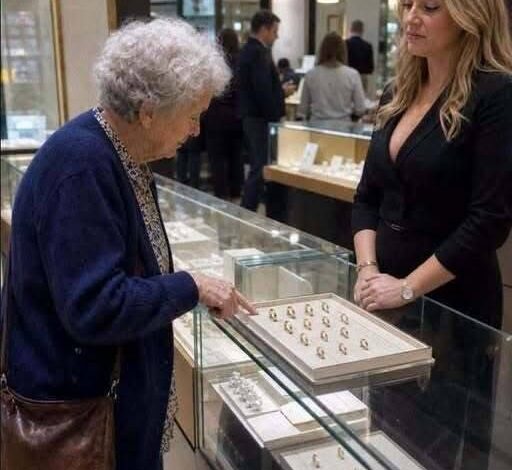
Instead, less than ten minutes after entering the jewelry store, Grandma Margaret was standing beside a glass display case with tears in her eyes.
The saleswoman had taken one look at her faded cardigan, comfortable walking shoes, and battered leather purse and apparently decided she didn’t belong there.
What she didn’t know was that Grandma had spent months saving for those rings.
She didn’t know why Grandma’s fingers had become so thin.
And she definitely didn’t know what Grandma had done years earlier for the woman who owned the store.
The day before, I’d found Grandma sitting at her living-room table surrounded by money.
There were wrinkled bills, loose coins, and several envelopes with RINGS written across them in her careful handwriting.
She counted everything.
Then started again.
“Lost my place,” she said, laughing. “Chemo brain.”
She said it casually.
That was Grandma.
She could make a joke out of almost anything.
Behind her sat the old sewing machine she’d used for decades. Neighbors brought her dresses that didn’t fit, torn jackets, school uniforms, curtains, wedding gowns—anything that needed saving.
Grandma could rescue almost anything made of fabric.
Over the years, she’d earned a little money from those jobs.
But she’d given away far more work than she’d ever charged for.
That year, every spare dollar had gone into those envelopes.
She and Grandpa Harry were approaching their fiftieth wedding anniversary.
A year earlier, we hadn’t been sure either of them would make it.
Grandpa was diagnosed with cancer first.
Six months later, Grandma received her own diagnosis.
Treatment seemed to shrink them before our eyes.
Their hair disappeared.
Then their appetites.
Then much of their strength.
Both lost nearly forty pounds.
Some days, walking from the bedroom to the kitchen felt like an accomplishment.
But they kept going.
When one was too weak, the other became strong.
When Grandpa couldn’t eat, Grandma sat beside him until he managed three spoonfuls.
When Grandma was frightened before treatment, Grandpa held her hand and told terrible jokes until she laughed.
Cancer took plenty from them.
Including, strangely enough, their wedding rings.
Grandma’s slipped from her finger while she was washing dishes.
By the time she realized it was missing, it had vanished down the drain.
Grandpa confessed afterward that his had disappeared during a hospital visit weeks earlier.
They searched.
Neither ring was recovered.
Grandma pretended it didn’t bother her.
Then Grandpa completed treatment.
And she made a decision.
“We need new ones,” she told me.
Not expensive ones.
Not diamonds.
Two simple matching gold bands.
Something that fit their thinner fingers.
Something they could exchange again at their anniversary dinner.
“A fresh start,” she called it.
She wanted it to be a surprise.
So she saved.
Sewing money.
Birthday cash.
Loose change.
Every little bit went into those envelopes.
The morning we went shopping, she checked her purse three times before we left.
Then, sitting in the car outside the nicest jewelry store in town, she suddenly stopped moving.
“Do you have the envelope?”
“Yes.”
“You’re sure?”
I showed her.
She nodded.
Then she admitted, “I’m nervous.”
That surprised me.
This was a woman who had walked into chemotherapy appointments cracking jokes.
“What are you nervous about?”
She looked through the window at the polished storefront.
“I don’t know. Places like this make me feel like I’m going to touch something I’m not supposed to.”
I squeezed her hand.
“You’ve earned the right to touch every ring in there.”
She laughed.
Then we went inside.
A bell chimed above the door.
Everything gleamed.
Glass counters.
Perfect lighting.
Velvet trays.
Jewelry sparkling beneath spotlights.
A young saleswoman approached.
Her name tag read CHLOE.
She smiled at me first.
Then looked at Grandma.
Her eyes traveled downward.
Cardigan.
Shoes.
Purse.
The smile faded.
Grandma didn’t notice.
She had already spotted a display of simple gold bands.
“Oh, those are pretty.”
She walked over.
“Excuse me,” she said. “Could I try that one?”
Chloe didn’t unlock the case.
Instead, she asked, “Were you looking for something in a particular price range?”
Grandma nodded.
“Two matching bands, if possible.”
“Those are part of our premium collection.”
“That’s all right. I’d just like to see whether that one fits.”
Chloe folded her arms.
“We don’t usually take pieces out for casual browsing.”
I looked at her.
Grandma’s smile weakened.
“I’m not browsing. I’d like to buy two.”
Chloe gave a small laugh.
Not loud.
Almost worse.
The kind meant to communicate something without saying it directly.
“Most customers establish their budget before handling the more expensive merchandise.”
Several people nearby could hear her.
Grandma’s cheeks turned red.
I stepped forward.
“She has money. We’re here to buy.”
Chloe looked at me.
“I’m simply protecting our inventory.”
Then she glanced at Grandma again.
“We can’t hand expensive jewelry to everyone who comes in.”
The showroom went strangely quiet.
Grandma lowered the hand she’d been holding toward the glass.
I looked at her face.
Tears were forming.
That broke something in me.
I’d watched this woman lose her hair.
I’d watched her vomit after treatment.
I’d watched her become so weak that Grandpa had to help her into bed.
Through all of it, she rarely cried in front of us.
But a stranger had looked at her clothes and made her feel small in less than five minutes.
I was furious.
Before I could speak, Grandma touched my arm.
“Please.”
Her voice was barely audible.
“Take me home.”
“Grandma—”
“Please.”
So I swallowed everything I wanted to say.
We turned toward the door.
My fingers had just reached the handle when someone called from behind us.
“Margaret?”
Grandma froze.
We turned.
A woman had emerged from the back carrying coffee in one hand and keys in the other.
She stared at Grandma.
Then the coffee nearly slipped from her hand.
“Margaret!”
She hurried across the showroom and wrapped Grandma in both arms.
Grandma blinked in surprise.
“Donna?”
Donna stepped back and held Grandma’s shoulders.
“My God. Look at you.”
Then she noticed how thin Grandma was.
Her expression changed.
“What happened?”
Grandma tried to wave it away.
“Oh, I’ve been a little sick.”
“A little sick?”
“Cancer.”
Donna’s face crumpled.
Grandma immediately added, “I’m doing better.”
Then Donna noticed her eyes.
Red.
Wet.
She looked at me.
“What happened?”
Grandma shook her head.
“Nothing.”
I wasn’t Grandma.
So I told her.
Every word.
Donna listened without interrupting.
Then she turned.
“Chloe.”
Chloe’s face had already gone pale.
“Come here.”
She approached slowly.
“Aunt Donna, I was only following store policy.”
Donna stared at her.
“What policy?”
“The expensive pieces. I was just trying to—”
“There is no policy allowing you to humiliate someone.”
“I wasn’t humiliating her.”
“You refused to show her merchandise.”
“I didn’t think she was actually going to buy it.”
Donna’s expression hardened.
“Why?”
Chloe hesitated.
“She just didn’t look like—”
“Finish that sentence.”
Silence.
“Didn’t look like what?”
Chloe looked at the floor.
Donna nodded slowly.
“Exactly.”
Then she turned toward Grandma.
“You never told her?”
Grandma looked confused.
“Told her what?”
Donna almost laughed.
“Of course you didn’t.”
She faced Chloe again.
“Do you know who this woman is?”
Chloe said nothing.
“Years ago, before your cousin’s rehearsal dinner, her dress was damaged. Remember hearing that story?”
Chloe nodded.
“Margaret drove across town in pouring rain and repaired it by hand.”
Grandma shrugged.
“It wasn’t a big job.”
Donna ignored her.
“And she refused to take a penny.”
Then Donna’s voice softened.
“But that’s not even why I know her.”
The showroom had become completely silent.
“After my husband died, this store nearly disappeared.”
Grandma looked down.
Donna continued.
“I was drowning in debt. I had committed to supplying formalwear for a charity event because I thought the exposure might save the business. Then I realized I couldn’t afford all the alterations.”
She pointed toward Grandma.
“This woman sat behind her sewing machine for three weeks.”
Grandma murmured, “Donna…”
“Three weeks, Margaret.”
Donna looked back at Chloe.
“Dozens of gowns. Tuxedos. Hemming. Repairs. Adjustments. She worked until her hands hurt.”
Chloe’s face had changed completely.
“I tried to pay her.”
Donna’s eyes filled.
“She wouldn’t let me.”
Grandma smiled faintly.
“I told you to help somebody else someday.”
Donna nodded.
“You did.”
Then she gestured around the showroom.
“That charity event brought customers through these doors when I desperately needed them. Some became clients for years.”
She looked directly at Chloe.
“This woman helped keep my business alive.”
Nobody spoke.
“And today,” Donna continued, “you decided she wasn’t good enough to touch one of our rings.”
Chloe whispered, “I didn’t know.”
Donna’s answer came immediately.
“That’s the problem.”
She stepped closer.
“You shouldn’t have needed to know.”
That sentence silenced the room.
Donna pointed toward the entrance.
“Every person who walks through that door gets dignity. I don’t care whether they’re wearing designer clothes or pajamas. I don’t care whether they have ten dollars or ten million dollars.”
Chloe wiped at her eyes.
“You don’t make people prove they’re wealthy enough to deserve respect.”
Grandma, somehow still worried about everyone except herself, stepped forward.
“Donna, sweetheart, she’s young. Please don’t make a big thing of this. We’ll come back another day.”
Donna stared at her.
Then smiled.
“No.”
Grandma blinked.
“If you leave without choosing your anniversary ring, I will drive to your house tonight and put one on your finger myself.”
Grandma burst out laughing.
The tension finally cracked.
Donna took her arm.
“Come with me.”
She led us to another display and unlocked it.
Then another.
Soon, velvet trays covered the counter.
“Try everything.”
“Donna—”
“Everything.”
So Grandma did.
One ring was too wide.
Another felt heavy.
A third spun around her thin finger.
Then Donna handed her a simple gold band.
Grandma slid it on.
It fit perfectly.
She stopped.
Her thumb gently traced the gold.
“That’s it.”
“You sure?”
Grandma nodded.
“That’s the one.”
Then we found a matching band for Grandpa.
I reached into my purse and pulled out the envelope.
Bills.
Coins.
Months of sewing money.
I began counting.
Donna placed her hand over mine.
“No.”
“Donna, she saved for these.”
“I know.”
“She’ll want to pay.”
Grandma immediately said, “Absolutely I will.”
Donna turned toward her.
“No, Margaret.”
“I can afford them.”
“I know you can.”
“Then—”
“These aren’t charity.”
Grandma went quiet.
Donna took both her hands.
“Years ago, when I couldn’t afford to pay you, you told me to help someone else someday.”
Her voice trembled.
“I did that whenever I could.”
She smiled.
“But I’ve waited a long time to help you.”
Grandma’s eyes filled again.
Donna continued.
“Let me.”
For once, Grandma didn’t argue.
Donna arranged to have both rings engraved with their names and anniversary date.
The following evening, our family gathered for dinner.
Grandma had kept everything secret from Grandpa.
After dessert, she brought out the small box.
“Harry.”
He looked suspicious.
“What have you done?”
Everyone laughed.
Grandma opened the box.
Grandpa stared at the ring.
His eyes immediately filled.
“Oh, Margaret.”
She took his hand.
His fingers were thinner than they had been fifty years earlier.
Older.
Scarred.
Still hers.
She slid the gold band onto his finger.
Perfect fit.
Then Grandpa started laughing.
“What?”
Grandma asked.
He reached inside his jacket.
“I may have done something too.”
He pulled out another velvet box.
Grandma covered her mouth.
Inside was a delicate gold band.
He’d apparently been planning his own surprise.
“You impossible man,” she whispered.
He slipped it onto her finger.
It fit.
For several seconds, nobody at the table spoke.
Grandma and Grandpa simply looked at each other.
Then they leaned forward until their foreheads touched.
Fifty years.
Children.
Bills.
Arguments.
Illness.
Cancer.
Lost rings.
Second chances.
All of it seemed contained in that tiny space between them.
And that’s when I finally understood what had really happened in the jewelry store.
Chloe had looked through the glass and believed the valuable things were inside the case.
She was wrong.
The most valuable thing in that room had walked through the door wearing an old cardigan.
Grandma had spent her life giving away things that couldn’t be displayed beneath spotlights.
Time.
Skill.
Patience.
Compassion.
She helped people when they were frightened.
She worked without charging when someone couldn’t afford her.
She gave without keeping score.
And decades later, one of those acts of kindness was still alive.
Waiting.
Not as a debt.
Not as repayment.
As a memory.
Grandma had once told Donna:
“Help someone else someday.”
Maybe that’s how kindness survives.
It moves.
One person carries it for a while, then passes it forward.
Sometimes it reaches strangers.
Sometimes it returns to the person who started it.
And sometimes, after traveling for twenty years, it finds its way back into the hands of an old woman standing beside a jewelry case, at precisely the moment she needs to remember that her worth was never determined by what she wore.
Grandma still has that ring.
So does Grandpa.
But whenever I look at them, I don’t think first about gold.
I think about an old sewing machine.
A woman working late into the night for someone who couldn’t pay her.
And a sentence that traveled through decades before finally finding its way home:
“Just help someone else someday.”
Because generosity doesn’t always disappear after we give it away.
Sometimes it simply takes the long way back.