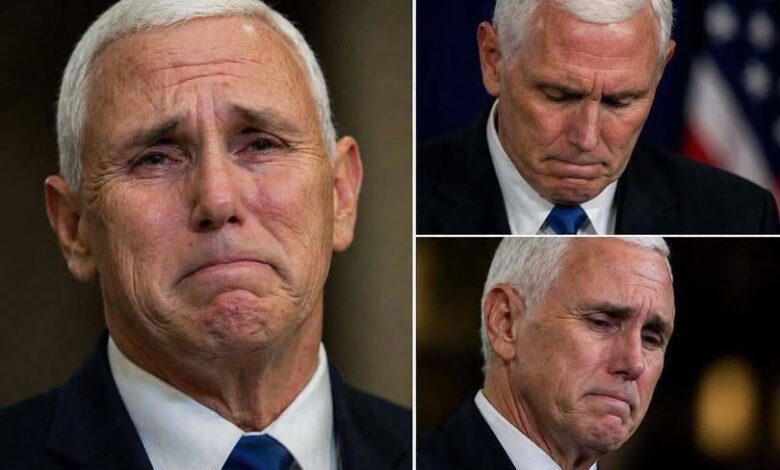
Mike Pence appears to be fighting a battle on two fronts—and losing ground on both.
Once one of the most recognizable figures in Republican politics, the former vice president now finds himself navigating a political landscape that has changed dramatically since he left office. Every public statement, every interview, and every carefully chosen criticism seems to reveal the same underlying reality: Pence is trying to reclaim influence in a party that no longer revolves around the principles he represents.
It is a difficult position to occupy.
On one side stands Donald Trump, the man whose presidency elevated Pence to the national stage and transformed him into a household name. On the other stands a Republican Party that has been fundamentally reshaped by the movement Trump created—a movement that increasingly values disruption over restraint and confrontation over consensus.
Caught between those forces, Pence is attempting to present himself as a voice of experience, stability, and conservative conviction.
The question is whether anyone is still listening.
His recent comments on CNN regarding the pause in weapons support for Ukraine offered a revealing glimpse into that struggle. Pence framed the issue as a matter of leadership, accountability, and responsible governance. His concerns suggested a belief that important national security decisions should emerge from clear processes, institutional coordination, and strategic planning.
The tone was familiar.
It was the language of a traditional Republican statesman—measured, serious, and focused on America’s role in the world.
Yet the reaction highlighted a deeper problem.
Rather than reinforcing his relevance, the remarks seemed to underscore how distant he has become from the political energy driving today’s Republican Party.
Pence is not simply arguing over policy details. He is defending an entire worldview.
For decades, mainstream Republican foreign policy emphasized American leadership abroad, strong alliances, military readiness, and an active role in shaping global events. It was a philosophy built around the belief that American strength projected stability and that engagement with the world served both national interests and broader democratic values.
Pence remains deeply rooted in that tradition.
When he warns about weakening America’s position internationally, criticizes isolationist tendencies, or emphasizes long-standing alliances, he is speaking from a framework that once defined Republican orthodoxy.
But the political environment has changed.
Many voters within the modern Republican coalition view those ideas differently. They are increasingly skeptical of foreign interventions, wary of international commitments, and distrustful of institutions they believe have failed to serve ordinary Americans. To them, appeals to traditional foreign-policy consensus often sound less like wisdom and more like a return to an era they believe should remain in the past.
That creates a serious challenge for Pence.
His arguments are often directed toward principles that no longer inspire the same enthusiasm they once did.
As a result, his message frequently struggles to find a political home.
If he stays silent, he risks fading further from public relevance.
If he directly attacks Trump, he risks alienating the voters whose support would be necessary for any future political role.
If he criticizes Trump cautiously—as he often does—he satisfies almost no one.
Supporters of Trump view him as insufficiently loyal.
Trump’s critics see him as unwilling to fully break away.
Traditional conservatives may appreciate his consistency and tone, but appreciation does not automatically translate into political influence.
The result is a sense of isolation that has followed Pence ever since the end of the Trump administration.
Ironically, that isolation stems in part from the role he once played within the movement itself.
When Trump first emerged as the dominant force in Republican politics, Pence served as an important bridge. He reassured evangelical voters. He appealed to traditional conservatives. He offered comfort to those who hoped Trump’s unconventional style could coexist with familiar Republican principles.
In many ways, Pence helped make Trumpism more acceptable to skeptical parts of the conservative movement.
But while he helped legitimize the political revolution, he never truly became its central figure.
The movement valued what he represented when it was useful.
When circumstances changed, so did that relationship.
The defining break came when Pence refused to challenge the certification of the 2020 election results. For many Americans, that decision represented a commitment to constitutional process and the rule of law. For some within Trump’s political base, it was viewed as a betrayal.
That moment permanently altered Pence’s standing inside the movement.
Since then, he has occupied a political middle ground that offers little comfort.
He is too closely associated with Trump to become a leading voice of anti-Trump conservatism.
Yet he is too independent of Trump to regain the trust of many of the movement’s most loyal supporters.
Few positions in politics are more difficult.
The broader transformation of the Republican Party has only intensified that challenge.
The center of political gravity has shifted away from traditional institutional conservatism and toward a style of politics defined by populism, cultural conflict, and open confrontation with established power structures.
Today’s Republican stars are often those who project combativeness rather than caution.
They are rewarded for challenging institutions, not defending them.
They thrive on conflict rather than consensus.
Pence, by contrast, continues to emphasize duty, responsibility, alliances, and constitutional principles. His message remains rooted in a version of conservatism that once dominated the party but now competes with newer priorities and political instincts.
Whether one agrees with him or not, his position increasingly resembles that of a man defending a shrinking political territory.
His comments on Ukraine therefore represent something larger than a disagreement over foreign policy.
They reveal a struggle over the identity of the Republican Party itself.
Pence is arguing for a vision of conservatism that emphasizes global leadership, institutional stability, and traditional governing principles.
Much of the modern Republican coalition is moving in a different direction.
That divergence explains why his public appearances often feel less like political momentum and more like acts of preservation.
He is trying to keep alive an approach to politics that once seemed permanent but now faces growing skepticism from within its own party.
In many respects, Pence’s predicament reflects one of the defining stories of modern Republican politics.
He helped usher in an era that ultimately left him behind.
He stood beside Trump during the movement’s rise.
He benefited from its success.
He reassured voters who worried about its unpredictability.
Yet as the movement evolved, it embraced Trump’s confrontational energy while largely discarding the restraint, discipline, and institutional loyalty that Pence represented.
That is why his political path appears so narrow today.
His challenge is no longer simply deciding how strongly to criticize Trump or how firmly to defend traditional conservative principles.
His challenge is finding a place within a political movement that has undergone a transformation he helped facilitate but no longer controls.
Every speech, interview, and public statement seems to raise the same unavoidable question.
Is Mike Pence offering a roadmap for the future of Republican politics?
Or is he speaking on behalf of a Republican past that many voters have already chosen to leave behind?
For now, the answer remains uncertain.
What is clear, however, is that the political tightrope he walks grows narrower with every passing year—and the distance between where he stands and where his party is heading appears larger than ever.