About twenty minutes after I ended the call, headlights swept across the rain-streaked windows of my clinic.
A black SUV pulled up beside the mailbox.
Behind me, Noah slept on the exam cot with one hand tucked beneath his cheek and the other resting near his head as if even sleep required protection.
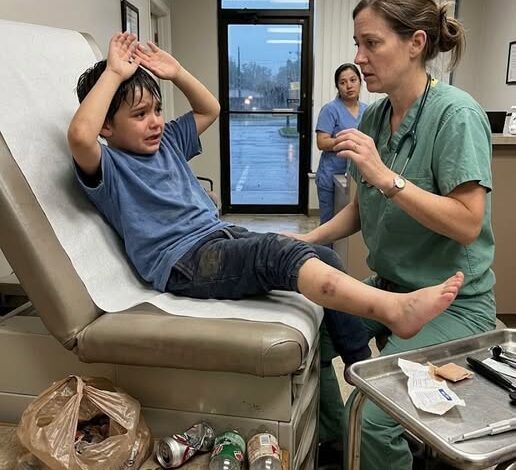
Beside the table sat the grocery bag he had carried through the rain.
Inside were twelve dollars in coins, two crushed cans, and three empty soda bottles.
That was everything my son had brought to pay for a broken leg.
And somehow, the money was the least frightening thing I had learned that night.
An hour earlier, I had been closing my neighborhood clinic after a long, miserable day.
Rainwater covered the entrance tile. The coffee had burned down to sludge. I was putting away supplies when a small figure appeared in the doorway.
He was soaked.
An oversized T-shirt clung to his shoulders. His sneakers squeaked against the floor. A plastic grocery bag was crushed against his chest.
“Doctor?”
His teeth were chattering.
“Can you fix me? I have money.”
Then he opened the bag.
Coins slid against the plastic.
Two crushed cans rolled beside three empty bottles.
“The recycling man said it’s twelve dollars,” he whispered. “I can bring more tomorrow.”
I forgot about closing.
His right leg was badly swollen and bent at an angle that made my stomach tighten.
I helped him onto the exam table.
“What’s your name?”
“Noah.”
I carefully pulled up his pant leg.
The fracture was serious.
Then I saw the bruises.
Some were fresh.
Others had faded yellow at the edges.
Marks from different days.
Different moments.
Every time I moved my hand near him, his whole body tightened.
I had treated frightened children before.
But his face was doing something to me.
The eyebrows.
The stubborn little chin.
Those large brown eyes.
For five years, I had trained myself not to search strangers for those features.
Not in grocery stores.
Not at playgrounds.
Not when a boy the right age passed me holding someone else’s hand.
Still, I asked.
“What’s your father’s name?”
Noah stared at his lap.
“Michael Hayes.”
My hands went cold.
Five years earlier, Michael Hayes had been my husband.
And Noah had been my baby.
When he was born, Michael’s family made their opinion of me painfully clear.
They had money.
Influence.
Connections.
His mother told me Noah deserved a life I could never give him.
Then she placed custody papers in front of me.
A check beside them.
I had been exhausted, terrified, and convinced that fighting people with that kind of power would destroy whatever future I had left.
So I signed.
For five years, I lived with that signature.
And now my son was sitting in front of me with a broken leg, trying to pay for medical care with bottles.
I forced my voice to remain calm.
“Noah, who hurt you?”
His shoulders folded inward.
“I was bad.”
“What happened?”
“I spilled water.”
He swallowed.
“And I didn’t clean it fast enough.”
Another pause.
“I fell asleep before I finished the dishes.”
He said it like he was confessing crimes.
I reached gently toward his ankle.
Noah jerked backward so violently that his shoulder struck the exam table.
Both hands flew over his head.
“Don’t hit me!”
I froze.
“Please,” he cried. “I’ll be good.”
I had to turn away for a second.
Then I lowered myself beside him.
“Noah, nobody is going to hit you here.”
He watched me with the terrible caution of a child who had learned every adult movement needed to be studied before it could be trusted.
At 6:18 p.m., I began documenting everything.
The fracture.
The bruises.
The older marks.
His reaction when I moved toward him.
I preserved the X-ray.
Photographed the grocery bag.
His worn sneakers.
The coins.
Five years earlier, I had learned what wealth and influence could do when powerful people wanted an inconvenient truth to disappear.
This time I wanted evidence.
Afterward, I warmed soup.
I gave him half a boiled egg from my lunch.
He ate slowly.
Carefully.
When he finished, he looked at the bowl.
“Do I wash it?”
My throat tightened.
“No.”
He looked uncertain.
“You can leave it.”
A few minutes later, he tried to stand.
Pain folded him immediately.
I caught him.
His hands grabbed my shirt.
Then he started apologizing.
“I’m sorry. I’m sorry. I’m sorry.”
For the first time in five years, my son was in my arms.
And he had no idea who I was.
Every part of me wanted to tell him.
But he had already carried too much for one evening.
His safety had to come first.
So I asked:
“If I take you back tonight, will someone hurt you?”
He didn’t answer.
His fingers tightened against my shirt.
Then he whispered:
“I’ll try not to cry.”
That was enough.
I opened another incident note.
Then I called the one number I had avoided for five years.
Michael answered on the second ring.
“Emma?”
“I found Noah.”
Silence.
“Is he with you?”
“Yes.”
I looked toward the cot.
“And I need you to tell me something. Did you know someone has been hurting him?”
Michael waited too long.
That pause wasn’t proof.
But it frightened me.
“No,” he finally said. “What do you mean?”
“His leg is broken. He has older bruises. When I reached toward him, he covered his head and begged me not to hit him.”
Michael stopped breathing for a moment.
Then:
“I’m coming.”
Twenty minutes later, the SUV arrived.
I stood between the entrance and Noah’s cot when Michael stepped inside.
He looked older.
Tired.
His expensive coat was soaked across the shoulders.
He barely looked at me.
His eyes went directly to Noah.
Then his face collapsed.
“Noah.”
Our son woke.
The instant he saw Michael, he did not smile.
He pulled the blanket higher.
Michael stopped walking.
That reaction told him more than anything I could have said.
“What happened?” he whispered.
Noah looked away.
Michael turned to me.
“I didn’t know.”
“Who has been caring for him?”
His eyes closed.
“My mother.”
Everything inside me went still.
Michael had been traveling constantly for work. His mother insisted Noah stay with her because she claimed stability was better than moving between homes.
“She told me he was doing well,” Michael said. “She sent pictures. School reports. She said his leg was hurt outside.”
“You believed her?”
The question came out hard.
Michael looked at me.
For once, he didn’t defend himself.
“Yes.”
He looked toward Noah.
“The same way I believed her five years ago.”
That silenced me.
Michael approached the cot slowly, then stopped several feet away.
“Noah?”
Our son watched him.
“Can I come closer?”
Noah shook his head.
Michael nodded.
“Okay.”
Then he sat on the floor.
No demands.
No “I’m your father.”
Just the floor.
A long minute passed.
“Did Grandma hurt you?”
Noah’s eyes filled.
He didn’t answer.
He didn’t have to.
Michael covered his mouth.
I saw the moment he finally understood.
The woman who had convinced both of us that she knew what was best for our son had apparently controlled far more than either of us realized.
I arranged Noah’s hospital transfer and made the required report.
Michael did not object.
For once, neither of us cared what his family would think.
Before the ambulance arrived, Noah looked at me.
“Doctor?”
“Yes?”
“Do I still owe you twelve dollars?”
I looked at the bag.
Then at him.
“No.”
He frowned.
“Why?”
I sat beside him.
“Because children don’t have to earn help when they’re hurt.”
He thought about that.
“Can I leave the bottles here?”
I smiled through tears.
“Yes.”
He let go of the grocery bag.
The plastic settled quietly against the floor.
Somehow, that tiny sound felt enormous.
Over the following days, the truth emerged slowly.
Michael’s mother was removed from Noah’s care while authorities investigated.
The fracture was treated.
The bruises were documented.
And Michael admitted something I never expected.
His mother had controlled far more of our divorce than I knew.
She told him I cared more about money than Noah.
She told me Michael wanted me gone.
We had both accepted stories about each other without asking enough questions.
That did not return five lost years.
Nothing could.
But it changed what happened next.
Michael and I did not magically become a family again.
We became two adults with one responsibility.
Noah.
Months later, after therapy, medical appointments, legal meetings, and more painful conversations than I could count, Noah returned to my clinic.
His cast was gone.
He walked carefully, but without pain.
He carried the same grocery bag.
For one terrible second, I thought it contained bottles again.
Instead, he opened it.
Inside was a drawing.
Three people stood beside a small building.
Michael.
Noah.
And me in a white coat.
Above us was a crooked yellow sun.
“What’s this?” I asked.
“My family.”
I couldn’t speak.
Noah glanced toward the cabinet where I had kept his original grocery bag folded away.
“You still have my bottles?”
“Yes.”
“Why?”
I looked at him.
“Because they remind me of the night you found me.”
He smiled.
“You found me too.”
That was the ending I had never allowed myself to imagine.
Not recovering the five years I lost.
Not pretending any of us had made perfect choices.
Just my son standing safely in front of me, knowing he did not need twelve dollars, empty bottles, perfect behavior, or anyone’s permission to deserve care.
Then he reached for my hand.
And this time, he knew exactly who I was.