Ellie stopped inside the emergency department as though the doctor’s question had physically struck her.
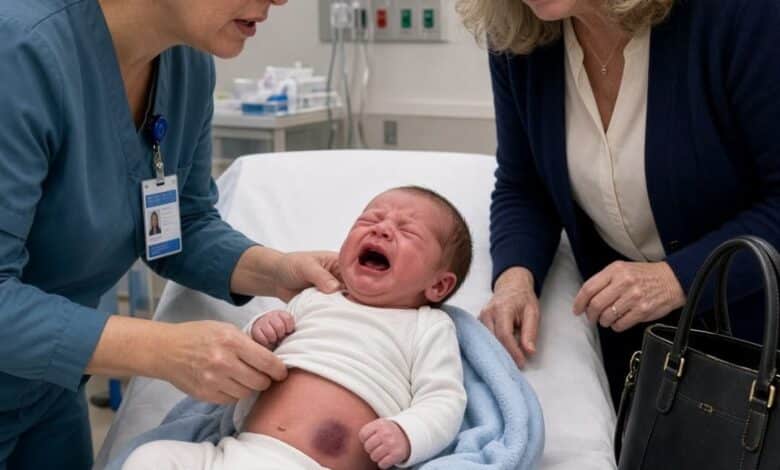
“Who was alone with Mason before his grandmother took over his care?”
I had been about to answer.
Then Thomas walked in behind his wife.
My son saw me, the pediatrician, and the nurse beside Mason’s bassinet.
The anger I’d heard over the phone disappeared.
For the first time that afternoon, Thomas looked frightened.
Not frightened for his baby.
Frightened for himself.
“Mom.”
I knew that voice. I’d heard it when he broke a neighbor’s window at seven, wrecked my station wagon at sixteen, and lost his first real job at twenty-three.
Thomas always sounded younger when he wanted me to rescue him from consequences.
This time, I stayed where I was.
Ellie stared at him.
Then she answered.
“I was packing Mason’s diaper bag. Thomas gave him the bath.”
“Ellie.”
She flinched.
The doctor noticed.
“Was anyone else in the bathroom?”
“No.”
“Did you see Mason before he was dressed?”
She shook her head.
“When I came in, the onesie was already on.”
Thomas stepped forward.
“This is getting completely twisted.”
Then he looked at me.
“Mom, tell them Mason cries like that all the time.”
Something inside me settled.
For sixty-four years, motherhood had meant stepping between my child and danger.
I had never imagined it might someday mean refusing to step between my child and the truth.
“He does not cry like that all the time.”
Thomas stared at me.
“You specifically told me not to remove his onesie.”
“I said we’d finally gotten him calm.”
“No. You told me not to take it off.”
“That doesn’t prove anything.”
“No,” I said. “But it’s what happened.”
Mason was taken for a more complete examination.
The next hour became a blur of questions, but I clung to the timeline.
2:16 p.m.
Thomas handed me Mason.
Thomas warned me not to remove his clothes.
Mason began screaming after his parents left.
He refused his bottle.
His abdomen felt wrong.
I opened the onesie.
I found the bruising.
I drove directly to the hospital.
Thomas called and demanded to know why I’d brought Mason there.
He reminded me that I hadn’t been supposed to undress him.
Then he told me not to tell the hospital anything else.
Facts sounded cold when arranged like that.
That afternoon, coldness helped.
It stopped me from editing the truth until my son looked better.
A hospital social worker spoke with us separately.
When Ellie returned, she sat two chairs away from me.
Her face was gray.
For several minutes she said nothing.
Then:
“He told me Mason hit the side of the baby tub.”
“When?”
“This morning.”
“Did you see an injury?”
“No.”
Her hands twisted together.
“He said there was a little red mark. Babies bruise easily.”
I looked at her.
“Did you hear anything?”
Her eyes filled.
“One scream.”
“What kind?”
She swallowed.
“Sharp.”
“Did you go in?”
“I started to.”
Her voice cracked.
“Thomas came out. He said Mason had slipped while he was lifting him, but he’d caught him.”
I looked toward the treatment area.
“And then?”
“Thomas dressed him.”
The missing pieces were connecting.
The scream.
The story about the tub.
The clothes Thomas didn’t want removed.
His panic when I went to the hospital.
Later, Thomas asked to speak with me privately.
I refused.
He tried again.
I refused again.
Finally, from across the waiting room, he said, “You’re making me look like some kind of monster.”
I almost laughed.
Even now, his first concern was how he looked.
“I haven’t made you look like anything. I’ve told them what happened.”
“You don’t know what happened.”
“Then tell them.”
He looked away.
Ellie stood.
“Tell me.”
“Not here.”
“Yes. Here.”
Thomas rubbed both hands across his face.
“Mason wouldn’t stop.”
Ellie stared at him.
“Wouldn’t stop what?”
“Crying.”
“He’s two months old.”
“I know that.”
“What did you do?”
Thomas’s eyes moved toward the treatment corridor.
“I was trying to dress him.”
“Thomas.”
“He kept screaming and moving.”
“And?”
His voice dropped.
“I held him down.”
Everything inside me went quiet.
Ellie whispered, “How?”
“Just with my hand.”
“Where?”
No answer.
“Across his stomach?”
Thomas closed his eyes.
That silence was enough to change the room, but it wasn’t the end of the medical or safety investigation. What he’d admitted still had to be considered alongside Mason’s examination and everything else the professionals were documenting.
“I didn’t mean to hurt him,” Thomas said.
Ellie backed away.
He reached toward her.
She recoiled.
And suddenly I understood why his warning had bothered me from the beginning.
Don’t take his onesie off.
Those weren’t instructions about keeping a baby comfortable.
They were instructions about keeping an injury unseen.
The hospital kept Mason under observation while the appropriate child-safety procedures began.
There was no cinematic moment where one confession settled everything.
There were medical findings.
Separate interviews.
Written statements.
Safety arrangements.
Questions that would take longer than one afternoon to answer.
But one thing was immediate.
Thomas was not simply taking Mason home.
Ellie decided she wasn’t returning to the apartment with him either.
When she told him, Thomas stared at her.
“You’re taking my son away?”
“You hurt him.”
“I lost my temper for one second.”
Ellie’s voice broke.
“You hurt him and then hid it.”
That distinction mattered.
A terrible second might explain how an injury began.
What happened afterward involved more decisions.
Dressing Mason.
Giving him to me.
Warning me not to uncover him.
Calling when he discovered we were at the hospital.
Telling me not to say more.
Thomas began crying.
Watching my grown son cry was almost unbearable.
I remembered holding him through fevers.
Bandaging scraped knees.
Sitting beside him when his childhood dog died.
Lending him money.
Answering midnight phone calls long after he had a family of his own.
I loved him.
That was the hardest truth of all.
Love didn’t disappear because I was horrified by what he’d done.
But love could no longer be used to hide it.
“Mom,” he said, “tell them I’ve never done anything like this before.”
“I can’t tell them what I don’t know.”
“You know me.”
“I thought I did.”
He looked as though I’d struck him.
Maybe part of me wanted to take the sentence back.
I didn’t.
“Tell them I’m exhausted,” he pleaded. “Tell them what having a newborn is like.”
“You can tell them.”
“You raised three kids. You know people lose patience.”
“Yes.”
I did know.
I knew exhaustion that made your bones hurt.
I knew babies screaming at three in the morning while you had work at seven.
I knew putting a crying child safely in a crib and walking into another room because you needed sixty seconds to regain control.
That knowledge did not help Thomas.
It made the distinction clearer.
“Do you think I meant to hurt him?” he asked.
I looked at my son.
“I don’t know exactly what was in your mind when it happened.”
His eyes lifted hopefully.
“But I know you realized afterward that Mason was hurt.”
His face fell.
“And instead of getting him help, you covered the injury.”
Thomas lowered his head.
There was nothing useful he could say to that.
When Mason was eventually cleared to leave under the safety arrangements that had been made, Ellie carried him.
I carried the diaper bag.
Thomas left separately.
Nobody applauded.
Nobody felt victorious.
There was only exhaustion.
In the weeks afterward, the process continued.
Medical records were reviewed. Questions were asked. Restrictions governed Thomas’s contact with Mason while the appropriate professionals and authorities worked through what had happened.
Ellie stayed elsewhere.
She struggled with her own guilt.
“I heard him scream,” she told me one night. “I should’ve gone in.”
“You started to.”
“And I let Thomas explain it away.”
I understood that sentence better than she knew.
Families become very skilled at accepting explanations from people they love.
Sometimes because the explanation sounds plausible.
Sometimes because the alternative is unbearable.
I had done versions of it with my own children.
Not with something like this.
But enough to understand the temptation.
Months later, Mason was lying against my chest after a bottle.
His stomach had healed.
The bruising was gone.
He was heavier now, round-cheeked and fascinated by ceiling fans.
He finished his bottle and made a tiny satisfied sound.
I looked down at him.
That afternoon at the hospital had changed the meaning of motherhood for me.
I’d spent most of my life believing protecting your children meant standing beside them when the world became cruel.
But Thomas wasn’t seven anymore.
He wasn’t the frightened little boy who needed me to negotiate with a neighbor over a broken window.
He was a thirty-four-year-old father.
And Mason was the child who needed protection.
Thomas once believed that calling me Mom would automatically put me on his side.
He was wrong about what my side was.
My side was not Thomas.
It wasn’t Ellie.
It wasn’t even Mason in some sentimental sense.
My side was the truth about what happened to a baby who could not speak for himself.
That didn’t require me to stop loving my son.
It required me to stop confusing love with rescue.
I still have the blue blanket I wrapped around Mason before driving to St. Vincent’s.
Sometimes when I fold it, I remember how light he felt in my arms.
And I remember the strange instruction Thomas gave me before leaving:
Don’t take his onesie off.
For weeks, I thought those were the words that changed everything.
Eventually, I realized they weren’t.
The words only revealed the choice Thomas had already made.
The choice that changed everything was mine.
When I saw what was underneath, I didn’t call my son and ask for an explanation.
I didn’t cover Mason again and wait for his parents to return.
I didn’t tell myself families should handle these things privately.
I picked up my grandson and took him where other people could see what I had seen.
For the first time in my life, protecting my family meant refusing to protect my own child from the consequences of the truth.
And if I had to make that choice again, I would make it before the phone could ring.