A Single Mom Was Sleeping in Seat 8A—Until the Captain Asked Over the Intercom, “Is There a Fighter Pilot on Board?”

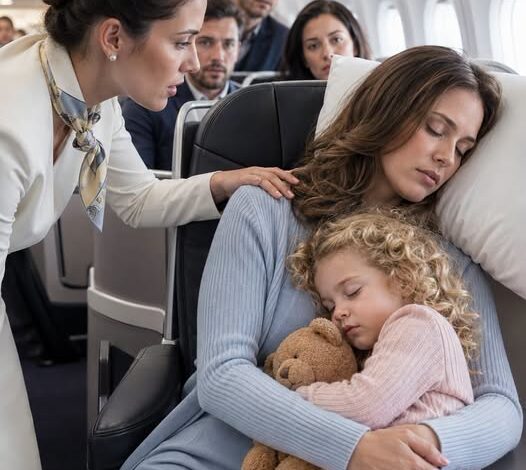
The captain’s voice woke Laura Vance two hours into the overnight flight from New York to Madrid.
“If there is anyone aboard with military fighter-pilot experience, please identify yourself to the cabin crew immediately.”
Nearly three hundred passengers went silent.
Laura remained in seat 8A, staring through the window at the black Atlantic below.
She was thirty-eight, dressed in a green sweater and jeans, with an airline blanket across her knees. Nothing about her suggested that eighteen months earlier she had been Major Laura Vance, an F-16 pilot with thousands of military flight hours behind her.
She had left that life for a reason.
Her wingman, Captain Gabriel Torres, had died during a training mission after his aircraft suddenly became uncontrollable. Laura had been beside him, ordering him to eject while listening to his breathing deteriorate over the radio.
He never got out.
Investigators eventually called the crash a mechanical failure.
Laura called it the moment she failed someone who trusted her.
She resigned.
Now she wanted anonymity, not heroism.
Then the announcement came again.
This time, the captain sounded less controlled.
A flight attendant hurried down the aisle.
“Does anyone here have military aviation experience?”
Laura closed her eyes.
She could remain silent.
Nobody knew who she was.
Then she looked across the cabin.
Children were waking. Couples were holding hands. An elderly woman was praying quietly.
Laura unbuckled.
“I do.”
The attendant stopped.
“You’re a pilot?”
“Former Air Force. F-16s.”
The man beside Laura stared at her.
“You?”
Laura ignored him.
The attendant motioned urgently toward the front.
“Please come with me.”
The cockpit door opened seconds later.
Captain Andrew Keller sat rigidly in the left seat. The first officer was unconscious in the right, oxygen strapped over his face.
Andrew gave Laura one skeptical glance.
“When did you last fly?”
“Eighteen months ago.”
“That’s a long time.”
A violent shudder passed through the aircraft.
Laura immediately looked toward the flight-control displays.
“That isn’t turbulence.”
Andrew’s expression changed.
“No.”
He explained quickly.
The autopilot had disconnected without command. Flight-control computers were generating contradictory warnings. Moments later, the first officer complained of numbness, blurred vision, and weakness before collapsing.
The aircraft rolled slightly right.
Andrew corrected.
Laura watched the controls.
“Ease off.”
“What?”
“You’re fighting the computer.”
He stared at her.
“That input isn’t coming from the airplane. One of the control channels is feeding you false commands.”
Andrew hesitated only a second before isolating a secondary channel.
The vibration stopped.
For the first time, he looked at Laura differently.
Then a doctor appeared behind them.
“I examined your first officer,” he said. “This may be poisoning.”
Laura turned sharply.
“What did he drink?”
Andrew pointed toward the console.
“Coffee.”
Except the thermos that had been there minutes earlier was gone.
Nobody spoke.
Then the cockpit keypad chimed.
Someone outside was trying to gain access.
Andrew checked the security display.
His face hardened.
“Richard Sterling.”
“Who?”
“Director of Flight Operations.”
The interphone rang.
The lead attendant’s frightened voice came through.
“Captain, Mr. Sterling is demanding access. He says corporate authority gives him the right to enter.”
Laura looked at Andrew.
“Don’t open that door.”
A warning sounded.
Hydraulic pressure on the right landing-gear system was dropping.
The nearest suitable airport was now on the coast of northern Spain, under heavy rain and strong crosswinds.
Andrew began the descent.
Laura slipped into the empty first-officer seat.
“You’ve never landed this aircraft,” he said.
“No.”
“That concerns me.”
“It concerns me too.”
Laura tightened the harness.
“But I know what a failing airplane feels like.”
As the runway emerged through sheets of rain, Andrew lowered the gear.
Two green indicators appeared.
The right main gear remained uncertain.
“If it folds on touchdown,” Andrew said, “we may leave the runway.”
Laura placed her hands on the controls.
“I’ll keep the wing up as long as I can.”
The jet crossed the threshold.
Main wheels touched.
The right side dipped violently.
Passengers screamed behind them.
Laura countered with rudder and asymmetric thrust while Andrew fought the aircraft straight.
Then came a brutal metallic thump.
The right gear locked.
Reverse thrust roared.
The airliner slowed.
Finally, it stopped.
For several seconds, the cockpit contained nothing but breathing.
Then cheering erupted throughout the cabin.
Laura did not celebrate.
Because Richard Sterling had known her name.
She discovered that moments later.
Spanish police boarded immediately.
Sterling was detained near the forward exit.
As officers escorted him past Laura, he smiled.
“Major Vance.”
Laura froze.
Andrew stepped beside her.
“You know her?”
Sterling’s smile widened.
“I know why she stopped flying.”
The investigation unraveled quickly after that.
Sterling had spent years running a procurement fraud scheme involving counterfeit aviation components and falsified maintenance records. An internal audit threatened to expose millions in stolen funds.
Flight 412 carried electronic records that could prove it.
Investigators concluded the first officer had been deliberately drugged. The flight-control faults had been engineered to overwhelm the cockpit during an Atlantic crossing, where a crash could conveniently destroy both passengers and evidence.
But Sterling’s connection to Laura reached further back.
His former defense company had supplied compromised avionics components to her military unit.
Including Gabriel Torres’s aircraft.
Laura learned the truth in a quiet investigation room forty-eight hours later.
A federal investigator placed a file in front of her.
“The failure that killed Captain Torres was not pilot error.”
Laura stared at him.
“We knew that.”
“You didn’t know the component had been knowingly passed through inspection.”
She stopped breathing.
The investigator turned another page.
“There’s something else.”
It was Gabriel’s final transmission.
Laura read the transcript.
His last words were not panic.
They were about her.
Tell Laura it wasn’t her fault. The controls locked. She did everything right.
Laura covered her mouth.
For eighteen months, she had replayed that flight in her head, searching for the command she should have given sooner, the maneuver she should have seen coming, the mistake she believed she had made.
Gabriel had died knowing she had not failed him.
Weeks later, Laura visited his mother in Texas.
The woman opened the door and embraced her before Laura could finish saying hello.
“I’m sorry,” Laura whispered.
“For what?”
“I couldn’t bring him home.”
Gabriel’s mother pulled back.
“You carried that boy with you long enough.”
Laura began crying.
“You didn’t abandon him,” the woman said. “But you have been abandoning yourself.”
That sentence followed Laura home.
She did not reenlist.
She did something she once believed she would never do again.
She returned to aviation.
Months later, Laura stood inside a commercial flight academy before twenty-four new pilots.
Her old F-16 helmet rested on the desk.
The students expected war stories.
Instead, Laura wrote one sentence across the board.
THE AIRCRAFT DOESN’T CARE WHO YOU USED TO BE.
She faced them.
“Your medals won’t save you. Your title won’t save you. Pride definitely won’t save you. What matters is whether you can recognize reality faster than fear convinces you to ignore it.”
Years afterward, newspapers still called her the woman from seat 8A who saved Flight 412.
Laura disliked the description.
Andrew had landed the airplane.
Cabin crew had protected the passengers.
A doctor had recognized poisoning.
Investigators had uncovered the sabotage.
Nobody had saved everyone alone.
One afternoon, Laura received a letter.
It came from a boy who had been aboard that flight.
I was in row six. Everyone looked scared. When you walked toward the cockpit, you looked at me and nodded. I thought that meant we were going to live. I start flight lessons tomorrow.
Laura read it twice.
Then she placed it beside Gabriel’s photograph.
Outside her office, a training aircraft accelerated along the runway and lifted into the blue.
For years, every climbing airplane had reminded Laura of someone falling.
That afternoon, it didn’t.
She stepped toward the window and watched until the aircraft became a silver point against the sky.
Then she smiled.
Not because the past had disappeared.
Because it no longer owned the horizon.