The smell hit me before I saw it.
One moment, I was enjoying the quiet beauty of an ordinary morning. The next, I was standing frozen in my garden, fighting the urge to gag.
The sun had only just begun climbing above the horizon, bathing the yard in soft gold. Dew sparkled across the grass like scattered crystals, and the air carried the familiar scent of damp earth and blooming flowers. It was my favorite time of day—the brief stretch of peace before emails, phone calls, and responsibilities took over.
Coffee mug in hand, I wandered toward the flowerbeds to begin my usual routine.
Then the odor arrived.
It rolled across the yard like an invisible wave.
Rotting meat.
That was the only way to describe it.
The stench was so strong it seemed to coat the inside of my nose and throat. My eyes watered instantly. I lowered my mug and looked around, searching for the source.
“Good lord…”
My first thought was that an animal had died somewhere nearby.
A squirrel, maybe.
A bird.
Something small hidden beneath the bushes.
I walked carefully through the garden, scanning every corner. The smell grew stronger with each step until it became almost unbearable.
Then I saw it.
At first, I thought it was a piece of flesh.
Something red and wet lying among the grass.
I stopped moving.
The object sat near the edge of a flowerbed, partially hidden beneath a cluster of plants. Even from several feet away, it looked wrong.
Terribly wrong.
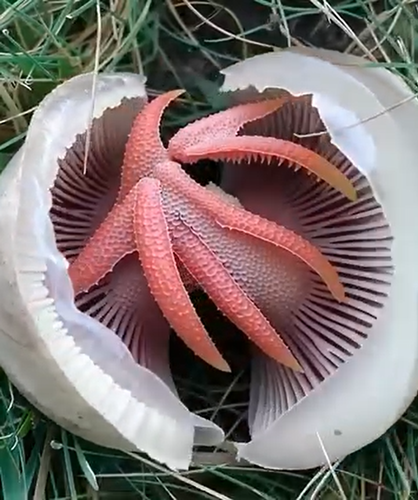
The thing was bright crimson, far too vivid to seem natural. Several long, finger-like structures stretched upward from a central point, twisted and curled as though frozen in the middle of movement.
For a brief, irrational moment, it looked alive.
My pulse quickened.
The morning suddenly felt much less peaceful.
I took another cautious step.
The strange growth glistened under the sunlight. A dark, sticky substance coated portions of its surface, reflecting light like fresh oil.
And that smell.
The closer I got, the worse it became.
Every instinct told me to back away.
Instead, curiosity rooted me to the spot.
“What are you?”
The question escaped my lips before I realized I had spoken aloud.
The object seemed almost alien.
Its red tendrils spread outward like claws emerging from the soil. The tips narrowed into sharp points stained with black slime that looked disturbingly similar to coagulated blood.
My imagination immediately went into overdrive.
Had some animal dragged remains into my yard?
Was it part of a carcass?
Something unearthed by raccoons during the night?
The possibilities became increasingly disturbing.
Unable to make sense of it, I pulled out my phone.
If nothing else, I wanted proof that I wasn’t imagining what I was seeing.
I snapped several photos from different angles.
Looking at the images somehow made the thing even more unsettling.
The camera captured details I hadn’t fully noticed before—the glossy texture, the twisted limbs, the grotesque contrast between the vivid red structure and the dark coating clinging to its surface.
I opened my browser.
After a moment of hesitation, I typed:
“Red slimy thing that smells like rotting meat.”
The results appeared instantly.
And within seconds, my fear began to transform into disbelief.
Devil’s Fingers Mushroom.
Anthurus archeri.
Photo after photo matched exactly what stood in my garden.
I stared at the screen.
Then back at the fungus.
Then back at the screen again.
Relief washed over me.
It wasn’t a dead animal.
It wasn’t some horrifying creature.
It was a mushroom.
A mushroom.
Granted, it looked like something that had escaped from a horror movie, but it was still just a fungus.
As I continued reading, my fascination grew.
Originally native to Australia and Tasmania, Devil’s Fingers had spread to various parts of the world over time. Though uncommon, sightings occasionally appeared in gardens, forests, and parks far from its original habitat.
What made it so memorable was its appearance.
And its smell.
The odor, I learned, wasn’t accidental.
It was a carefully evolved survival strategy.
The fungus mimics the scent of decaying flesh to attract flies.
Those flies land on the dark slime coating the fungus, unknowingly collecting spores before carrying them elsewhere.
Nature had essentially created a biological scam.
The fungus pretended to be a rotting corpse, and insects fell for it every time.
The more I read, the more incredible it became.
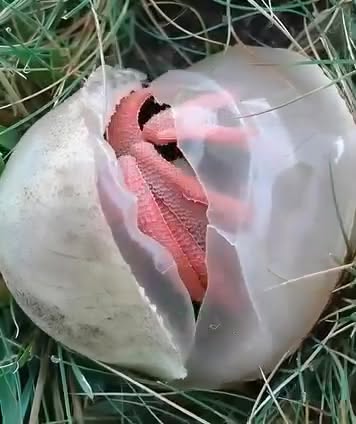
Before developing its eerie fingers, the fungus begins life inside a pale egg-like structure hidden beneath the soil.
When conditions are right, the outer layer ruptures.
Then the red arms emerge.
Slowly.
Deliberately.
Unfolding like something awakening from underground.
Suddenly, the image before me felt less disgusting and more fascinating.
I crouched several feet away and studied it carefully.
The structure possessed a strange elegance.
Each crimson arm curved differently, creating an almost artistic arrangement. Sunlight reflected across the wet surface, making the fungus appear as though it were moving even when perfectly still.
It was grotesque.
Yet somehow beautiful.
Nature often seemed to work that way.
We tend to associate beauty with flowers, butterflies, and songbirds.
But evolution doesn’t care about human preferences.
Evolution rewards effectiveness.
And by that standard, Devil’s Fingers was a masterpiece.
Its color attracted attention.
Its smell attracted insects.
Its shape maximized exposure of spores.
Every disturbing feature existed for a reason.
The realization shifted something in my perspective.
Hours earlier, I had looked at the fungus and seen danger.
Now I saw adaptation.
Survival.
Millions of years of refinement expressed through one bizarre organism.
Over the next few days, I found myself returning repeatedly to that corner of the garden.
Part of me hoped it would disappear.
Another part hoped it wouldn’t.
Each visit revealed new details.
The soil surrounding the fungus was rich with mulch and decaying organic matter—the perfect environment for growth. Tiny insects hovered nearby, drawn by the odor exactly as evolution intended.
Online forums warned that spores could remain dormant underground for extended periods before producing new fruiting bodies.
That knowledge added an unexpected sense of mystery to my garden.
Every patch of soil suddenly seemed capable of hiding secrets.
I eventually shared photographs with a local mycology group.
The responses poured in quickly.
Several experts confirmed the identification and expressed excitement over the sighting.
Apparently, Devil’s Fingers remained relatively uncommon in the area.
What had begun as a frightening discovery became an opportunity to contribute valuable observations to citizen science efforts.
Looking back now, I realize the fungus taught me something far more important than fungal biology.
It reminded me how easily fear grows from misunderstanding.
The moment I saw those crimson fingers emerging from the grass, my imagination filled the gaps with worst-case scenarios.
But reality turned out to be far more interesting than fiction.
What seemed monstrous was simply nature doing what nature does.
Adapting.
Surviving.
Evolving.
Even today, whenever I walk through my garden in the early morning light, I glance toward that flowerbed.
The fungus is gone.
The smell has long since vanished.
Yet the memory remains vivid.
Not because of the fear I felt.
But because of the wonder that followed.
The world is filled with things that appear strange, unsettling, or even frightening at first glance. Sometimes all it takes is curiosity and understanding to reveal the remarkable truth beneath the surface.
That bizarre red organism didn’t ruin my peaceful morning.
It transformed it.
And every time I think about those crimson fingers rising from the soil like something from a nightmare, I’m reminded that nature’s greatest wonders are often the ones we least expect to find waiting in our own backyard.