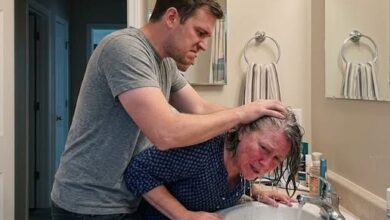
Before my 19-year-old son d!ed, he donated his heart to an 18-year-old girl — after the transplant, her mother handed me a letter from my son that began, “Mom, there’s something you need to know about her.”

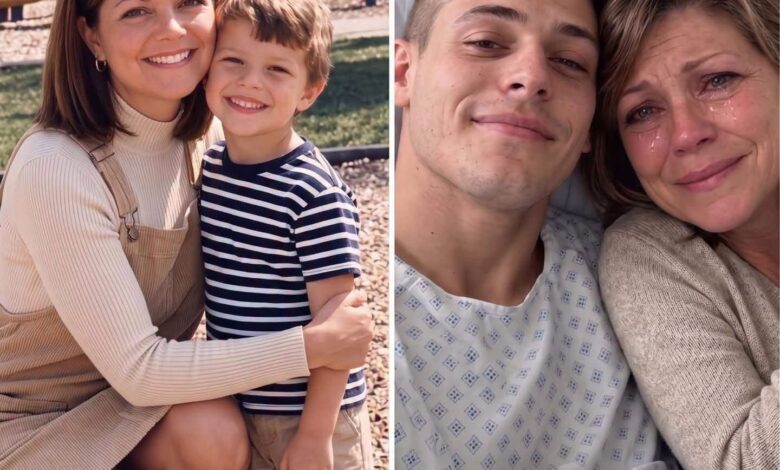
My husband had been dead for seven years when a doctor looked me in the eye and told me he was alive.
By then, our nineteen-year-old son Caleb was dead.
And his heart was beating inside an eighteen-year-old girl named Maya.
I had raised Caleb alone after Richard’s supposed death. When Caleb collapsed at nineteen and was diagnosed with a progressive neurological disease, I fought the diagnosis with everything I had.
I sold my car.
I sold family jewelry.
I emptied savings meant for his future.
None of it stopped the disease.
Near the end, Caleb took my hand in the hospital.
“Mom, if my organs can help somebody after I’m gone, let them.”
Accepting his decision felt like admitting he was going to die.
But it was his body, his final wish, and eventually I nodded.
After his death, I was told his heart had been transplanted into an eighteen-year-old recipient.
Then, at Caleb’s funeral, a woman named Sarah approached me.
“My daughter received your son’s heart.”
She handed me an envelope.
“He wanted you to have this.”
I recognized Caleb’s handwriting.
Or thought I did.
The letter began:
Mom, there’s something you need to know about her.
It claimed Caleb had met Maya in the hospital. According to the letter, she had been desperately ill, drawing pictures of the ocean while waiting for a transplant. Caleb supposedly learned she might be compatible and took comfort in imagining his heart giving her the future he would never have.
Two days later, I met Maya.
She was pale, thin, and recovering from major surgery.
Without saying much, she took my hand and placed it over her chest.
I felt the heartbeat.
Strong.
Steady.
Alive.
I broke.
For months afterward, Maya became part of my life.
I brought her food. Helped during rehabilitation. Listened while she talked about art school and the places she wanted to see.
Caring about her did not replace Caleb.
Nothing could.
But grief stopped feeling quite so empty.
Then I noticed the sketchbook.
It was sticking out of Maya’s backpack.
Brown leather.
Worn corners.
I recognized it immediately.
Inside the cover were two handwritten words:
Caleb Vance.
“Where did you get this?”
Maya hesitated.
“Caleb gave it to me.”
“When?”
“In the hospital.”
Something inside me shifted.
Caleb had guarded those old sketchbooks fiercely.
A week later, while cleaning his bedroom, I discovered his journal beneath the mattress.
I read the entries from his final months.
His fear.
His pain.
His worries about me.
His decision to become a donor.
But there was no Maya.
Not once.
Then I found an entry written shortly before he died.
Caleb wrote that he did not know who might eventually receive his organs.
I pulled out the letter Sarah had given me.
Under a bright lamp, the handwriting suddenly stopped looking perfect.
The loops were slightly wrong.
The crosses on certain letters were too deliberate.
Someone had copied my son’s handwriting.
Caleb had not written that letter.
The next morning, I brought both documents to Dr. Harrison, one of the physicians familiar with Caleb’s case.
“I want the truth.”
He examined them for a long time.
Then he said something I never expected.
“There are serious irregularities here that need investigation.”
Records were reviewed.
Questions multiplied.
The truth did not emerge in one dramatic confession. It came through documentation, interviews, transplant records, financial records, and eventually federal investigators.
And at the center of it was a man I had mourned for seven years.
Richard.
My husband had never died.
His supposed drowning had been staged while he was facing exposure over a major financial crime.
He disappeared under another identity.
And there was something else.
Before vanishing, Richard had fathered another child.
Maya.
The girl carrying Caleb’s heart was his biological half-sister.
I remember sitting perfectly still when investigators explained it.
“No.”
But there were records.
Dates.
DNA evidence.
Evidence that did not disappear simply because I couldn’t bear it.
Maya’s mother, Sarah, had not known the whole truth either.
Richard had manipulated people on both sides.
The forged letter had been part of that manipulation.
Investigators also examined whether anyone had improperly interfered with the transplant process. I learned quickly that organ allocation was far more regulated and complicated than Richard’s invented story suggested; he could not simply decide where Caleb’s heart went because he wanted it there.
What could be established was disturbing enough: Richard had secretly tracked both children, exploited information he should never have possessed, and constructed the letter so that after the transplant, Sarah and I would meet.
He wanted Maya connected to me.
He wanted me connected to her.
Perhaps he imagined that made his deception merciful.
It did not.
By the time authorities reached him, Richard had surrendered and was facing the consequences of the financial crimes and the newer conduct investigators had uncovered.
I did not visit him.
Instead, I went to see Maya.
She was sitting beside a rehabilitation-center window painting the ocean.
When she saw me, she smiled.
“Mrs. Vance?”
I stopped in the doorway.
Now that I knew, I could see Richard in her face.
But I could see something of Caleb too.
Not because they shared a father.
Because both of them loved to draw.
Both tilted their heads when concentrating.
Both had futures they had once been afraid they would never get.
Maya noticed my expression.
“Are you okay?”
I sat beside her.
“There’s something I need to tell you.”
The words frightened me.
For a moment, I considered protecting her from everything.
But Richard had already done enough damage by deciding which truths other people were allowed to know.
I would not continue that pattern.
So I told Maya carefully.
I told her the letter was not Caleb’s.
I told her that what we had believed about their supposed hospital friendship wasn’t supported by Caleb’s own journal or the investigation.
Then I told her about Richard.
Her father.
My husband.
Caleb’s father.
I watched confusion move across her face before understanding arrived.
“No.”
It was the same word I had used.
“I’m sorry.”
She stood so quickly the easel shook.
“Caleb was my brother?”
“Yes.”
Her hand went instinctively to her chest.
Then she began crying.
I reached for her but stopped before touching her.
This truth belonged to Maya now.
So did the choice of whether she wanted comfort from me.
After several seconds, she reached for my hand herself.
I held it.
“He didn’t choose me?”
“No.”
Her face crumpled.
“Then everything was fake.”
“No.”
I squeezed her hand.
“The letter was fake. Richard’s story was a lie. But Caleb really chose to donate. He really wanted whoever received what he could give to have a life.”
Maya looked down at her chest.
“He just didn’t know it would be me.”
“No.”
She cried harder.
Somehow, that truth became more meaningful than the invented version.
Caleb had not needed to know Maya.
He had not needed destiny, a secret romance, or a miraculous match arranged by fate.
He had chosen generosity toward a stranger.
And through circumstances neither of them controlled, that stranger happened to be his sister.
The months that followed were difficult.
Maya needed space.
So did I.
Sarah had her own betrayal to process.
Investigators continued untangling Richard’s actions.
There were no magical answers that transformed what he had done into love.
He had abandoned one family.
Deceived another.
Manipulated grief.
Forged our dead son’s voice.
Whatever good he imagined might result did not make those choices good.
But Richard had also failed at something else.
He had tried to control what Caleb’s gift meant.
He couldn’t.
That meaning belonged to Caleb.
A year later, Maya started art school.
On her first day, she came to my house carrying the old leather sketchbook.
“I think this belongs here.”
I looked at Caleb’s name inside.
“You can keep it.”
“Are you sure?”
I nodded.
“But there’s something you should know.”
“What?”
“Caleb hated people touching his sketchbooks.”
Maya looked horrified.
Then I smiled.
“He also would have been unbearably pleased that another artist wanted one.”
She laughed.
For a moment, I heard something familiar in it.
Not Caleb exactly.
Just life.
Before leaving, Maya hugged me.
I could feel the rhythm inside her chest.
I no longer pretended it meant Caleb was physically still here.
Maya was not a vessel for my son.
She was herself.
Her life belonged to her.
But Caleb had given a stranger a chance to keep living.
That stranger became someone I loved.
Not because Richard planned it.
Not because a forged letter instructed me to.
And not because grief demanded a replacement for the child I lost.
I loved Maya because after every lie had been stripped away, we chose to remain in each other’s lives.
That became the part Richard could never manufacture.
Caleb’s final gift had never been a secret message from beyond the grave.
It was simpler than that.
He knew he was dying.
Someone else wasn’t ready to.
So he gave what he could.
And in the end, the most beautiful part of my son’s story was the one nobody needed to forge.