The suitcase scraping across my daughter’s bedroom floor was the moment I stopped thinking Maya was simply skipping school.
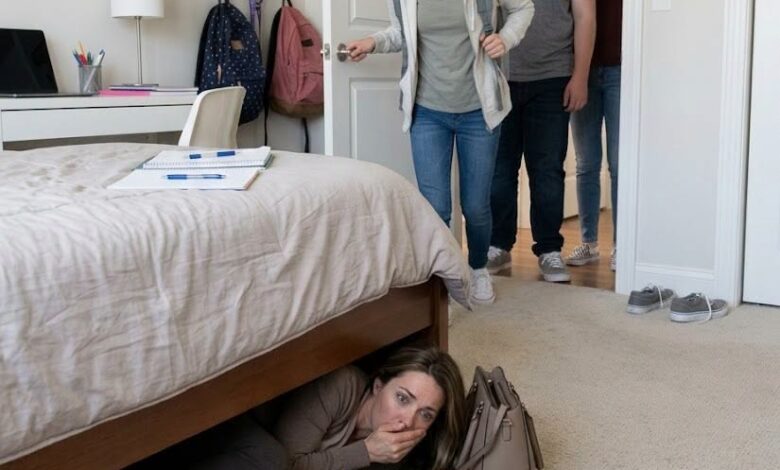
I was still wedged beneath her bed, one cheek pressed into the carpet, when two small wheels rolled into view. The black carry-on was packed so tightly the zipper bowed at the corners.
Maya dragged it toward the youngest child in the room.
“You can take my sweatshirt,” she whispered. “There’s food in the side pocket.”
My stomach dropped.
They weren’t sneaking home to fool around.
Someone was planning to disappear.
I crawled out.
Maya screamed.
One boy slammed backward into her desk. Another immediately stepped between me and a younger girl curled near the wall.
My daughter stared at me as though I were the intruder.
“Mom?”
“Yes.”
“You were under my bed?”
“Yes.”
“That’s incredibly weird.”
“Agreed. Now tell me why there’s a packed suitcase in your room at nine-thirty on a school morning.”
Nobody answered.
I raised both hands.
“I’m not angry right now. I need to understand what’s happening.”
Maya’s face crumpled.
“I was going to tell you.”
“When?”
“When I knew Evelyn was safe.”
The younger girl looked up.
She couldn’t have been older than nine.
Her name was Evelyn. The older boy beside her was her brother, Benjamin. The third child was one of Benjamin’s friends.
They all looked exhausted.
Not mischievous.
Afraid.
I noticed things I had missed from beneath the bed: Evelyn tugging one sleeve over her wrist, Benjamin checking the hallway every few seconds, Maya’s half-empty backpack beside the dresser with water bottles and granola bars stuffed inside.
Suddenly, weeks of strange behavior made sense.
The missing food.
Maya washing her uniform late at night.
Her poor sleep.
The way she jumped whenever her phone buzzed.
I lowered myself onto the floor.
“Start at the beginning.”
Benjamin did.
Things at home, he said, had been getting worse for months.
Their father’s temper was unpredictable. He confiscated phones when he thought the children were talking about him. He stood in doorways during arguments so nobody could leave. He punched walls close enough to frighten them.
And he constantly repeated one rule:
Family problems stayed inside the family.
Two nights earlier, Evelyn had been hurt while trying to get away from an argument.
Benjamin stopped there.
I didn’t force him to continue.
“How long have you been coming here?”
“Almost three weeks,” Maya admitted.
Three weeks.
On mornings when Benjamin sent a certain message, the children would leave school or avoid going altogether and come to our house after I left for work.
Sometimes they returned later.
Sometimes they stayed until dismissal.
My thirteen-year-old daughter had been running an unofficial safe house using crackers, clean clothes, Band-Aids, and an empty bedroom.
I wanted to be furious.
Part of me was.
But another part understood exactly how a child arrives at a terrible solution when every better option seems dangerous.
I pointed toward the suitcase.
“What’s that for?”
Evelyn whispered, “I don’t want to go home tonight.”
Maya immediately defended herself.
“I told her she couldn’t just disappear. I told her we needed an adult.”
I stared at her.
“You have an adult.”
Her eyes filled.
“I didn’t know if you’d listen before you called her dad.”
That silenced me.
I almost said, Of course I would.
But would I have?
Yesterday morning I had believed my daughter was sneaking home with bad influences.
If Maya had told me only that two children were skipping school and hiding in our house because they were afraid of their father, would my first instinct have been to contact him?
The hesitation on my face must have answered for me.
“I won’t call him,” I said.
Evelyn finally looked directly at me.
“Are you making us leave?”
“No.”
Benjamin’s shoulders loosened slightly.
“Nobody goes anywhere alone. And before I call anyone, I’ll tell you what I’m doing.”
Maya covered her face.
A sob slipped out.
I wanted to hug her.
Instead, I asked the questions that mattered first.
Did anyone need immediate medical help?
Did their father have weapons?
Did he know my address?
That last question produced four uncertain looks.
Then Benjamin’s phone vibrated.
His entire body stiffened.
Maya read the message over his shoulder and stood so quickly she kicked the suitcase.
“He knows.”
Benjamin handed me the phone.
His father wanted to know where they were.
A second message appeared while I was reading.
I’m coming to get you.
“How does he know where?”
Benjamin went pale.
“He went through my messages before. Maybe he remembers the street.”
That possibility ended the discussion.
I locked the doors.
Checked every entrance.
Then called for help.
I explained that several minors were inside my house, two said they were afraid to leave with a parent, and that parent might be coming here.
The dispatcher stayed calm.
So did I.
Mostly.
While I was still talking, a car door slammed outside.
Every child froze.
Three hard knocks hit the front door.
Benjamin whispered, “That’s him.”
Evelyn backed into the wall.
Maya immediately moved in front of her.
I pulled my daughter aside.
“No.”
She looked startled.
“You do not stand between someone and danger. That is my job.”
I walked into the hallway but stayed away from the door.
Their father called their names from outside.
His voice was controlled.
That frightened me more than yelling would have.
“Sarah Jenkins?”
I didn’t answer that.
“The children are safe,” I said through the door. “Help is on the way. Nobody is leaving until this can be handled safely.”
“You have my children in your house.”
“I have children telling me they’re afraid.”
“They’re kids.”
“Yes.”
“They lie.”
Behind me, Benjamin flinched.
Then came the version of events he wanted me to accept.
His daughter had behavior problems.
His son was defiant.
My daughter was helping them skip school.
I was interfering in a private family matter.
And that was when I understood why Maya had been scared to involve adults.
Parts of his story were true.
The children had skipped school.
Maya had lied.
They had entered my house without permission.
Every bad decision they’d made could be stacked neatly in front of the reason they made it.
He tried my doorknob once.
Evelyn whimpered.
Something inside me became very calm.
“Do not touch my door again.”
Across the street, Mrs. Gable stepped onto her porch with her phone raised.
The father noticed.
His voice immediately softened.
“Evelyn, sweetheart. Come outside. We’re going home.”
She started shaking.
Benjamin stepped behind me.
“We’re not coming out.”
“You don’t know what you’re doing,” his father replied.
“Yes, I do.”
“You’re embarrassing this family.”
Benjamin’s face tightened.
Then he shouted:
“Maya didn’t make us do anything! I asked her for help!”
Silence.
“I told her Evelyn was scared. I asked her for somewhere you wouldn’t look.”
Maya stared at him.
And every story I had invented about my daughter over the past twenty-four hours collapsed.
She wasn’t being dragged into trouble.
She had become the person frightened children ran toward.
The problem was that she had been too young to know what to do once they arrived.
When authorities came, nobody rushed the children straight back outside.
Everyone was separated.
The children were interviewed independently.
So was their father.
So was I.
Mrs. Gable explained exactly what she had witnessed: him arriving angry, calling for the children, and testing my locked door.
She didn’t exaggerate.
She didn’t need to.
By afternoon, a temporary safe arrangement had been made for Evelyn and Benjamin while the situation was investigated properly.
Before Evelyn left, she picked up the black suitcase.
Then she looked at me.
“Are you mad at Maya?”
I thought carefully.
“No.”
Maya looked surprised.
“But we have a serious conversation coming.”
Evelyn frowned.
“For helping me?”
“Helping you wasn’t the part she did wrong.”
My daughter lowered her eyes.
She understood.
After everyone left, Maya and I stood in the silent kitchen.
Four drinking glasses remained on the counter.
A torn bandage wrapper sat beside the sink.
A crushed granola-bar crumb marked the hallway rug.
“Am I grounded?” she asked.
“Yes.”
Her mouth fell open.
“For helping people?”
“For skipping school, lying to me, bringing children into an empty house, and trying to handle something dangerous without an adult.”
“That’s… a lot.”
“It is.”
Then I crossed the kitchen and hugged her.
For half a second, she stayed stiff.
Then she collapsed against me.
“I didn’t know what else to do.”
“I know.”
“I really thought you’d call him.”
“I know.”
“I was scared.”
“I know.”
My daughter had made dangerous choices for compassionate reasons.
Both truths mattered.
A week later, we created a new rule.
If Maya ever believed a friend was unsafe, she didn’t have to explain every private detail before asking for help.
She only had to say:
“Mom, listen before you act.”
My job would be to listen.
Her job would be to tell me enough to keep everyone safe.
No hidden children.
No secret suitcases.
No thirteen-year-olds carrying escape plans alone.
A few mornings later, Maya walked toward the bus stop wearing her clean uniform and pastel-pink backpack.
At the corner, she turned.
“I love you, Mom.”
“I love you more.”
She rolled her eyes.
“You always say that.”
“I always mean it.”
Then she boarded the bus.
Weeks earlier, I thought I was discovering that my daughter had been living a double life.
In a way, she had.
But her secret wasn’t rebellion.
It was responsibility that never should have belonged to her.
Maya had seen frightened children and tried to become the adult they needed.
What she really needed was to learn something I should have taught her much earlier:
Helping someone does not mean carrying their danger alone.
Sometimes the bravest thing you can do is tell the right person—
and let an adult finally take over.