I Sewed My Daughter a Dress for Her Kindergarten Graduation from My Late Wifes Silk Handkerchiefs – A Rich Classmate Mom Called Me Pathetic, but What Happened Next the Whole Town Would Never Forget

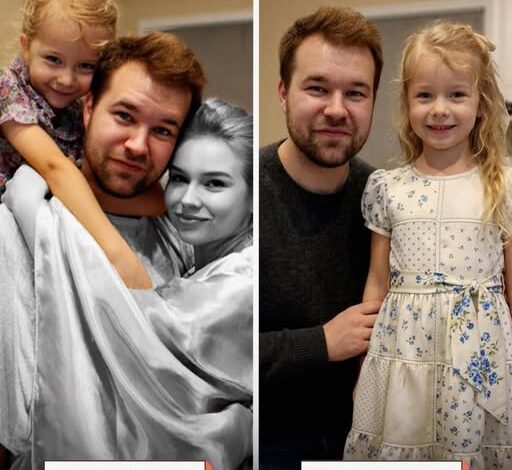
My wife, Jenna, was gone in six months.
One minute we were standing in the kitchen arguing about something as small as cabinet colors—white or blue—going back and forth like it actually mattered. The next, I was sitting beside her hospital bed in the middle of the night, holding her hand while machines filled the room with that cold, steady beeping that never changes no matter what kind of life is ending.
I remember thinking: this can’t be how it happens.
Like death needed permission.
Like love was supposed to be enough to negotiate with it.
But illness doesn’t argue back.
It just takes.
After she passed, the house didn’t feel empty in the usual way.
It felt… paused.
Like time had stopped mid-breath and forgot to restart.
A half-finished cup of coffee stayed on the counter longer than it should have. Her sweater still hung on the back of a chair like she might come back and finish wearing it. Even the air felt wrong—too still, too careful, like it didn’t want to disturb anything.
And then there was Melissa.
She was four when we lost Jenna.
Too young to understand death, but old enough to know absence.
She stopped asking when Mommy was coming home after a while. Kids do that thing where they accept what adults won’t explain properly. They build their own version of reality and just live inside it.
By six, she had become this bright, steady little force in my life.
She’d laugh in a way that felt too big for her age.
Sometimes I’d catch her humming in the same tone Jenna used to hum while cooking, and I’d have to walk out of the room just to breathe normally again.
She carried her mother in pieces.
Just not in ways she understood yet.
From then on, it was just the two of us.
And survival.
I worked HVAC—whatever job came in, I took it. Summers that burned through metal roofs, winters where your fingers stopped feeling like yours. Money came and went like it didn’t care if we were okay.
It never felt like enough.
But Melissa never once made me feel like I was failing her.
Not once.
Even when I clearly was.
One afternoon, she came running in from school, backpack half-open, shoes barely tied.
“Daddy! Daddy!”
I was halfway under the sink, fixing a leak that I’d already fixed twice before.
“What is it?” I asked, wiping my hands.
“Kindergarten graduation is next week!” she said, like she was announcing something life-changing. “We have to dress fancy!”
I smiled automatically.
Then I felt it hit me.
That quiet drop in the stomach when your brain does math faster than your heart can accept it.
“Fancy?” I asked again.
She nodded.
But I saw it.
That tiny hesitation in her face when she said it.
Kids don’t always ask for things directly.
Sometimes they just hope you’ll notice what they didn’t say out loud.
That night, I checked my bank account three times like it might improve if I kept looking at it.
It didn’t.
Rent, electricity, groceries, gas… everything already spoken for.
There was nothing left for “fancy.”
I sat at the edge of the bed for a long time after Melissa fell asleep, staring at the wall like it might offer suggestions.
That’s when I remembered the box.
Jenna’s handkerchiefs.
I hadn’t opened that wooden box in years.
It sat in the closet like a sealed memory I wasn’t ready to touch.
But that night, I pulled it down.
Slowly.
Carefully.
Like it might still belong to her in a way that would punish me for disturbing it.
Inside were layers of silk—soft, delicate, folded like they had been waiting for someone to need them again.
I sat on the floor for a long time just holding one.
That smell—faint, impossible, but real in the way grief tricks you into believing things.
And then an idea came.
Not a good one.
Not a logical one.
Just… something that refused to leave.
The sewing machine was in the garage.
Old. Heavy. Covered in dust and forgotten intentions.
Mrs. Patterson down the street had given it to me years ago and I never had a reason to use it.
Until now.
I dragged it inside like it mattered.
Because suddenly it did.
I didn’t know what I was doing. Not really.
I watched videos on my phone until my eyes hurt. I broke thread. Ripped seams. Swore quietly so I wouldn’t wake Melissa.
Twice I almost gave up.
Once I almost threw the whole thing away.
But on the third night, something started to take shape.
Not perfection.
Not even close.
But something real.
Something alive.
The dress came together piece by piece.
Jenna’s handkerchiefs—ivory silk, soft blues, faded floral edges—stitched into something new but still carrying the past inside it.
When I held it up, it didn’t feel like fabric anymore.
It felt like memory sewn into shape.
I called Melissa into the room.
She stopped in the doorway.
Didn’t move.
Didn’t speak.
Just stared.
“Daddy…” she whispered.
“Try it on,” I said.
When she came out, she was spinning before she even reached me.
“I look like a princess!” she said, laughing.
But then she slowed down.
Like she felt something she couldn’t name.
She touched the fabric gently.
“Where did it come from?”
I knelt down.
“It used to belong to your mom,” I said.
She went very still.
“So… Mommy helped make it?”
I nodded.
“Yeah,” I said quietly. “She did.”
And something in her face softened in a way I still don’t know how to describe.
Like she understood something bigger than words.
Graduation day came too fast.
The school gym was loud—chairs scraping, parents talking, cameras clicking, kids running around like chaos had a schedule of its own.
Melissa held my hand tighter than usual.
“You nervous?” I asked.
“A little,” she admitted.
“You don’t have to be.”
But I was lying to both of us.
Because I knew people would notice the dress.
And I knew not everyone notices things kindly.
They did notice.
Whispers started before the ceremony even began.
Then came the comments.
“That’s homemade.”
“Poor thing.”
“Some people try their best…”
Then a woman in heels stepped closer.
Perfect hair. Sharp voice.
She looked at Melissa like she was evaluating something she might return.
“You made that?” she asked me.
“Yes,” I said.
She smiled like she was doing me a favor.
“You know,” she said loudly enough for others to hear, “some families just aren’t equipped. There are better opportunities for children if you really care about her future.”
Silence spread.
I felt heat rise in my chest.
But before I could speak—
Her son tugged her sleeve.
“Mom…”
“Not now,” she snapped.
But he pointed anyway.
“Dad gives Miss Tammy those same handkerchiefs.”
Everything stopped.
Even the noise.
Even breath.
And suddenly, the woman’s confidence cracked in real time.
She turned pale.
And without another word, she left.
Melissa looked up at me.
“What just happened?”
I exhaled slowly.
“I think,” I said, “someone just learned not to talk before thinking.”
She accepted that answer immediately, because kids don’t need full explanations to move on.
When her name was called on stage, she walked carefully.
Not nervous anymore.
Just proud.
And when the announcer said, “Her dress was handmade by her father,” the applause wasn’t polite.
It was real.
It was warm.
It was the kind of sound you don’t forget because it doesn’t just fill a room—it fixes something in it.
The photo went online that night.
Someone at the school posted it.
Then someone shared it.
Then it spread.
I didn’t even notice at first.
Until messages started coming in.
Then a call.
A tailor in town wanted to meet.
I almost said no.
Because I didn’t think there was anything special about what I did.
But I went anyway.
He studied the dress for a long time.
Didn’t speak at first.
Just traced the seams.
Then he looked at me.
“You learned this on your own?” he asked.
“Yeah,” I said. “More or less.”
He nodded slowly.
“You’ve got something most people can’t teach,” he said. “If you’re willing… I could use someone like you.”
I thought he was joking.
He wasn’t.
Months passed.
I worked.
Learned.
Failed.
Learned again.
Melissa grew into a version of herself that didn’t look like survival anymore.
More like stability.
More like joy returning slowly.
Eventually, I opened my own small tailoring shop.
Nothing fancy.
Just honest work.
And on the wall, behind glass, I framed the dress that started everything.
Not because it was perfect.
But because it was proof.
That something made out of loss could still become something that carried life forward.
One afternoon, Melissa sat on the counter swinging her legs.
“That’s still my favorite,” she said.
“I know,” I replied.
She smiled.
“You think Mom would like it?”
I looked at the dress.
Then at her.
“I think,” I said, “she already does.”
And for the first time in a long time, I believed that healing doesn’t always feel like healing.
Sometimes it just feels like continuing.