Patricia pressed the phone against her cardigan before I could reach for it.
“Emily called me that night,” she said. “I got there before anyone else.”
For a second, the laundry room seemed to tilt.
Ava was still pressed against my chest.
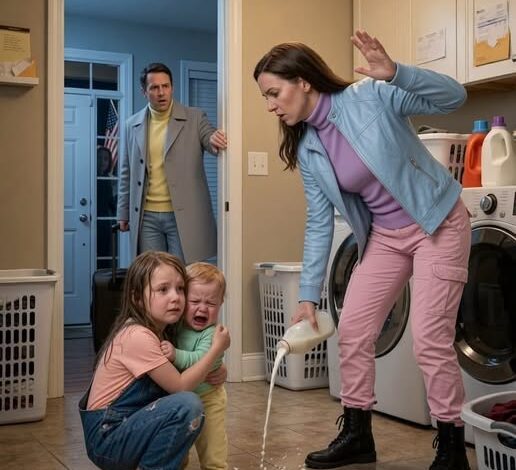
Lucas sat on the floor beside my leg, too tired even to cry properly, while spilled milk crept through the grout lines.
I stared at Patricia.
“What did you just say?”
She looked at Ava before she looked at me.
That mattered.
Then she tightened both hands around the phone.
“Your wife was alive when I arrived.”
I had spent almost two years believing something completely different.
Emily had died suddenly while I was away for work.
Patricia had always said she found out afterward, just like everyone else.
She brought food after the funeral.
Sorted paperwork.
Held Lucas when I couldn’t stop shaking.
Sat beside Ava when she woke at night screaming for her mother.
Eventually, she became the person I trusted most.
Then she became my wife.
And now, standing in a laundry room where my children had apparently been locked without enough food, she was telling me she had been with Emily before emergency help ever arrived.
“What happened?” I asked.
Her jaw tightened.
“You want the truth? Then stop acting like I’m some monster because the kids missed a few meals.”
Ava made a tiny sound against my chest.
That ended the argument.
Not my questions.
Just the negotiation.
I bent down and lifted Lucas with my free arm.
He felt frighteningly light.
Patricia stepped toward me.
“Where are you going?”
“To get them help.”
“If you call anyone, I’m done talking about Emily.”
I kept walking.
“You hear me?” she said. “You involve strangers and you’ll never know what Emily told me.”
I stopped.
There it was.
Leverage.
Patricia knew I had spent two years desperate for answers.
She also knew how guilty I felt about being away so often.
For months, she had encouraged every trip.
Every late meeting.
Every extra shift.
Whenever I hesitated, she told me the same thing.
The kids are fine.
I’ve got them.
Go work.
And I believed her.
“I’ll tell them the truth,” I said.
Patricia gave a bitter laugh.
“That you abandoned your children with me?”
“That I trusted you.”
Her face changed.
Not fear.
Calculation.
She was already rewriting the story.
So I called for help.
I explained that my six-year-old daughter and two-year-old son said they had not eaten properly for three days.
That I found them locked inside the laundry room.
That Ava had been trying to care for Lucas herself.
That there was plenty of food in the house.
Patricia stood across from me clutching the phone.
When I finished, she whispered:
“You’re going to regret making this official.”
“Why?”
“They’re going to ask where you were.”
“I’ll answer.”
That surprised her.
Help arrived soon afterward.
Nobody needed a dramatic speech.
Ava’s cracked lips.
Lucas’s exhausted body.
The locked laundry-room door.
The spilled milk.
The full pantry.
Those things spoke loudly enough.
When one of the workers asked Ava whether she felt safe answering questions with Patricia nearby, my daughter buried her face against me and shook her head.
Patricia was moved away.
Only then did Ava whisper:
“She makes us practice.”
I crouched beside her.
“Practice what?”
“What to tell people.”
My stomach tightened.
“She says if anybody asks, we eat every night.”
Ava twisted my shirt around her fingers.
“And if my teacher asks why I’m tired, I have to say Lucas kept me awake.”
I felt sick.
Then she added:
“She says Mommy Emily wanted her to be our new mom.”
That sentence landed differently.
Patricia had told me almost the same thing months after Emily died.
She claimed Emily once joked that if anything happened to her, Patricia was the only woman she would trust with the children.
I had believed it because I needed to.
Now Ava was telling me Patricia had turned that claim into part of a script.
That night, I started looking at everything I should have checked long before.
School messages.
Missed calls.
Teacher notes.
Grocery receipts.
The pantry.
The children’s rooms.
Warnings were everywhere.
Ava had been arriving at school exhausted.
Several messages had gone unanswered.
Food was being bought, but the children said they were often denied access to it when I was gone.
Patricia had controlled information so completely that I saw only the version of our family she wanted me to see.
Then I found the recordings.
They were on the hidden phone.
Not recordings of Emily.
Recordings of Ava.
My six-year-old daughter’s voice repeated sentences after Patricia.
“I eat dinner every night.”
“Patricia never scares me.”
“Daddy is gone because he doesn’t want to be home.”
Then Patricia’s voice.
“Again.”
Ava repeated it.
“Say it properly.”
Again.
Again.
Again.
I stopped listening.
Patricia had not simply neglected my children.
She had been training them to protect her.
And suddenly her confession about Emily mattered even more.
Because after Emily died, Patricia told me she had not been there before emergency responders arrived.
Now she was saying Emily had called her directly.
Both stories could not be true.
Phone records provided the first break.
Emily had contacted Patricia that evening.
Patricia’s device had been at our house much earlier than she had admitted.
And there were twenty-seven minutes between Patricia’s arrival and the call for emergency help.
Twenty-seven minutes.
I stared at that number until it stopped looking like time and started looking like a void.
Patricia eventually admitted she went inside.
“She was upset,” she said.
“Was she conscious?”
“Yes.”
“Was she asking for help?”
“She said she didn’t want anyone called.”
“Then why did you eventually call?”
“She got worse.”
I looked at her.
“What happened during those twenty-seven minutes?”
She gave me explanations.
Emily was confused.
Emily was emotional.
Emily was dramatic.
That word stopped me.
Dramatic.
Patricia had used it about Ava too.
My daughter was hungry and locked in a room.
Dramatic.
Emily was sick and needed help.
Dramatic.
Then investigators uncovered another detail.
Weeks before Emily died, she had asked Patricia to return the spare key to our home.
Emily had grown uncomfortable with how freely Patricia entered.
She caught her reading private messages.
Inserting herself into family decisions.
Acting as if boundaries did not apply to her.
Emily wanted distance.
Patricia did not.
After Emily died, Patricia used her access to our house as proof of how close they had been.
In reality, Emily had been trying to take that access away.
I finally asked:
“Were you angry because Emily wanted the key back?”
Patricia looked away.
“She treated me like a stranger.”
There it was.
Not panic.
Not confusion.
Resentment.
“You waited because you were angry with her?”
“She was always overreacting.”
Something inside me went completely still.
I would never know whether those twenty-seven minutes could have saved Emily.
No responsible doctor could promise me that.
But I knew enough.
Patricia had been there.
She delayed calling for help.
She lied afterward.
Then she used Emily’s death to move deeper into our family.
And when Ava resisted her control, Patricia used food, fear, isolation, and rehearsed lies to control her too.
I no longer needed a dramatic confession.
The pattern was enough.
Patricia still tried to threaten me.
“If you leave me, people are going to ask why you were never home.”
“I know.”
“They’ll ask why you didn’t notice Ava changing.”
“I know.”
“They’ll ask why Lucas clings to Ava more than you.”
“I know.”
She stared at me.
She expected shame to silence me.
It didn’t.
“I should have been home more,” I said. “I should have checked. I trusted you when I should have been paying attention.”
For the first time, Patricia had nothing left to use against me.
Because I had stopped pretending I had done everything right.
I filed for divorce.
Patricia lost access to the house and the children while the allegations involving them were investigated.
Emily’s death was reviewed again after Patricia’s changed account and the new timeline came to light.
I refused to let that investigation become the center of Ava and Lucas’s lives.
They had already spent too much time inside adult secrets.
They needed ordinary things.
Breakfast.
School.
Baths.
Bedtime.
Someone who came when they called.
Doors that did not lock them inside.
So I changed my life.
I cut back travel.
I checked school messages myself.
Packed lunches.
Learned which cereal Ava actually liked instead of the one Patricia always bought.
Learned how Lucas wanted his blanket tucked under his chin.
Slowly, the children changed.
Ava stopped hiding crackers beside her bed.
Lucas stopped crying every time I walked into another room.
Ava stopped asking exactly how many minutes I would be gone whenever I stepped outside.
Months later, she asked the question I had been dreading.
“Dad?”
We were at the kitchen table.
She was coloring.
“Did Mommy Emily really tell Patricia to take care of us?”
I put down the dish towel.
“No.”
Ava looked up.
“Patricia said she did.”
“I know.”
“Was Mommy mad at her?”
I chose my words carefully.
“Your mom wanted Patricia to respect our family’s boundaries.”
Ava thought about it.
“Did she?”
“No.”
That was enough.
Someday, there would be more truth.
But children do not need every adult detail simply because adults failed to handle it responsibly.
The legal process took longer.
Patricia was eventually charged over what happened to the children.
The renewed investigation into Emily’s death did not produce the dramatic murder charge some people expected.
There was no proof Patricia caused Emily’s medical emergency.
But investigators concluded that she had lied repeatedly about the timeline and delayed seeking help after finding Emily in distress.
That truth entered the official record.
For me, it clarified something bigger.
Patricia had spent years convincing herself that other people’s needs mattered only when they did not interfere with what she wanted.
Emily wanted distance.
Ava wanted food.
Lucas needed an adult.
Each time, Patricia treated another person’s need as an inconvenience.
Then she created a story that made herself look innocent.
A year after I found the children in the laundry room, I was making breakfast when Ava knocked over her glass of milk.
The cup tipped.
Milk poured across the table.
Ava froze.
Her whole face changed.
For half a second, she was back in that locked room.
I grabbed a towel.
“It’s okay.”
She watched me carefully.
I wiped the table.
Then poured her another glass.
Lucas pushed one of his toy cars through the milk that had dripped onto the floor and started laughing.
I groaned.
Ava stared at him.
Then she laughed too.
Really laughed.
No fear.
No apology.
No rehearsed explanation.
Just spilled milk.
I stood there looking at my children in the morning light.
For a long time, I thought solving Emily’s final twenty-seven minutes was the only way our family could heal.
I was wrong.
The truth mattered.
Accountability mattered.
But healing was happening somewhere much quieter.
In ordinary mornings.
Open doors.
Full plates.
Answered calls.
And children who no longer needed to practice what they were allowed to say.
Patricia had controlled our family by deciding which version of reality everyone else was permitted to hear.
She lost that control the moment Ava finally told me the truth.
From that day forward, we had one rule in our house that mattered more than any other.
Nobody had to rehearse the truth.
THE END