The moment my husband stopped arguing with my mother and stepped toward the oven, I understood that something in our family had changed forever.
Until then, part of me was still searching desperately for an explanation.
My mother had always been stubborn. She trusted old remedies, distrusted doctors, and treated disagreement like proof that everyone else simply lacked her experience. Growing up, I had learned that the easiest way to keep peace was to let her talk until she felt heard.
But there was no peaceful explanation for what she had done that night.
Our newborn had developed a high fever accompanied by violent chills. My mother saw the trembling and decided the baby was freezing. Somehow, she convinced herself that the answer was more heat.
Not another blanket.
Not a warm room.
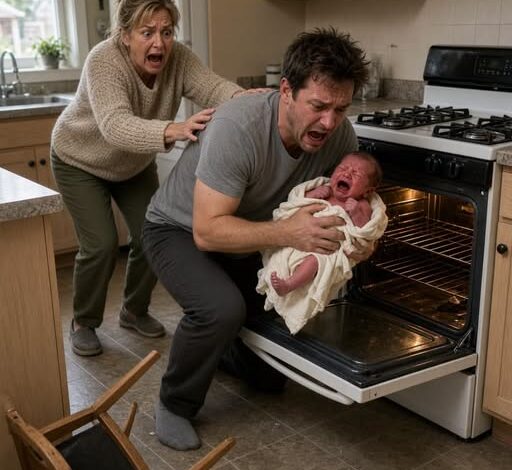
She put our newborn inside a heated oven.
Even worse, when the screaming began and my husband and I tried to intervene, she refused to let us reach our child.
Now I stood in the kitchen with 911 on the phone while my mother spread herself across the oven door.
My husband looked at her once.
“Move.”
“You don’t understand,” she insisted. “The cold has to come out.”
Behind her, our baby screamed.
My husband stepped forward.
Something in his face must have finally reached her, because she backed away.
He opened the oven immediately and got our child away from the heat.
I could barely process the dispatcher’s instructions. My mother was still shouting. My baby was crying. My hands were shaking so violently that I had to grip the phone with both hands.
My husband carried the baby away from the kitchen and followed the emergency operator’s directions.
My mother remained beside the oven, breathing hard.
Then she said something I will never forget.
“You took the baby out too soon.”
I stared at her.
There was no horror on her face.
No sudden realization.
No What have I done?
She still believed she had been right.
That was the moment I stopped trying to understand her reasoning.
The emergency responders arrived minutes later.
Their presence changed everything.
Until then, my mother had treated the crisis like another family disagreement—something she could win by speaking louder, repeating herself, or accusing us of overreacting.
The responders weren’t interested in winning an argument.
They went straight to our baby.
One began the medical assessment while another asked us questions.
“What happened?”
My mouth opened, but nothing came out.
My husband answered.
“The baby was placed inside the oven.”
The responder looked up.
“Who did that?”
“My mother-in-law.”
The room went silent.
My mother turned toward me immediately.
I recognized that look.
I had seen it my entire life.
Fix this.
She expected me to soften the story.
She wanted me to explain that she loved her grandchild. That she had misunderstood the chills. That she came from a different generation. That she had only been trying to help.
For years, I had done exactly that.
I had translated her cruelty into concern.
Her control into love.
Her refusal to listen into stubbornness.
But this time there was a newborn between us.
So I told the truth.
“She put the baby in the heated oven because she thought the fever meant the baby was cold. When we tried to get the baby out, she blocked us.”
“That’s not what happened!” my mother cried.
The responder turned toward her.
“What did you believe the heat would do?”
My mother hesitated.
Then she explained.
The chills meant cold was trapped inside the body.
Heat would force the sickness out.
If we had waited longer, she insisted, the treatment would have worked.
The responder listened without mocking her.
He didn’t argue.
He simply let her finish.
Somehow, that silence was more powerful than anything my husband or I had said.
My mother had prepared herself to fight us.
She had not prepared herself to hear her own explanation spoken aloud in front of people whose only concern was whether our baby was safe.
Finally, she looked at me.
“Tell them I was trying to help.”
I swallowed.
“You were trying to help.”
Relief flickered across her face.
Then I continued.
“But you hurt our baby. And when we tried to stop you, you wouldn’t let us.”
Her expression collapsed.
For the first time that night, certainty disappeared from her face.
It wasn’t remorse.
Not yet.
It was something simpler.
She realized I wasn’t going to rescue her from the consequences.
The responders continued working.
Questions became instructions. The kitchen that had been filled with screaming became strangely organized.
For the first time since I walked in, everything centered on the person who actually mattered.
Our child.
My mother tried again.
She talked about remedies from her childhood. She insisted people once trusted family experience instead of rushing to doctors for every illness.
My husband had remained remarkably quiet.
Finally, he looked at her.
“Experience doesn’t give you authority over our child.”
“But I was trying—”
“You heard the baby screaming.”
She stopped.
“You heard us telling you to move,” he continued. “You still blocked the oven.”
There was nothing she could say to that.
And suddenly I understood why that part disturbed me almost as much as what she had initially done.
A person can make a catastrophic mistake.
Someone can misunderstand symptoms.
Someone can panic.
But my mother had been given repeated opportunities to recognize the danger.
She heard our baby crying.
She watched me try to reach the oven.
She watched my husband move left and blocked him.
He moved right.
She blocked him again.
At every stage, she chose her own certainty over what was happening directly in front of her.
Later, after the immediate emergency had moved beyond the kitchen, my mother asked to speak with me privately.
Her voice had softened.
“I’m sorry everything became so dramatic.”
I stared at her.
“That’s what you’re sorry about?”
She frowned.
“I was trying to save the baby.”
“Do you understand what you did?”
“I just told you—”
“No. Do you understand what you did?”
She looked away.
For once, I didn’t fill the silence for her.
Eventually she whispered, “I thought I knew what I was doing.”
That was the closest she came to the truth.
She had been so certain of herself that evidence couldn’t reach her.
Not the crying.
Not our warnings.
Not our fear.
Her confidence had become more important than our baby’s safety.
My husband entered quietly and stood beside me.
My mother looked between us.
Then came the question that finally erased whatever hesitation remained inside me.
“You’re really going to let this destroy our family?”
For years, those words would have worked.
Family.
My weakest point.
The word that had persuaded me to forgive things I should have confronted.
But now I understood what she was actually asking.
She wanted us to pretend that preserving our relationship with her mattered more than acknowledging what she had done.
I shook my head.
“We didn’t destroy this.”
Her eyes filled with tears.
“You’re my daughter.”
“And that’s my child.”
She began crying.
Ordinarily, I would have crossed the room.
I would have hugged her.
I would have apologized for upsetting her even when she had hurt me.
That night, I stayed where I was.
Because my responsibility had changed.
Maybe it had changed the moment I became a mother.
Maybe I had simply failed to understand it until then.
My job was no longer to protect my mother from uncomfortable consequences.
My job was to protect the child who could not protect themselves.
In the days afterward, I replayed the kitchen scene constantly.
The heat.
The screaming.
My mother’s body pressed against the oven.
My shaking hand holding the phone.
My husband saying, “I’m getting our baby out.”
But one moment returned more than all the others.
The responder asking:
“Who put the baby there?”
And my husband answering immediately.
No hesitation.
No softened language.
No attempt to preserve appearances.
He simply told the truth.
That taught me something I should have learned years earlier.
Sometimes keeping the peace is only another way of protecting the person causing the harm.
My husband understood that before I did.
Our baby mattered more than my mother’s feelings.
The truth mattered more than her reputation.
Safety mattered more than family harmony.
From then on, we decided together who could be around our child. Help would only be help if we wanted it. Advice would never become authority simply because it came from an older relative.
And love would never again be accepted as an excuse for dangerous behavior.
My mother believed that night forced me to choose between her and my husband.
She was wrong.
It wasn’t a choice between two adults.
It was a choice between preserving an illusion and protecting someone completely dependent on me.
When I looked back at that oven door, there was never really a choice at all.
My mother had already made it for me the moment she stood between us and our crying child—and refused to move.