My ten-year-old daughter had been quiet for weeks before the custody hearing.
I blamed the divorce.
Children become watchful when families are breaking apart. They listen from hallways. They study expressions. They learn which questions make adults tense. So when Harper began speaking less, eating quickly, and disappearing into her room with her tablet tucked against her chest, I thought she was grieving.
I had no idea she was building a case.
Caleb and I had been married for twelve years.
To everyone else, he was thoughtful, charming, controlled. He remembered birthdays, shook hands firmly, listened with his head tilted in exactly the right way. He understood how to make people feel heard.
For years, I believed that was kindness.
Eventually, I understood it was skill.
Caleb knew how to control a room without raising his voice.
He controlled our finances the same way. Accounts were complicated because he made them complicated. Whenever I questioned a transfer, he explained it patiently until I felt foolish for asking. When I noticed inconsistencies, he called me anxious.
Eventually, I stopped asking questions.
That was what he wanted.
So when he filed for divorce and demanded primary custody of Harper, I already knew how he would present me.
Emotional.
Reactive.
Unstable.
He wanted the house too, along with a financial settlement that made no sense to me. Money was missing. I suspected hidden accounts, but every trail vanished before I could prove where it went.
Caleb’s attorney turned every concern into evidence against me.
If I questioned the finances, I was paranoid.
If I became upset, I was unstable.
If I defended myself too strongly, I was hostile.
By the morning of the hearing, I felt like I had spent months drowning in front of people who could not see water.
Caleb sat across the courtroom wearing a charcoal suit and the same calm expression he wore at charity dinners.
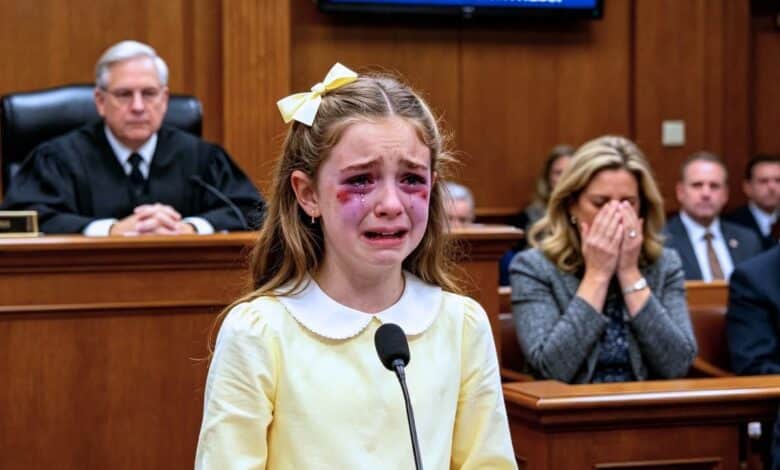
Harper sat in the gallery beside her court-appointed advocate.
Blue dress.
Hair pulled back.
Tablet clutched against her chest.
I remember thinking how small she looked.
Then she stood.
“Your Honor?”
Everyone turned.
Harper swallowed.
“Can I show you something my mom doesn’t know about?”
My heart stopped.
Caleb changed instantly.
Not dramatically.
His shoulders tightened.
His jaw locked.
“Harper,” he said softly. “Sweetheart, this isn’t the time.”
She looked directly at him.
“You said the judge needed to know the truth.”
For the first time in twelve years, I watched Caleb lose control of a room.
His attorney jumped up.
“Your Honor, this is highly inappropriate. The child has obviously been influenced—”
“Sit down, counselor.”
The judge looked at Harper.
“What do you want to show me?”
“A video.”
“Did your mother ask you to record it?”
Harper shook her head.
“No.”
“Does your mother know you have it?”
“No.”
The judge studied her carefully.
“Why did you save it?”
Harper’s fingers tightened around the tablet.
“Because I thought if I told Mom, she’d cry again.”
Silence swallowed the courtroom.
The judge decided the recording would be reviewed privately in chambers with both attorneys present.
Caleb objected immediately.
“It’s nothing,” he said.
The judge looked at him.
“Then you should have no reason to fear my seeing it.”
Inside chambers, Harper handed over the tablet.
“There’s a folder,” she whispered.
The judge opened it.
The title appeared on the screen.
FOR WHEN I NO LONGER BELIEVE YOU.
My stomach twisted.
The video began.
Our living room appeared at an odd angle.
Caleb stood near the sofa holding a glass of whiskey.
Beside him sat Vanessa, the woman he had repeatedly described as a financial adviser.
She was wearing a silk robe.
That explained more than I needed explained.
Then Caleb’s voice filled the room.
“Harper will repeat whatever we need eventually.”
My entire body went cold.
On-screen, Vanessa laughed.
Caleb continued.
“Just keep telling her Mom gets emotional. That she forgets things. That she yells sometimes. Nothing dramatic. Kids absorb repetition.”
My attorney slowly turned toward me.
I couldn’t look away from the screen.
Vanessa asked, “What if she refuses?”
Caleb smiled.
“She’s terrified of disappointing me.”
I looked at Harper.
She was watching me instead of the video.
Suddenly I understood those weeks of silence.
She had not withdrawn.
She had been observing.
Recording.
Waiting.
Caleb continued talking.
“With full custody, keeping the house becomes easier. And once the judge believes Laura’s unstable, nobody looks too closely at the finances.”
Vanessa mentioned an account.
“Arizopa?”
Caleb laughed.
“According to the court, Arizopa doesn’t exist.”
My attorney inhaled sharply.
That was the account I had spent months trying to prove existed.
Vanessa asked what would happen if I discovered it.
Caleb took a drink.
“She won’t. Laura’s more sentimental than intelligent. She gets upset, falls apart, apologizes. She’s predictable.”
The judge stopped the video.
Nobody moved.
Finally she looked at Caleb.
“Would you like to explain?”
His face had gone pale.
“It’s out of context.”
The judge replayed one sentence.
“She’s terrified of disappointing me.”
Then she removed her glasses.
“I’ve heard enough.”
What followed happened quickly.
The judge froze the sole-custody request.
She ordered an emergency forensic accounting review.
She ordered further evaluation regarding Harper’s welfare and directed that precautionary measures be filed immediately.
Then she turned toward me.
“Mrs. Dawson, I am sorry your daughter had to bring evidence into this room before concerns you raised were taken as seriously as they should have been.”
Something inside me released.
Not broke.
Released.
For months I had carried the exhausting burden of proving I was not imagining my own life.
Now I didn’t have to carry it alone.
Caleb turned toward Harper.
“You recorded me?”
His voice no longer sounded fatherly.
Harper lifted her chin.
“Yes.”
I stood immediately.
The judge noticed too.
So did Caleb’s attorney.
Harper did not move.
She simply held his gaze.
That image will stay with me forever.
Not because I wanted my daughter to be brave.
Because she never should have needed to be.
When the meeting ended, Harper crossed the room toward me.
I dropped to my knees before she reached me.
She collapsed into my arms.
“I’m sorry I didn’t tell you.”
I held her tighter.
“No, sweetheart.”
Her whole body began trembling.
“I’m sorry you had to carry it.”
The forensic accountants found the Arizopa account within days.
Nearly two hundred thousand dollars had been moved through intermediary accounts designed to make the money difficult to trace.
Caleb’s custody strategy collapsed.
The financial case changed completely.
Eventually, even his attorney withdrew.
But none of that mattered as much to me as what happened afterward with Harper.
She began seeing Dr. Adeyemi, a therapist experienced with children pulled into adult conflict.
I never asked what they discussed.
I watched instead.
Harper began sleeping through the night.
She started drawing again.
She invited her friend Lila over.
Her shoes started appearing in the hallway where I tripped over them.
Her laughter came back.
One evening, while doing math homework, she said quietly, “Mom?”
“Yeah?”
“I don’t feel like I have to watch everything anymore.”
I sat across from her.
“What do you mean?”
She erased a number.
“Before, I thought if I stopped paying attention, something bad would happen and nobody would believe us.”
My throat tightened.
“And now?”
She shrugged.
“Now people believe us.”
That sentence should have comforted me.
Instead, it nearly broke my heart.
My daughter had learned before she was eleven that truth sometimes needed evidence before adults respected it.
Her courage saved us from something terrible.
But bravery born from fear is still something a child should never have been required to develop.
Months later, Harper sat on the kitchen floor making friendship bracelets.
Beads covered the rug.
A popsicle wrapper lay beside her.
Her homework was still on the counter.
“Mom?”
“Yes?”
“Can we get a dog?”
I looked around at the mess.
At the beads.
At the abandoned shoes.
At the half-finished homework.
At my daughter worrying about something wonderfully ordinary.
“We’ll talk about it.”
She grinned.
And I stood there thinking about the folder she had once created in secret.
For When I No Longer Believe You.
She did not need that folder anymore.
She did not need to watch every room.
She did not need to preserve every sentence.
She was finally allowed to be a child.
And as evening light turned the kitchen windows soft blue, I realized that ordinary mess had become the most beautiful proof I had ever seen.
We were safe enough to stop collecting evidence.
We were safe enough to simply live.