My Husband Grabbed My Hair and Told Me to Cook 20 Dishes or Leave—He Had No Idea I’d Been Preparing to Leave for a Year

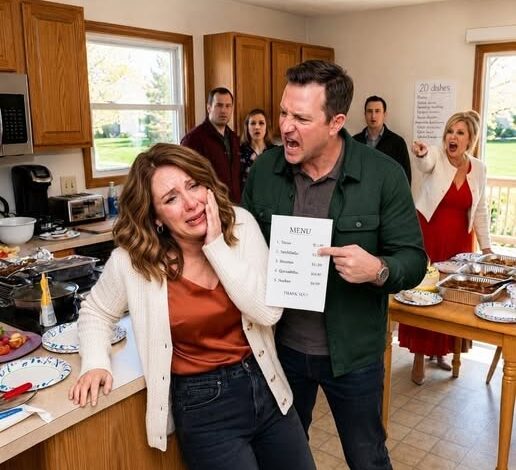
“Twenty dishes. Not eighteen. Not nineteen. Twenty.”
Linda tapped the handwritten menu against my chest like she was handing me an order from someone I had no right to question.
Her fifty-fifth birthday dinner was happening at our house that evening.
Twenty-three relatives were coming.
Roast beef.
Glazed ham.
Salmon.
Shrimp casserole.
Three kinds of potatoes.
Macaroni and cheese.
Stuffing.
Vegetables.
Biscuits.
Salads.
Deviled eggs.
Four desserts.
I stared at the list.
Then at my mother-in-law.
“Linda, I can’t make all of this by six. We have one oven.”
Behind me, Mark sighed.
Then his hand closed around my hair.
Hard.
My head snapped backward.
“Cook,” he said quietly, “or get out.”
Linda smiled.
That was the moment something inside me became completely still.
Not frightened.
Finished.
For eleven years, I had cooked, cleaned, paid bills, covered Mark’s debts, and apologized whenever he became angry.
Linda always defended him.
If he shouted, I had provoked him.
If he spent money we didn’t have, I was controlling for asking questions.
If he shoved me or blocked a doorway, she called it a marital disagreement.
If he grabbed me, she told me not to embarrass him by “making a scene.”
What neither of them knew was that beneath a loose floorboard in our storage room sat a small metal box.
Inside was six thousand dollars.
Beside it was a flash drive.
On that drive were photographs, threatening messages, audio recordings, bank statements, and a spreadsheet containing dates I hoped I would never need to explain to anyone.
I had been preparing to leave for almost a year.
Linda tapped the menu again.
“Well?”
I looked at Mark.
“Fine.”
He released my hair.
For the next three hours, I gave them exactly what they expected.
I cooked.
I smiled when relatives arrived.
I carried platters into the dining room.
I refilled glasses.
I answered questions about recipes.
I even brought Linda’s birthday cake to the table while twenty-three people sang to her.
Nobody looking at me would have known I had already left in my mind.
At 5:47 p.m., I went upstairs.
I changed into jeans.
Took the backpack I had packed two months earlier.
Lifted the loose floorboard.
Removed the cash and flash drive.
Then I placed an envelope on our bed.
Inside was a copy of the police report I had filed that morning.
At 5:58, while Linda blew out fifty-five candles downstairs, I walked through the back door.
At 6:12, Mark called.
For the first time in eleven years, seeing his name on my screen did not make my stomach drop.
I blocked him.
I did not go to a hotel.
Mark would think of that immediately.
Instead, I drove to a small furnished apartment that belonged to Teresa, a woman from my accounting office.
Months earlier, she had noticed bruising around my wrist.
She had never pushed me for an explanation.
She simply handed me a spare key.
“If you ever need a door he can’t open, use this.”
That night, I finally did.
The apartment was tiny.
One bed.
A folding table.
An old television.
Beige walls.
To me, it looked beautiful.
I turned my phone on once.
Fourteen voicemails.
The first few were furious.
“You humiliated me.”
“Get home.”
“My mother is crying because of you.”
Then came the apologies.
“I was stressed.”
“You know I didn’t mean it.”
“We can fix this.”
The final message sounded different.
“If you try to take my house or my money, you’ll regret it.”
I saved every one.
The next morning, I sat across from an attorney named Rebecca Sloan and placed the flash drive on her desk.
“There’s about a year on there.”
She opened it.
Photographs.
Texts.
Audio.
Bank statements.
My spreadsheet.
Rebecca looked at me.
“You documented a pattern.”
Then she found something else.
More than eighteen thousand dollars had been transferred from our joint accounts to Linda over the previous eighteen months.
“Did you approve these?”
“No.”
“Did you know about them?”
“No.”
Rebecca leaned back.
“Then we protect what’s left before he understands exactly what you have.”
That afternoon, I filed for divorce.
We also requested temporary financial restrictions and a protective order.
Mark was served at work two days later.
Then Linda began messaging people around me.
She sent Teresa one line:
Tell Claire she’s destroying this family.
I saved that too.
For years, I had tried defending myself with explanations.
Now I had learned something better.
Evidence.
Three weeks later, Mark’s attorney claimed I had abandoned the marital home, stolen household funds, and deliberately ruined Linda’s birthday.
Mark described pulling my hair as “mutual physical contact.”
Rebecca slid the filing toward me.
“Ignore the adjectives.”
I looked at her.
“We answer with proof.”
So we did.
The police report.
Photographs.
Voicemails.
Bank records.
Receipts showing I had paid the mortgage, utilities, insurance, groceries, and household repairs.
The six thousand dollars I took had not come from our joint account.
I had saved it slowly from bonuses, weekend bookkeeping, birthday cash, refunds, and small amounts Mark never noticed.
He had spent years mocking me for keeping receipts.
Now every receipt had a date.
And every date helped tell the truth.
At the temporary hearing, Mark sat across the courtroom wearing a gray suit I had bought him.
Linda sat behind him, glaring.
Once, one look from Mark could make me reconsider whatever I was about to say.
Not anymore.
There was a deputy near the door.
Rebecca beside me.
And a binder of evidence on the table.
The judge listened to one voicemail in which Mark warned that I would “regret it” if I touched his money.
Then an older recording played.
Linda’s voice came through clearly:
“She only understands consequences.”
Mark’s attorney argued the recording lacked context.
Rebecca calmly asked what context would make the statement appropriate.
Nobody answered.
The protective order remained in place.
Outside the courtroom, Linda tried to approach me.
“You’re proud of yourself?”
Rebecca stepped between us.
“Do not contact my client.”
Linda snapped, “I’m her family.”
I looked at her.
“No.”
One word.
Then I walked away.
The divorce took almost a year.
There was no magical courtroom scene where everything suddenly became fair.
There were appraisals.
Financial disclosures.
Legal bills.
Settlement negotiations.
Mark claimed the money sent to Linda had been repayment for an old family loan.
Linda produced a handwritten agreement supposedly created four years earlier.
Rebecca noticed the address listed on the document belonged to a house Linda had not moved into yet.
More records were requested.
No evidence existed showing any loan money entering our accounts.
The transfers to Linda, however, were real.
One hurt more than the others.
Years earlier, our furnace failed during winter.
Mark told me we could not afford a replacement.
I put $3,800 on my personal credit card.
Two days before that conversation, he had transferred four thousand dollars to his mother.
I stared at the statement.
“I remember being cold.”
Rebecca did not tell me how to feel.
She just let the fact sit there.
Eventually, the house had to be sold because Mark could not afford to buy out my share.
Teresa drove me past after the sale sign appeared.
I expected grief.
Instead, I noticed the crooked gutter.
The worn driveway.
A faded strip of birthday ribbon still tangled in one of the trees.
“I thought that house was my whole life,” I said.
Teresa kept driving.
“It was an address.”
I never forgot that.
I rented a one-bedroom apartment closer to work.
Cheap cabinets.
A narrow balcony overlooking a parking lot.
The first thing I bought was a secondhand dining table.
Not because I needed one.
Because I wanted somewhere to sit without serving anybody.
My first dinner there was takeout noodles.
One container.
One fork.
No twenty-dish menu.
Nobody calling me back into the kitchen.
Nobody asking why dinner was late.
Nobody telling me I had forgotten something.
My sister Emily flew in from Denver a few days later.
Mark had spent years convincing me that visiting her was too expensive or inconvenient.
When she walked into my apartment, she hugged me until I almost dropped my keys.
“This is yours?”
“Rented.”
“I didn’t ask who owns the building.”
I laughed.
“Yes.”
I looked around.
“It’s mine.”
Eight months after I left, Mark violated the protective order.
I came out of a grocery store and found him waiting beside my car.
“Claire.”
I stopped several yards away.
“You need to leave.”
“I just want five minutes.”
“You can’t contact me.”
He held both hands up.
“I’m not touching you.”
Once, that sentence might have made me question whether I was overreacting.
Now I understood what it meant.
He still believed boundaries only mattered if he physically hurt me.
“I’m calling the police.”
His expression changed.
“After everything I did for you?”
I took out my phone.
“You turned everybody against me.”
I dialed.
He left before officers arrived.
The store cameras recorded the entire encounter.
It became another report.
Afterward, I sat inside my locked car shaking so badly I could barely hold the steering wheel.
That was when I finally understood courage.
Courage was not becoming fearless.
It was being terrified and making the call anyway.
Eleven months after Linda’s birthday, Mark signed the final settlement.
The house had been sold.
The remaining equity was divided.
Some disputed transfers were accounted for during negotiations.
I kept my car.
My personal belongings.
And enough money to build a real emergency fund.
There was no enormous revenge payout.
No miraculous fortune.
Just something I valued more.
Stability.
When the judge finalized the divorce, I expected fireworks inside my chest.
Instead, I felt tired.
Rebecca closed the folder.
“That’s it.”
I blinked.
“That’s it?”
“That’s it.”
Eleven years ended with signatures and a case number.
Outside the courthouse, I called Emily.
“It’s done.”
She screamed so loudly I had to pull the phone away from my ear.
Teresa insisted on taking me to dinner.
“What do you want?”
I opened the menu.
For a second, all I could see was Linda’s list.
Twenty dishes.
Twenty-three guests.
One woman disappearing under everyone else’s expectations.
“I want a burger.”
“That’s it?”
“And fries.”
Teresa smiled.
“Living dangerously.”
A month later, I turned forty-three.
I invited six people to my apartment.
Emily.
Teresa.
Rebecca.
My supervisor Daniel and his wife.
And Mrs. Greene, the neighbor who left tomatoes outside my door every Sunday.
I cooked one pot of chili.
Emily brought cornbread.
Teresa bought a grocery-store cake.
Nobody complained.
Nobody asked what else I was making.
Halfway through dinner, Rebecca looked at me.
“You know what’s different?”
“What?”
“You’ve been sitting down all night.”
I looked at my bowl.
It was still warm.
For once, I had eaten at the same time as everybody else.
That almost made me cry.
The next morning, a box arrived containing belongings from the old house.
At the bottom was Linda’s handwritten birthday menu.
I unfolded it.
Twenty dishes.
A grease stain near one corner.
For a moment, I considered throwing it away.
Instead, I placed it inside the same folder as the first police report and the spreadsheet I had kept while preparing to leave.
Not because I wanted to remember Linda.
Because I wanted to remember me.
That birthday dinner was not the worst day of my marriage.
It was simply the last demand I obeyed.
The following year, on Linda’s fifty-sixth birthday, I came home from work and made pasta.
One plate.
I sat at my secondhand dining table and paid the electric bill from my own account.
The apartment was quiet.
Nobody grabbed my hair.
Nobody ordered me to cook.
Nobody threatened to throw me out.
Then my phone buzzed.
For half a second, my body still reacted.
I looked down.
Emily.
Still proud of your boring chili.
I laughed.
Then I put the phone aside and finished dinner while it was still warm.
For years, I imagined freedom would arrive as something dramatic.
A perfect speech.
A slammed door.
A courtroom victory.
It didn’t.
Freedom turned out to be quieter.
It was knowing nobody could walk through my door without permission.
Buying groceries without explaining a receipt.
Saying no without preparing for punishment.
Eating food while it was hot.
And realizing that when Mark told me:
Cook or get out.
He believed leaving would destroy me.
He was wrong.
Getting out was the first decision that finally allowed me to build a life that belonged to me.