My mother-in-law showed up at my restaurant with 38 friends and announced, “Order the most expensive things. I’m treating everyone today,” even though she knew she had no intention of paying. Instead of throwing them out, I looked at the manager and said, “Serve them everything.” Three hours later, when she saw the $23,289 bill and the folder I placed on the table, she stopped smiling.

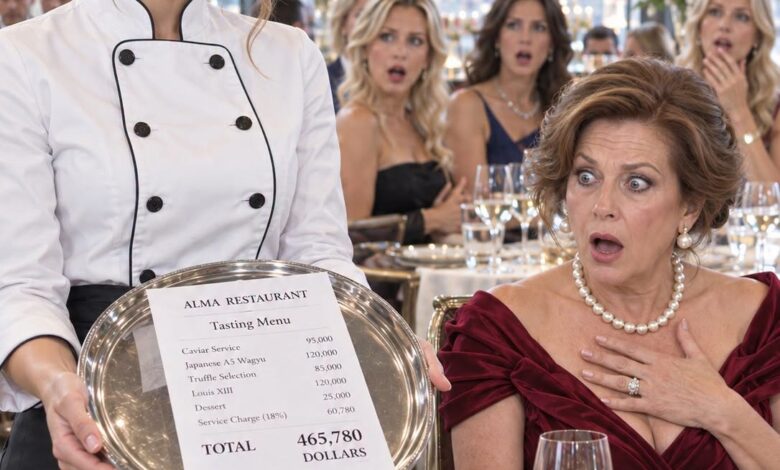
At 1:30 on a packed Friday afternoon, my mother-in-law walked into my restaurant with thirty-eight friends and announced, “Order anything you want. I’m paying for everyone.”
She smiled like she owned the place.
Three hours later, that smile disappeared when I placed a $23,289 bill in front of her—along with documents proving her son had been stealing from my business.
Beatrice arrived like royalty.
Designer handbag. Expensive perfume. Loud voice.
“My daughter-in-law’s restaurant is practically a family business,” she declared. “Today we’re eating like queens.”
My manager, Gavin, rushed over.
“Camilla, they don’t have a reservation. We’re full.”
I looked across the dining room.
Beatrice had already removed a RESERVED sign and was ordering staff to push tables together.
“Seat them,” I said.
Gavin stared at me.
“All thirty-nine?”
“All of them.”
He lowered his voice.
“You know she won’t pay.”
“Yes.”
“Then why—”
“Give them exactly what they ask for.”
He stopped questioning me.
I had built Lumina from nothing.
Years as a line cook.
Then sous-chef.
Then executive chef.
I saved every dollar I could, signed the lease myself, selected the equipment, hired the staff, and created every menu.
My husband, Lucas, contributed nothing financially.
But Beatrice preferred her own version.
“My son gave Camilla that restaurant,” she told anyone willing to listen. “She just cooks.”
For years, she walked in without reservations, ordered steak, seafood, desserts, and wine, and left without paying.
Whenever I complained, Lucas dismissed me.
“She’s my mother.”
“She still has to pay.”
“She brings publicity.”
“She brings unpaid bills.”
“Camilla, don’t be dramatic.”
That afternoon, Beatrice decided to see how far my silence could stretch.
“I want the most expensive tasting menu,” she told the server. “And bring up the reserve wines. Nothing cheap.”
Her friends applauded.
“That’s why we love you, Beatrice!”
She smiled toward me.
“That’s the benefit of having a restaurant in the family.”
We served everything.
Scallops.
Tuna tartare.
Prime ribeyes.
Imported cheeses.
Luxury desserts.
Reserve bottles from the cellar.
At one point, I personally poured the wine.
Beatrice watched me.
“Well, look at that. The great chef can wait tables too.”
Several women laughed.
One said, “She cooks beautifully, though.”
Beatrice took a sip.
“Camilla is excellent at working. That’s what she’s good for.”
I kept pouring.
Then someone asked about Lucas.
Beatrice leaned forward.
“Oh, my son is doing wonderfully. He even has a lovely young woman keeping him entertained.”
The room went quiet.
I froze.
Beatrice laughed.
“Don’t look so shocked. Camilla is never home anyway.”
Another woman asked, “And how is Lucas paying for all this fun?”
Beatrice lifted her glass.
“With money from this restaurant, of course. It all stays in the family.”
That was the moment the final piece fell into place.
For three months, I had been investigating unauthorized withdrawals.
Hotels.
Jewelry.
Transfers.
Personal debts.
Lucas claimed he knew nothing.
I didn’t believe him.
What I hadn’t known was that Beatrice knew about the affair—and apparently knew where the money came from.
I returned to the kitchen.
Gavin followed.
“You heard that?”
“Every word.”
“Then stop serving them.”
“No.”
“Why?”
“Because I want her responsible for everything she orders.”
Three days earlier, I had discovered nearly forty thousand dollars in Lucas’s hidden debts.
My corporate attorney had also found draft documents intended to transfer control of Lumina to him.
Lucas apparently believed he could pressure me into signing.
He was wrong.
That morning, my divorce had become final.
He just didn’t know yet.
For three hours, Beatrice kept ordering.
More wine.
More desserts.
More coffee.
“Don’t be shy!” she kept saying. “My treat.”
The total reached $23,289.
Then she called me over.
Beside her sat a thick folder.
“Sign these.”
I opened it.
Business-transfer documents.
I looked at her.
“What exactly am I signing?”
She frowned.
“Ownership goes to Lucas. He’ll handle business decisions. You’ll continue cooking.”
One of her friends nodded.
“A man can probably grow the business faster.”
Beatrice smiled.
“Exactly.”
I closed the folder.
“I’ll review it.”
She mistook my calmness for surrender.
“Good. Bring it back signed with the bill.”
I went to my office.
I printed the itemized receipt.
Then I placed three things beneath it.
The certified divorce decree.
Copies of unauthorized transfers.
Photos of Lucas entering a boutique hotel with another woman.
I carried everything out on a silver tray.
“Ladies,” I said, “before anyone leaves, we need to settle the account.”
Beatrice laughed.
“What account?”
I placed the bill in front of her.
Her expression collapsed.
“Twenty-three thousand dollars?”
“Twenty-three thousand two hundred eighty-nine.”
“I’m not paying this.”
“You repeatedly announced that you were.”
“That was a figure of speech! Lucas will cover it.”
“Call him.”
She grabbed her phone.
“With pleasure.”
She put him on speaker.
“Lucas, your wife has lost her mind. She’s charging me over twenty-three thousand dollars. Tell her to stop this nonsense and sign the transfer papers.”
Silence.
Then Lucas said weakly:
“Mom… what did you do?”
Beatrice frowned.
“What do you mean?”
“It’s not our restaurant.”
The room went still.
“I never invested in Lumina,” he continued. “Camilla owns it.”
Beatrice’s face drained.
“But you said—”
“I lied.”
One of her friends leaned forward.
“You told us your son owned this place.”
Beatrice ignored her.
“Lucas, explain the loans.”
Another pause.
“The restaurant isn’t bankrupt,” he admitted. “I am.”
Then everything unraveled.
Lucas confessed that he had taken money from my business.
Some went to hotels and gifts for his mistress.
Some paid personal debts.
And some, he eventually admitted, had gone directly to Beatrice.
I stepped closer.
“How much?”
Lucas hesitated.
“Over twenty thousand.”
Beatrice looked stunned.
“For what?”
He laughed bitterly.
“You know what for, Mom. Bags. Trips. Lunches. Clothes.”
Her friends began murmuring.
Then I asked the question that changed everything.
“Did she know the money came from my business?”
Lucas went silent.
“Lucas?”
“Yes.”
Beatrice closed her eyes.
“And did she know about the affair?”
“Yes.”
“How long?”
“Almost from the beginning.”
Beatrice snapped, “Lucas!”
But he kept talking.
“She said she wouldn’t tell you as long as I kept helping her.”
The room erupted.
Her friends backed away from her.
I lifted the receipt.
“The bill still needs to be paid.”
Beatrice stared at me.
“Camilla, we’re family.”
I slid the divorce decree toward her.
“Not anymore.”
She looked at the court seal.
Then at me.
“When you mocked me in front of your friends, were we family?”
Silence.
“When Lucas stole from my company, were we family?”
Nothing.
“When you tried to make me sign away the business I built, were we family then?”
Her eyes filled.
“My son deceived me too.”
“Maybe he did.”
I nodded toward the bill.
“But you still ordered lunch.”
Several women immediately paid their individual portions.
Others argued.
Beatrice refused.
Eventually, security and local police were called to document the unpaid balance and collect statements.
Later that evening, Lucas stormed into my office.
“Did you really involve the police?”
“You both involved yourselves.”
He paced.
“This is going to destroy me.”
I stared at him.
“Why?”
“Because they’re going to examine the transfers.”
“You mean the transfers you stole?”
He stopped.
Then, panicked, he admitted even more.
He had been sending Beatrice money regularly.
The detective handling the financial complaint was still connected to my phone.
When Lucas finally noticed, his face turned white.
“You were on a call?”
“You walked in and confessed voluntarily.”
Months of audits and legal proceedings followed.
Lumina remained mine.
The unauthorized funds were traced.
Lucas lost any claim he imagined he had.
Beatrice had to sell assets to satisfy financial obligations arising from the dispute.
Her thirty-eight friends vanished almost immediately.
I didn’t celebrate.
I only wanted my life back.
Two months later, my attorney handed me the final settlement papers.
“All recovered,” she said.
That evening, a longtime couple came in for dinner.
I cooked their meal myself.
When I brought the check, the husband placed down his card without hesitation.
His wife looked up at me.
“You seem different.”
“How?”
“Peaceful.”
I glanced toward the entrance.
For years, I had feared Beatrice walking through those doors demanding free food, free respect, free access to what I had built.
Not anymore.
“I think I finally learned something,” I said.
“What?”
“Protecting what belongs to me doesn’t make me cruel.”
She smiled.
“Then remember it.”
That night, I was the last person to leave.
I looked at my hands before turning off the kitchen lights.
Small scars.
Burn marks.
Calluses.
Those hands had built Lumina.
Lucas and Beatrice had believed the word family entitled them to everything those hands created.
They were wrong.
Family is not permission to exploit someone.
Love is not a license to steal.
And silence is not the same thing as peace.
I locked the glass doors behind me.
For the first time, the sound of the deadbolt didn’t feel like fear.
It sounded like ownership.