MY NEIGHBOR DESTROYED MY LAWN WITH HIS MOTORCYCLE AND ACTED LIKE IT MEANT NOTHING — THE NEXT MORNING, A LITTLE “SURPRISE” WAS WAITING FOR HIM.

The morning after my neighbor’s son destroyed the garden my husband had planted for me twenty-nine years earlier, he stepped outside expecting another ordinary day.
Instead, he found a legal notice waiting where he could not ignore it.
That was the first time all summer Kyle Hauser stopped smiling.
My name is Eleanor Marsh, though everyone in the neighborhood calls me Ellie. I was seventy-one that year, and I had lived in the same house since 1996.
The garden came one summer later.
Roy never asked whether I wanted it.
One Saturday in 1997, he backed his truck into the driveway with bags of soil, tools, and trays of red and yellow flowers stacked in the bed.
“What are you doing?” I called from the porch.
“You’ll see.”
Roy was fifty-three then. Older than the man I had married in 1970, but still unmistakably himself—deliberate, patient, and stubborn whenever he believed he had a good idea.
He spent nearly the entire day kneeling in the dirt.
By evening, a sweeping bed of red and yellow flowers curved along the front lawn.
I stood beside him on the porch.
“Why those colors?”
Roy gave me that slow smile of his.
“Ellie, those are the flowers I bring you every anniversary.”
As if I should have known.
I looked at the garden glowing in the late sunlight.
“This might be the prettiest thing anyone has ever given me.”
Roy shrugged.
“It’s just flowers.”
“No,” I told him. “It isn’t.”
He knew I was right.
Roy died in March 2011.
A heart attack.
He was sixty-seven and working in that same garden when it happened.
The doctors told me it was quick.
I chose to believe them.
Afterward, I kept the garden.
Not perfectly. Gardens refuse perfection.
Flowers die. Soil shifts. Winters kill things. Every spring requires a little rebuilding.
But each year, I restored Roy’s pattern.
Red.
Yellow.
Red.
Yellow.
The flowers themselves cost very little.
What they held was another matter.
Then Kyle came home from college.
Kyle was twenty-two and the son of Dennis Hauser, who lived three houses down.
Dennis owned several businesses and had done very well for himself. He was polite enough, but his son had grown up believing consequences were something other families dealt with.
Kyle had a motorcycle and apparently believed our neighborhood was a racetrack built for his convenience.
He revved the engine late at night.
Blocked driveways.
Cut across lawns.
Mrs. Patterson complained once.
Nothing changed.
The Nguyens stopped confronting him after he carved a tire mark along the edge of their grass.
Most people decided silence was easier.
I decided something else.
I started writing things down.
June 15: motorcycle across the Nguyens’ lawn.
June 22: Patterson driveway blocked at 11:06 p.m.
July 8: prolonged engine revving shortly before midnight.
Photographs when possible.
Dates.
Times.
Descriptions.
Roy used to tell people I had the soul of an auditor.
He wasn’t wrong.
By August, I had even retained an attorney named Patricia Delgado.
Not because I wanted to sue anyone.
Because I suspected that someday Kyle would do something worse, and I preferred preparation to outrage.
That day arrived near the end of September.
I was making tea when I heard his motorcycle approaching far too fast.
Seconds later came the sound of tires tearing through soft ground.
I reached the window.
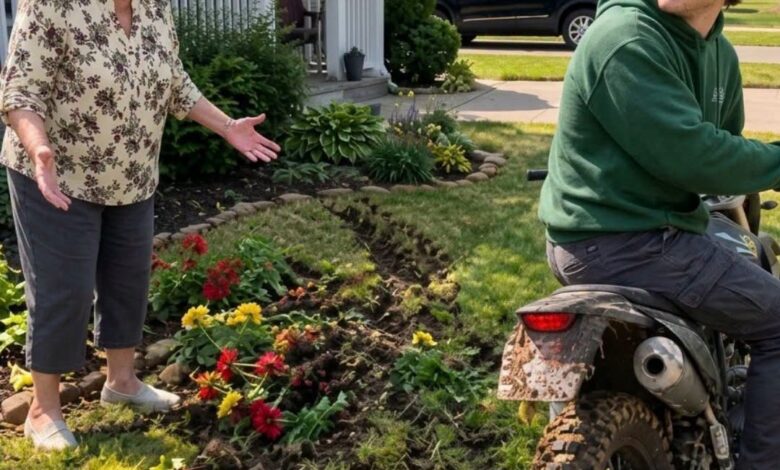
Kyle had cut across my lawn.
His rear tire went straight through Roy’s flower bed.
Seven or eight plants disappeared under the wheel.
Dark soil sprayed across the grass.
The beautiful curve Roy had designed nearly three decades earlier was split by a muddy track.
I went outside.
Kyle had stopped near his driveway.
He removed his helmet.
I crossed the lawn and looked at the damage before looking at him.
“Those flowers were for my husband,” I said. “He died.”
Kyle glanced toward them.
Then shrugged.
“It’s just grass and flowers.”
I stared at him.
“They’ll grow back.”
Across the street, Janet Kowalski stood on her porch.
She had seen everything.
Kyle noticed her.
Janet lowered her eyes and went inside.
A tiny smirk appeared on his face.
That expression decided something for me.
I didn’t yell.
I didn’t threaten him.
I went inside.
Opened my desk drawer.
Took out the folder I had been keeping all summer.
And called Patricia.
“Mrs. Marsh,” she said. “What happened?”
“He finally damaged something.”
I told her everything.
She asked for photographs.
Witnesses.
Dates.
I already had them.
Patricia laughed softly.
“Of course you do.”
Then she said, “The flowers themselves probably aren’t worth much legally.”
“I know.”
“But the documented pattern is.”
That mattered more.
Patricia contacted the city regarding repeated nuisance and property complaints. She also learned that Kyle’s riding privileges had prior conditions connected to an earlier incident.
Then she arranged something simpler.
A formal notice.
Nothing threatening.
Nothing dramatic.
Just a professionally written statement placed beside my front walkway declaring that incidents involving the property were being documented, legal counsel had been retained, and any future damage would be added to the record.
Kyle came outside the next morning.
He walked toward his motorcycle.
Saw the notice.
Stopped.
Read it once.
Then again.
The smirk disappeared.
Twenty minutes later, Dennis saw it too.
Forty minutes after that, he knocked on my door.
“Mrs. Marsh.”
“Dennis.”
“I understand Kyle damaged your flowers.”
“Yes.”
“I’ll pay for them.”
“Yes,” I said. “You will.”
He blinked.
“I just said that.”
“I heard you.”
Then I explained that the flowers were no longer the whole issue.
The city had the complaint.
My attorney had the documentation.
Several months of incidents had been recorded.
Dennis became very still.
“You’ve been documenting him?”
“Since June.”
He looked toward the garden.
I told him Roy had planted it in 1997.
I told him I had kept it after Roy died.
I told him exactly what Kyle had said after riding through it.
They’ll grow back.
Dennis closed his eyes briefly.
Then he asked, “What do you want?”
“Kyle.”
He frowned.
“I want him to come here when he understands why this mattered.”
“You want an apology?”
“A real one.”
Dennis stared at me for several seconds.
Then his posture changed.
“I owe you one too.”
That surprised me.
“I knew about the noise,” he admitted. “And the driveway problems.”
He looked embarrassed.
“I kept hoping he’d grow out of it.”
“That was easier.”
“Yes.”
Three days later, a city representative visited the street.
At first, I stood alone.
Then Janet came out.
Then the Nguyens.
Mrs. Patterson.
Others followed.
One by one, they told the same story.
Noise.
Blocked driveways.
Tire tracks.
Intimidation through entitlement.
They had all stayed quiet because everyone thought complaining alone would accomplish nothing.
Now they were no longer alone.
A local newspaper later published a small community article.
Kyle and Dennis weren’t named.
The piece was about neighborhood responsibility, silence, and what happens when repeated minor disrespect becomes normal.
But Roy was mentioned.
So was the garden.
Two days after the article appeared, Dennis called.
“Kyle wants to speak with you.”
“Did you tell him to?”
“No.”
“Saturday morning.”
Kyle arrived without the motorcycle.
No helmet.
No jacket.
Just jeans and a nervous expression.
He sat across from me at the kitchen table.
“I read about your husband.”
I waited.
“And the garden.”
“Yes.”
He stared at his hands.
“I didn’t understand it.”
“No.”
“I saw flowers.”
“Yes.”
He swallowed.
“I didn’t see what they meant.”
That was the first thing he’d said that mattered.
“I’ve been thinking about what I told you.”
“They’ll grow back.”
He winced.
“Yes.”
Then he looked at me.
“I think I’ve spent a long time acting like if something can be replaced, it doesn’t matter.”
His voice dropped.
“And maybe I do that with people too.”
I said nothing.
He continued.
“My dad always fixed everything.”
“Paid for things.”
“Called people.”
“Handled problems.”
He shook his head.
“I got used to believing that made what I did disappear.”
“And now?”
“Now I know it doesn’t.”
Then he apologized.
No speech.
No excuses.
Just:
“I’m sorry, Mrs. Marsh.”
I believed him.
He offered to pay for the landscaping himself.
Then, before leaving, he hesitated.
“Next spring…”
“Yes?”
“Could I help replant it?”
That surprised me more than the apology.
I studied him.
“Saturday morning.”
He nodded.
“I’ll be here.”
“Bring gloves.”
Before he left, he asked one final question.
“What was Roy like?”
I smiled.
“The kind of man who would bring home an entire truckload of dirt without telling his wife why.”
Kyle laughed.
“He sounds like he knew what mattered.”
“Yes.”
Then Kyle said something I never forgot.
“I’d like to become someone who knows what matters to other people.”
He looked embarrassed.
“I’m not there yet.”
“You’re twenty-two.”
“That sounds like an excuse.”
“It isn’t.”
I shook my head.
“It means you still have time.”
Then I added, “What you do with it is your responsibility.”
The following spring, Kyle showed up wearing borrowed gardening gloves.
We planted red and yellow flowers together.
I showed him the old photograph of Roy kneeling beside the first version of the garden.
Kyle followed the pattern carefully.
Red.
Yellow.
Red.
Yellow.
When we finished, he stood beside me.
“Does it look right?”
I studied it.
“No.”
His face fell.
Then I smiled.
“It never looks exactly the same.”
Gardens change.
People do too, if they decide to.
Roy built that garden in 1997.
Kyle damaged it in seconds.
But neither the motorcycle nor the muddy tire track destroyed what truly mattered.
Because the garden was never only flowers.
It was memory.
Love.
Time.
And, eventually, it became something else too.
Proof that consequences don’t always have to humiliate someone.
Sometimes they simply have to make a person stop long enough to finally see what they drove over.