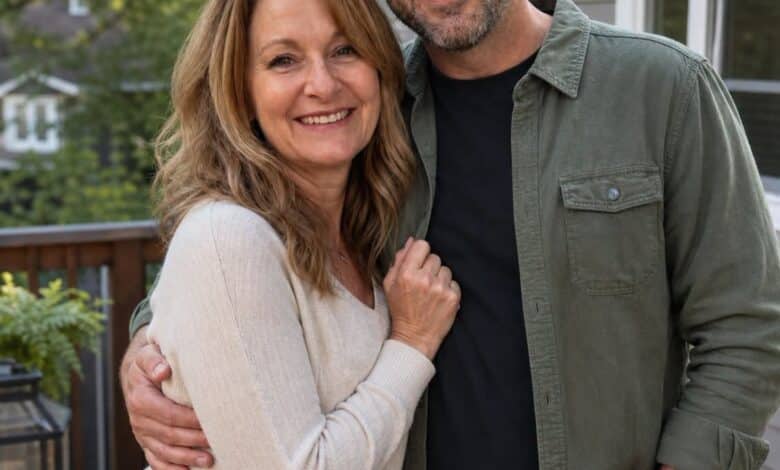
The first time my son saw Richard standing in my backyard, he dropped the glass in his hand.
It struck the patio stones and shattered.
For one suspended second, none of us moved.
Richard had been smiling beside me, one hand resting lightly against my back. Jason had come through the gate carrying a bottle of wine, prepared to meet the man his widowed mother had finally allowed into her life.
Then he saw Richard’s face.
All the color disappeared from his.
“You.”
Richard’s hand fell away from me.
“Jason?”
That was when I understood they weren’t strangers.
My name is Theresa, and after my husband died, I spent years believing grief was something you survived by becoming smaller.
I worked. I paid bills. I called Jason every Sunday. I learned how to sleep on one side of the bed without looking at the other.
Then Richard appeared.
He was patient without making a performance of patience. He never tried to replace my husband. He understood that loving someone who had lost a spouse meant occasionally sharing the room with a memory.
For the first time in years, I began imagining a future without feeling disloyal to the past.
Jason knew I was seeing someone, but I had delayed introducing them.
I worried Jason would think I was moving too quickly.
Instead, when they finally met, my son stared at Richard as if a ghost had stepped into daylight.
“What is going on?” I asked.
Jason didn’t answer me.
He looked at Richard.
“Tell her.”
Richard’s face had changed too.
“I didn’t know Theresa was your mother.”
“Tell her who you are.”
I stepped between them.
“Jason.”
He was breathing too quickly.
Then his hand moved unconsciously toward his left shoulder.
The scar was beneath his shirt, but I knew exactly where it was.
Twelve years earlier, when Jason was twenty, he’d been caught in a warehouse fire.
I still remembered the hospital call.
I remembered arriving to find soot embedded around his hairline and a burn across his shoulder. I remembered him telling me that he’d dragged a man from the building before part of the structure came down.
For years, that was all I knew.
Jason rarely discussed it.
He woke from nightmares for months afterward. Certain smells bothered him. Fire alarms could make him go strangely quiet.
We called it trauma.
We never asked whether there was more.
Richard finally spoke.
“I’m the man he pulled out.”
My knees nearly gave way.
I looked from one to the other.
“You’re telling me Jason saved your life?”
Richard nodded.
Jason laughed, but there was no humor in it.
“That’s not all.”
He walked away from us and stood near the fence.
Richard closed his eyes.
That frightened me more than anything.
“What aren’t you telling me?”
The story came slowly.
Richard had worked around the warehouse operation at the time. What he knew about the fire, and what he suspected about events surrounding it, was more complicated than the version Jason and I had lived with for twelve years.
There had been questions.
Records.
People who didn’t want certain details examined too closely.
Richard had been afraid.
Jason had known enough afterward to understand that something about the fire didn’t fit the simple explanation we’d been given.
Neither man claimed to possess every answer.
That almost made it worse.
This wasn’t a neat conspiracy waiting for one dramatic confession.
It was fragments.
Missing context.
Old fear.
A photograph Richard had kept hidden.
When he finally showed it to us, Jason sat down.
I won’t pretend the photograph solved everything.
It didn’t.
But it connected people and places Richard had spent years trying not to think about, and it confirmed that Jason’s unease had not simply been the imagination of a traumatized twenty-year-old.
I turned toward my son.
“How long have you carried this?”
He looked at the ground.
“Mom—”
“How long?”
“Twelve years.”
The answer broke something in me.
“You were twenty.”
“I was trying to protect you.”
“From what?”
“From being scared.”
I stared at him.
“I was already scared. You nearly died.”
“I know.”
“No, Jason. You don’t get to decide that I couldn’t handle knowing.”
He flinched.
I regretted the sharpness immediately, but not the truth.
Then he said something I have never forgotten.
“Dad had just died two years before. You were finally functioning again. I couldn’t make you afraid every time I left the house.”
There it was.
The logic of love twisted into silence.
He had thought protecting me meant carrying the fear himself.
Richard had done something similar.
He had convinced himself that staying quiet would keep old danger buried.
And I had my own version.
After losing my husband, I had stopped asking difficult questions whenever the answers might threaten the fragile peace I’d constructed.
All three of us had confused silence with safety.
We went inside.
Nobody touched the dinner I’d prepared.
The three of us sat at my kitchen table while evening disappeared beyond the windows.
Jason told me about the calls he’d received after the fire.
About the questions he’d been discouraged from asking.
About details he’d remembered later and then convinced himself were probably meaningless.
Richard filled in what he could.
Sometimes their memories differed.
Sometimes one corrected the other.
Sometimes neither knew.
That mattered.
Fear can turn uncertainty into certainty if you let it. So we agreed not to do that.
We would preserve what existed.
The photograph.
Any documents.
Names.
Dates.
Old messages.
We would distinguish what they remembered from what they could prove.
And if there was credible evidence of wrongdoing or continuing danger, we would take it to the appropriate authorities and seek legal advice rather than trying to investigate or confront anyone ourselves.
Jason resisted at first.
“I don’t want you involved.”
“I became involved twelve years ago when they called me from the hospital.”
“Mom—”
“No.”
My voice was quieter this time.
“You don’t protect me by lying about the weight you’re carrying.”
Richard looked down.
“That applies to you too,” I told him.
He nodded.
That night didn’t solve the mystery of the warehouse fire.
It didn’t erase Jason’s nightmares.
It didn’t absolve Richard of every decision he’d made out of fear.
And it certainly didn’t transform me into some fearless woman who suddenly knew exactly what to do.
Real life rarely gives you that kind of ending.
What changed was simpler.
Nobody was carrying it alone anymore.
Over the following weeks, Jason brought over a box he’d kept hidden in his apartment.
Richard began reconstructing what he remembered.
We organized rather than speculated.
We wrote down questions instead of inventing answers.
When memories conflicted, we left them conflicting.
Truth, I discovered, doesn’t become stronger because you force it into a cleaner story.
And something changed between Jason and me too.
I finally understood that the scar on his shoulder had never been the whole injury.
For years, I’d looked at it and thought, He survived.
I hadn’t asked what survival had required afterward.
One evening, while Richard was making coffee, Jason caught me staring at the scar where it disappeared beneath his sleeve.
“I’m okay, Mom.”
I almost gave him my usual answer.
I know.
Instead I said, “You don’t always have to be.”
His eyes filled.
So did mine.
Richard quietly remained by the counter.
That was one of the reasons I loved him.
He had learned that being present didn’t always require speaking.
I once thought love healed people by removing pain.
Age has corrected me.
Love doesn’t erase burned buildings.
It doesn’t restore the dead.
It doesn’t make frightening information harmless.
It doesn’t guarantee justice, closure, or answers.
Sometimes love does something much less glamorous and much more difficult.
It pulls out a chair.
It puts the photograph on the table.
It lets someone say, “I was afraid.”
It lets another person answer, “So was I.”
And then it refuses to leave.
That first night, the three of us sat around my kitchen table until nearly dawn.
A mother.
Her son.
And the man her son had once carried through fire.
For twelve years, that blaze had survived underground—in scars, nightmares, sealed-away papers, avoided conversations, and one photograph Richard could never quite bring himself to destroy.
By morning, we still didn’t know where the truth would lead.
But for the first time, I wasn’t afraid of knowing.
The fire had taken enough from all of us.
We weren’t going to feed it our silence too.