My parents had called Mia “difficult” so many times that eventually the word seemed to explain everything.
Why they rarely brought her to family gatherings.
Why every request I made to spend time with her ended the same way.
“She needs quiet.”
“She gets overwhelmed.”
“She’s better with routine.”
Apparently, “difficult” also explained why they believed they could leave a nine-year-old girl at my house for four days without asking me first.
My mother didn’t knock that morning.
She let herself in with the spare key I had asked her to return years earlier, sunglasses still covering her eyes.
Mia followed several feet behind.
“Stand by the refrigerator while we bring everything in,” Mom told her.
Mia obeyed immediately.
That was the first thing that bothered me.
Most nine-year-olds would have questions.
Where am I sleeping?
Can I watch television?
What are we having for dinner?
Mia asked nothing.
She stood perfectly still with both hands gripping her backpack straps, staring at the floor as though waiting to discover what rule she had already broken.
The ceiling fan clicked.
Mia flinched.
My father came through the door dragging two suitcases, already wearing the tropical shirt he’d been bragging about for weeks.
“Your mother packed enough clothes for her.”
I looked at Mia’s tiny backpack.
“How long are you leaving her?”
“Until Sunday.”
“You never asked me.”
Dad sighed.
“Because you would have turned it into a whole production.”
“Leaving a child here without asking me is already a production.”
His eyes flicked toward Mia.
“She’s enough work. We don’t need you ruining the cruise too.”
Mia’s fingers tightened around the straps.
Neither of them noticed.
Then Mom removed a folded document from her purse.
“Sign this.”
It looked like a temporary custody authorization.
I skimmed it.
Then stopped.
The section describing Mia said she had been born unable to speak.
That part was true.
Then it claimed she couldn’t reliably remember dates.
That she became “agitated” when investigators tried questioning her.
I read the sentence again.
“What investigators?”
Dad stopped adjusting his suitcase handle.
For half a second, neither parent moved.
Then he looked toward the driveway.
“Your brother left a mess when he died.”
Caleb.
Mia’s father.
My younger brother had died two years earlier in a warehouse fire.
The official story had always felt incomplete, but grief does strange things to your standards for truth. Sometimes you accept an explanation simply because questioning it feels harder than surviving it.
After Caleb died, my parents became Mia’s guardians.
At first, I called constantly.
I asked to take her for lunch.
To the park.
To my house for a weekend.
Mom always had an excuse.
Mia was tired.
Mia needed routine.
Mia was overwhelmed.
Eventually every conversation ended with:
“She needs quiet.”
There had been other details too.
Things I had trained myself not to connect.
My parents once called Caleb’s death “a blessing in disguise,” then quickly changed the subject.
There was an insurance payout.
Then a condo.
Then a new car.
Then the cruise they were about to take.
I hated myself for noticing.
Now, holding that document, I hated myself more for ignoring it.
“I’m not signing this.”
Mom exhaled dramatically.
“You always make everything harder.”
“It says investigators questioned Mia.”
“We don’t have time.”
“Then don’t leave.”
Dad’s face hardened.
“We paid for this trip months ago.”
They left anyway.
Mia didn’t wave goodbye.
She didn’t even watch through the window.
She remained beside the refrigerator until I told her she could sit wherever she wanted.
For two days, she barely left my side.
She also never removed the backpack.
Kitchen.
Living room.
Bathroom.
Guest bedroom.
It went everywhere.
At night, she slept wearing her shoes.
At breakfast, she tore toast into identical pieces and lined them along the edge of her plate.
Then, on the second morning, the ice maker dumped a tray.
The crash was ordinary.
Mia reacted as if a bomb had exploded.
She dropped beneath the dining table and covered both ears.
I took one step toward her.
She scrambled farther away.
So I sat on the kitchen floor.
“Nobody’s angry.”
She didn’t move.
“You can stay there as long as you want.”
Eventually, she crawled out.
I didn’t ask questions.
Something told me questions had already been used against her enough.
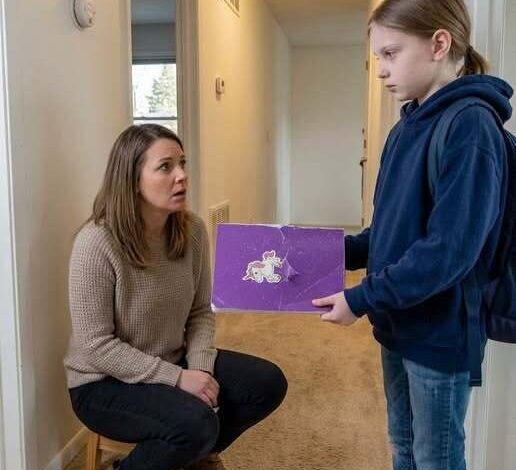
On the third morning, she appeared outside my office holding a purple notebook against her chest.
A cracked unicorn sticker covered the front.
She extended it toward me.
Her hand shook.
I took it slowly.
Inside were drawings.
At first they looked random.
Then patterns appeared.
A blue storage unit.
Again.
And again.
Always the same door.
The same structure beside it.
The same markings across the ground.
Another page showed what looked like a ferry terminal clock.
Another showed Mom’s bracelet beside a pile of papers.
I recognized the bracelet instantly.
Then I saw the dates.
Pages of them.
Precise.
Repeated.
Deliberate.
The custody form sitting on my counter claimed Mia couldn’t remember dates.
Mia had filled an entire notebook with them.
Three figures appeared repeatedly.
She had labeled them carefully:
GRANDMA.
GRANDPA.
DAD.
My mouth went dry.
I turned another page.
A warehouse office.
Caleb lying on the floor.
My father standing near a door.
I stared until my vision blurred.
Then I reached the final page.
Five words.
Grandma said quiet girls stay alive.
My knees gave out.
I slid down the hallway wall.
Mia stood in front of me, watching.
Not like a child waiting to see whether I understood.
Like a child trying to determine whether understanding would make me dangerous too.
I forced myself not to react.
No questions.
No accusations.
No demands that a frightened nine-year-old explain something adults had apparently spent years trying to bury.
I put my hand flat on the carpet between us.
“You don’t have to tell me anything else.”
Mia watched me.
“I’ll keep this safe.”
Then I added the words I should have been able to promise her years earlier.
“And I’ll keep you safe.”
Her shoulders dropped.
Barely.
But they dropped.
I photographed every page.
Then I found a business card I had kept since Caleb’s funeral.
A woman named Agent Morris answered.
I gave her my name.
Then Caleb’s.
Silence.
Not confusion.
Recognition.
Her first question was immediate.
“Is the child safe with you?”
I looked at Mia.
Backpack on.
Both straps.
“Yes.”
“When do the grandparents return?”
“Sunday.”
“Do not confront them.”
Her voice became precise.
“Do not sign anything they gave you.”
I looked toward the kitchen counter.
“Do not let that notebook out of your possession.”
Suddenly, the custody statement no longer sounded like a medical description.
It sounded like preparation.
Born silent.
Unable to remember dates.
Agitated when questioned.
Words designed to make adults dismiss anything Mia might someday try to communicate.
“What happened after Caleb died?” I asked.
“I can’t discuss that fully over the phone.”
“Were my parents investigated?”
Another pause.
“Mia’s safety comes first.”
That was answer enough.
Sunday.
My parents would return expecting everything unchanged.
Mia quiet.
Me obedient.
Their paperwork signed.
Then Mia unzipped her backpack.
She pulled out a folded sheet.
Their cruise itinerary.
The Sunday arrival pier had been circled in purple crayon.
I looked at her.
She opened the notebook again.
Flipped to the back cover.
Pressed one finger against the lining.
Something shifted underneath.
Hard.
Hidden.
My pulse hammered.
I peeled back the paper carefully.
Inside was a small plastic sleeve.
And inside that—
a memory card.
Mia immediately stepped backward.
I stopped touching it.
“You kept this safe?”
She nodded.
“For your dad?”
Another nod.
Then she raised one finger to her lips.
Quiet.
The gesture nearly broke me.
For two years, everyone had believed Mia’s silence meant she had nothing to say.
But she had been speaking the entire time.
Through drawings.
Dates.
Places.
Objects.
Through everything adults had dismissed because she couldn’t use her voice.
I looked at the memory card again.
Whatever Caleb had left behind, his daughter had guarded it through every meal, every punishment, every sudden noise, and every night she slept in her shoes.
My parents hadn’t brought Mia to me because they trusted me.
They had brought her because they believed they had finally made her harmless.
They were wrong.
On Sunday, they expected to come home from vacation and collect the same frightened child they had left behind.
Instead, federal investigators would be waiting.
And for the first time since my brother died, the person my parents had spent two years teaching everyone not to believe was about to become the most important witness of all.