The investigator placed the tube of concealer beside Paige’s diaper bag and asked the question that changed everything.
“If your sister says the injury happened after she left the baby with you, why was this already packed in the bag?”
I stared at it.
An hour earlier, that bag had contained nothing more sinister than bottles, diapers, wipes, spare clothes, and toys.
Now it looked like evidence.
I repeated the morning from the beginning.
Kate and her husband had brought six-month-old Paige to my house. Kate said the baby had been awake most of the night teething.
Before leaving, she told me, “You’re the one person I trust to make the call if she gets too fussy.”
Twenty minutes later, Paige began screaming.
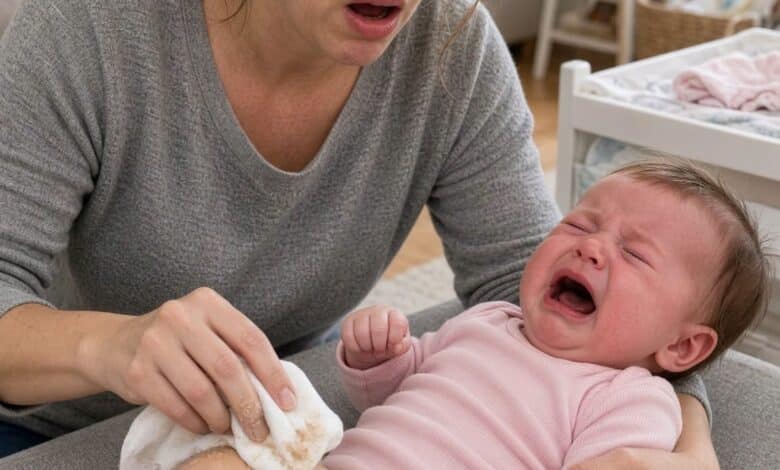
When I repositioned her, she reacted as though I had hurt her. Her left leg barely moved. Under her green sleeper, I smelled something floral and powdery.
Then I found the beige coating.
I wiped one tiny section.
Concealer came away.
Underneath was dark bruising and swelling.
“And then?” the investigator asked.
“I stopped.”
“Why?”
“Because I realized somebody had already seen the injury.”
Saying it aloud made the truth unavoidable.
This wasn’t a bruise someone had overlooked.
Someone had noticed it closely enough to cover it.
I showed her the text I sent Kate from the emergency room.
Paige is in the ER. Something is seriously wrong with her leg. There was makeup covering a huge bruise. Get here NOW.
Beneath it was one word.
Read.
Kate had seen my message almost immediately.
She hadn’t asked which hospital.
Hadn’t asked whether Paige was conscious.
Hadn’t called me.
Instead, she had apparently told investigators Paige was perfectly healthy when she entered my house.
“Has your sister ever accused you of hurting Paige before?”
“Never.”
“Have you two been fighting?”
“No.”
“Any reason she would believe you’d harm her daughter?”
“No.”
That answer hurt.
Kate was my older sister.
She trusted me.
Or I had thought she did.
The doctor returned with Paige’s X-ray results. She explained carefully that Paige had a serious injury to her left leg requiring treatment and further evaluation. Given Paige’s age, the bruising, and the apparent attempt to conceal it, the hospital could not treat the situation as an ordinary accident without understanding what happened.
“Could it have happened during those twenty minutes with me?” I asked.
The doctor didn’t pretend the imaging could answer every question by itself.
“The medical findings have to be considered alongside the timeline and everyone’s statements.”
Then she added something important.
“But the bruising had already been covered before you removed her clothing.”
That was the first solid thing I had heard all afternoon.
Whatever had happened to Paige, someone knew enough to conceal what was visible.
And I hadn’t put concealer on her.
The investigator photographed and preserved the diaper bag and its contents.
Then she asked:
“Who dressed Paige this morning?”
“Kate.”
“Did you change her clothes before discovering the bruise?”
“No.”
“Did you open the pocket where we found the concealer?”
“No.”
She wrote everything down.
Forty minutes later, Kate finally arrived with her husband.
I heard her before I saw her.
“I want to see my daughter!”
A hospital employee calmly told her to wait.
Then Kate demanded to see me.
The investigator entered instead.
“Your sister is here.”
I stood.
“Can I talk to her?”
“Not yet.”
Then she told me something else.
Kate and her husband had been interviewed separately.
Their accounts did not match.
Kate had said Paige spent the previous night crying because she was teething.
Her husband admitted there had been an incident.
He called it an accident while he was handling Paige.
My pulse jumped.
That did not automatically establish exactly how Paige had been injured.
But it established something critical.
Something had happened before they brought her to me.
Something serious enough for both parents to know Paige might be hurt.
Investigators confronted Kate with the discrepancy.
At first she denied using makeup.
Then she said she might have put a little concealer on Paige because the skin looked irritated.
But the hospital photographs showed something very different from mild redness.
There was substantial discoloration.
Swelling.
Pain when the area was touched.
Eventually, Kate stopped denying the most basic facts.
She had seen the bruise that morning.
She had covered it.
She had dressed Paige afterward.
And she had deliberately said nothing to me.
What she struggled to explain was why.
Her husband supplied part of the answer.
They had argued about taking Paige to the hospital.
They were frightened that an injury on a six-month-old who could not explain what happened would bring questions.
So instead of seeking care immediately, they waited.
Then they brought her to me.
Suddenly Kate’s strange sentence at my door made terrible sense.
You’re the one person I trust to make the call if she gets too fussy.
She had handed me responsibility for the decision she was afraid to make herself.
If Paige remained quiet, perhaps nobody would discover anything that day.
If she became worse, I would be the person who took her for medical care.
And when that happened, there would be a new window of time in which the injury could supposedly have occurred.
Kate later insisted she had never planned to frame me.
Maybe that distinction mattered to her.
It mattered less to me after I learned what happened when she received my hospital message.
She knew Paige had been hurt before arriving at my house.
She knew she had covered the bruise.
Yet when questioned, she initially said Paige had been fine when she left her with me.
Her first instinct had not been to tell the truth about her daughter.
It had been to protect herself.
And when that required suspicion to fall somewhere else, it fell on me.
The plan—or panic, or whatever Kate wanted to call it—didn’t unravel because I was particularly clever.
It unraveled because Paige screamed.
Her body refused to cooperate with the story adults were constructing around her.
The hospital did not simply send Paige back into the same circumstances that night. A temporary safety arrangement was established while professionals continued evaluating what had happened and what environment was appropriate for her.
Everyone was interviewed separately.
The X-rays were preserved.
The photographs were preserved.
So were my text messages, the diaper bag, the concealer, and the medical notes.
Investigators documented something else too:
I had wiped only one small portion of Paige’s thigh.
Then I stopped and sought medical help.
That mattered when Kate suggested I might somehow have caused or altered the injury while changing her.
I had discovered something already concealed.
I had stopped touching it.
And I had taken Paige directly to people who could help her.
Over the following days, our family fractured.
My parents begged me not to “choose sides.”
“There are no sides,” I told them.
“There’s Paige.”
A six-month-old baby had been injured.
Someone had covered the visible evidence.
Both parents knew something concerning had happened before she entered my home.
Everything else came second.
Kate called me crying.
“I panicked.”
“I know.”
“I love her.”
“I know.”
“I was terrified they’d take her away.”
I believed her.
That was perhaps the hardest part.
People want harmful choices to come from people who feel nothing.
Sometimes they come from frightened people who love someone and still choose terribly.
Fear could have driven Kate toward a hospital.
Instead, it drove her toward concealer.
Then silence.
Then me.
That was the part our relationship could not simply recover from.
As the investigation continued, I was asked whether I would remain part of Paige’s safe support network if needed.
“Yes.”
I didn’t hesitate.
Not because Kate was my sister.
Because Paige was my niece.
The first time I saw her again, her injured leg was protected and she was calmer.
She still startled when repositioned.
Every tiny wince twisted something inside me.
I sat beside her and offered one finger.
Her whole hand wrapped around it.
There was no floral smell.
No makeup.
Nothing hidden beneath her clothes.
Just a baby whose pain should have mattered the first moment someone noticed it.
Later, Kate sent me a long message.
For once, there were no carefully edited versions.
She admitted seeing the bruise.
She admitted applying the concealer because she feared questions about how Paige had been hurt.
And she admitted that after receiving my hospital message, she had initially blamed me because she believed moving the timeline forward might protect her and her husband.
I read that sentence repeatedly.
Then I saved the message.
I did not reply.
The old version of me would have called immediately.
I would have told Kate I understood.
I would have tried to soothe her guilt because she was my sister and because keeping peace had always felt like another form of love.
I couldn’t do that anymore.
Her fear explained something.
It did not erase anything.
Paige had been in pain before I knew it.
The pain remained real while makeup covered it.
It remained real while Kate smiled at my front door.
It remained real while she drove away.
Months later, Paige was healing well.
The bruising disappeared.
Our family did not return to what it had been.
Neither did I.
I still remembered that Saturday through tiny details.
The green sleeper.
Kate’s exhausted face.
The unanswered message.
The powdery floral scent.
And one white baby wipe turning beige in my hand.
Kate had told me I was the one person she trusted to make the call.
In the end, she was right.
I made it.
Just not the call she had expected.
I chose a six-month-old baby’s pain over an adult’s explanation.
I chose evidence over family loyalty.
I chose Paige over the silence everyone wanted me to preserve.
And once I saw what was underneath the concealer, I never helped anyone cover it again.