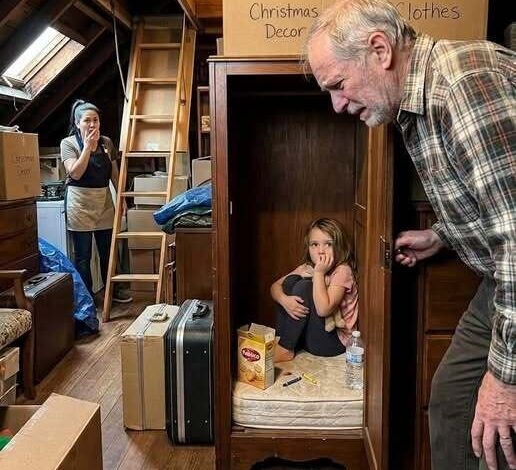
The first thing I noticed was that Sophie did not run toward me.
She sat inside the attic wardrobe with her knees pulled to her chest, clutching a worn stuffed rabbit while heat pressed down around her like a second wall.
Five years old.
Alone.
Hidden inside a house I owned.
And the man who had put her there was my son.
For nearly four years, Dennis and his wife, Trisha, had lived in my Portland property without paying rent. I told myself I was helping them get established. I told myself grown children deserved privacy.
Eventually, I got so good at explaining their distance that I stopped asking why they rarely let me through the front door.
Then Dennis called on June 3.
“Dad, can you hire someone to deep-clean the house while we’re away?”
No hello.
No conversation.
Just another favor.
I said yes anyway.
That is the humiliating thing about loving your only child. Sometimes you mistake being useful for being wanted.
Dennis said he and Trisha were leaving town and wanted the house cleaned before they returned. He gave me almost no details.
Find someone.
Unlock the door.
Pay them.
Make sure everything was finished.
So I hired Rosa Martinez.
I trusted Rosa completely. She had worked for me before and was one of the most straightforward people I knew.
The next morning, I let her into the house.
The place looked strangely perfect.
White furniture.
Framed vacation photographs.
Decor arranged precisely.
No toys.
No children’s shoes.
No drawings.
Nothing suggesting a five-year-old girl had ever lived there.
I left.
Less than an hour later, Rosa called.
Her voice was shaking.
“Mr. Stanley, come back.”
“What happened?”
“There’s a child crying in the attic.”
I drove faster than I should have.
When I arrived, Rosa was waiting outside with her phone in both hands.
“I didn’t touch anything,” she said. “I just heard her.”
Inside, the house was silent.
Then I heard it.
A tiny, broken cry somewhere overhead.
I pulled down the attic ladder.
Heat rolled over me.
Boxes filled the rafters. Christmas decorations, old suitcases, storage bins—years of forgotten things stacked almost to the roof.
At the far end stood an old wooden wardrobe buried behind several boxes.
Then came another sound.
Crying.
From inside.
I opened the door.
Sophie stared at me.
Thin mattress.
Cracker box.
Half a bottle of water.
Two broken crayons.
Stuffed rabbit.
No fan.
No bathroom.
No safe way down.
She looked about five, but there was something older in the way she watched me.
I had worked in social services for almost forty years.
I knew that stillness.
It belonged to children who had learned that making themselves smaller sometimes kept them safer.
I crouched several feet away.
“My name is Elmer.”
She tightened her grip on the rabbit.
“I’m not going to hurt you.”
Her first question nearly broke me.
“Are you the cleaning lady’s friend?”
“Yes.”
I swallowed.
“You don’t have to be quiet anymore.”
That frightened her more than anything else I said.
“What’s your name?”
“Sophie.”
“How old are you?”
“Five. Almost six.”
I knew I should wait for police before asking anything else.
But one question was already sitting in my throat.
“Who told you to stay up here?”
Her eyes dropped.
“My daddy.”
My stomach tightened.
“What is your daddy’s name?”
She looked directly at me.
“Dennis.”
For several seconds, everything inside me stopped.
My son.
My only child.
The man whose childhood drawings I still kept in a box.
The boy I had taught to ride a bicycle.
The teenager I once sat beside after his first heartbreak.
Dennis had a daughter.
A daughter he had never told me existed.
A daughter he had hidden in my attic.
I carried Sophie downstairs while Rosa called 911.
The little girl wrapped both arms around my shirt and made almost no sound.
She felt frighteningly light.
On the living-room wall, photographs showed Dennis and Trisha everywhere.
Beaches.
Christmas dinners.
Anniversaries.
Vacations.
Sophie appeared nowhere.
Paramedics arrived first.
Police followed.
An officer climbed into the attic and returned with an expression I recognized immediately.
Not confusion.
Evidence.
They photographed everything.
The wardrobe.
The mattress.
Food.
Water.
Crayons.
The path through the storage boxes.
Then Sophie looked toward a photograph of Trisha.
“Daddy said the lady in the pictures would be angry if she knew I was here.”
The room changed.
An officer knelt gently beside her.
“Which lady?”
Sophie pointed.
Trisha.
So perhaps Dennis had been hiding Sophie from his wife.
That was the explanation I desperately wanted.
Then I remembered the exterior cameras.
Dennis had never transferred control of the security system. The recordings still backed up to my account.
I opened the app.
Three nights earlier, Dennis appeared in the garage.
Beside him walked Sophie.
Pink shirt.
Same stuffed rabbit.
He led her toward the interior door.
The footage did not show the attic itself.
But it proved he had brought her there.
The officer downloaded the original recording.
Then my phone rang.
Dennis.
I answered on speaker.
“Dad,” he said sharply, “why are there police cars at the house?”
He didn’t ask if someone was hurt.
He didn’t ask where Sophie was.
I looked at the little girl on the couch.
“Your daughter is safe.”
Silence.
Then, from somewhere behind him, Trisha screamed:
“He found her?”
Everyone in the room heard it.
She knew.
Dennis immediately started talking.
“Dad, wait. This isn’t what it looks like.”
“You left a five-year-old in an attic.”
“She had food.”
My hand tightened around the phone.
“She had crackers and half a bottle of water.”
“We were handling it.”
Handling it.
As though she were a storage problem.
Sophie flinched at the sound of his voice.
Every officer noticed.
“Come home,” I said.
Dennis exhaled.
“Good. We’ll straighten this out as a family.”
“No.”
A pause.
“You’re coming home to explain it to detectives.”
His voice hardened.
“Dad, listen to me.”
I let him talk.
For once, I didn’t rescue him from his own words.
Then an officer entered carrying a sealed evidence bag.
Inside was a birth certificate.
They had found it hidden beneath the attic mattress.
The officer read the father’s name.
Dennis Stanley.
That erased any remaining doubt.
Then he read the mother’s name.
Trisha screamed through the phone.
The sound was so sudden that everyone turned toward the speaker.
The detective looked at the document again.
Then at me.
His expression changed.
I stared at the name beneath the plastic.
And suddenly I understood why he was looking at me like that.
The mother listed on Sophie’s birth certificate was not Trisha.
It was Emily Stanley.
My daughter.
Dennis’s younger sister.
A child I had buried twelve years earlier after what I had been told was an overdose.
The room seemed to tilt.
“That’s impossible,” I whispered.
The detective didn’t answer.
Because it wasn’t impossible.
The document was real.
Sophie was five.
Emily had supposedly been dead for twelve years.
Nothing made sense.
Then Sophie slid from the couch.
She walked toward me slowly.
“Grandpa?”
The word nearly stopped my heart.
I crouched.
She reached into the pocket of her pink shirt and pulled out a tiny folded photograph.
It was creased almost beyond recognition.
But I knew the woman immediately.
Emily.
Older than she had been when I last saw her.
Alive.
Holding a newborn baby.
Sophie.
On the back, someone had written a date from five years earlier.
And beneath it:
If anything happens to me, take Sophie to Dad. Dennis knows why.
I looked toward the phone.
Dennis was still connected.
Still breathing.
Still listening.
For years, I had believed my daughter died alone.
Now I was holding proof that she had lived at least seven years longer than I had been told.
Proof that Dennis knew.
Proof that Sophie existed.
And perhaps proof that every explanation my son had given me about our family had been built on a lie.
“Dennis,” I said.
He didn’t answer.
So I asked the only question that mattered.
“What happened to Emily?”
The line went dead.
For the first time that day, Sophie reached for my hand without being asked.
I closed my fingers around hers.
I had entered the house believing my son had become distant.
I left knowing distance had been the least of our problems.
A hidden child.
A daughter who might not have died when I was told she did.
A birth certificate that should have been impossible.
And a son suddenly terrified of one simple question.
Finding Sophie was not the end of the mystery.
It was the moment the entire story of my family began to collapse.