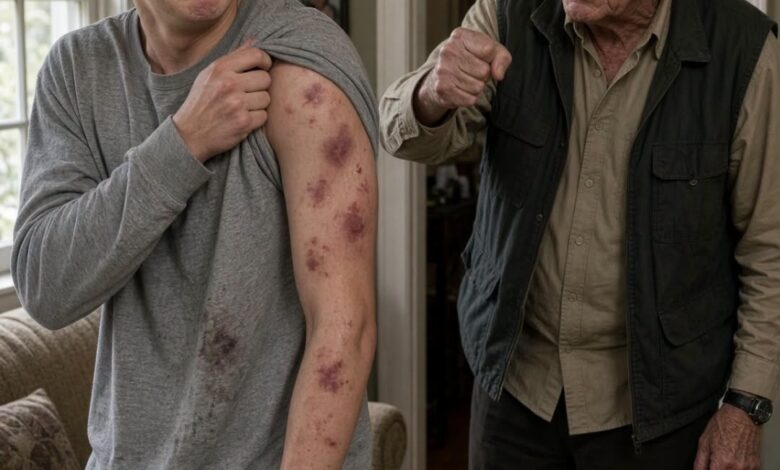
Miranda stopped the instant the officer raised his hand.
“Ma’am, stay there.”
For half a second, her face changed.
The polished concern disappeared.
Then it came back.
“I’m only trying to bring her home.”
The second officer looked directly at me.
“Can we speak with you separately?”
My stomach dropped.
Miranda answered before I could.
“She’s confused. She’s been emotional lately.”
Grandpa Elias turned toward the officer.
“She can answer for herself.”
That sentence mattered more than he knew.
Nobody had let me answer for myself in months.
I sat on the edge of Grandpa’s couch, the cedar-smelling quilt still folded beside me. The officer asked my name, my age, and finally whether I felt safe returning home with Miranda.
“No.”
It came out as a whisper.
He waited.
So I said it again.
“No.”
Then he asked about the bruises.
I told him some of it.
Not perfectly.
Not in order.
A hard grab.
Being shoved into a wall.
Her fingers closing around my arm when I talked back.
The time she hit my ribs and later told me I had made her lose control.
Some bruises were old.
Some were fresh.
I couldn’t remember exactly when each one happened.
The officer didn’t make me guess.
He simply listened.
That was new too.
People imagine telling the truth about abuse is one clean moment.
Something bad happens.
You tell.
An adult fixes it.
But when the person hurting you lives inside your house, cooks your dinner, signs school forms, smiles at neighbors, and knows exactly how frightened you are of being called difficult, the truth starts feeling dangerous.
What if Dad believed her?
What if he confronted her and then left for work?
What if she came upstairs afterward?
Those questions had kept me quiet longer than fear itself.
From outside the room, I heard Miranda explaining that I bruised easily.
Then the bicycle story.
That part frightened me because it was partially true.
I had fallen off my bike three weeks earlier.
One scraped knee.
She had taken one real fact and stretched it until it covered everything else.
“I did fall,” I told the officer.
He nodded.
“Okay.”
“But not like this.”
“Okay.”
No accusation.
No surprise.
Just room for both things to be true.
The officer asked whether a doctor had seen my injuries.
“Not yet.”
Grandpa answered from the doorway.
“That was where we were heading.”
Miranda immediately said, “I’m a nurse. I know what accidental bruising looks like.”
The officer glanced at her.
“So do doctors.”
Miranda went quiet.
That silence scared me more than her shouting.
She was never quiet when she believed she controlled the room.
Then tires crunched across Grandpa’s driveway.
Dad.
He parked crooked and jumped out still wearing his work jacket.
“What’s going on?”
Miranda reached him first.
Of course she did.
“Daniel, thank God. Your father took her last night. Now she’s making accusations because she fell off her bike.”
Dad looked at Grandpa.
Then the officers.
Then me.
His eyes dropped to my arms.
He stopped.
“Sweetheart?”
That one word almost broke me.
Because he sounded like my father again.
The man who used to tuck notes beside my cereal.
The man who packed too many snacks into my school bag.
The man I had spent months telling myself was simply tired.
Miranda saw me crying and moved closer to him.
“See? She’s emotional.”
Dad looked at me.
“What happened?”
I couldn’t speak.
Grandpa did something I’ll never forget.
He stopped Dad before he could ask again.
“No.”
Dad turned toward him.
Grandpa pointed at me.
“She tells you.”
For the second time that morning, he gave me my voice back.
I tried.
Nothing came.
Then I forced it out.
“Miranda did it.”
Dad went completely still.
Miranda laughed—a small, shocked sound.
“Daniel, come on.”
“She grabs me,” I continued.
Dad’s face changed.
“She shoves me.”
“Stop.”
Miranda’s voice sharpened.
The officer raised his hand.
“Ma’am.”
I looked at Dad.
“She said you’d believe her.”
His eyes closed.
Only for a second.
Then he asked the question I had expected.
“Why didn’t you tell me?”
Grandpa leaned forward.
“Wrong question.”
Dad stared at him.
Grandpa’s voice stayed calm.
“Ask why she was afraid to.”
Silence.
That was the moment something shifted in Dad.
He looked at Miranda.
For the first time, she looked genuinely frightened.
Not of the police.
Of losing the person whose automatic trust she had counted on.
“Daniel,” she whispered.
Dad ignored her.
He looked at the officer.
“What happens now?”
“She gets medically evaluated. We document what she tells us and what the doctor observes.”
Dad nodded.
Miranda started talking quickly.
“This is insane. She knows exactly what she’s doing. She’s manipulating all of you.”
Dad turned toward her.
“Stop.”
She froze.
“What?”
“I said stop.”
Then he looked at me.
“I need to hear her.”
That was the first moment I believed maybe I wouldn’t have to go back.
Grandpa picked up my backpack.
“Ready?”
I nodded.
Dad said, “I’m coming.”
Miranda grabbed his arm.
“No.”
Dad pulled free.
“I’m going with my daughter.”
My daughter.
Not her.
Not the situation.
Me.
Grandpa drove us to the clinic.
Dad sat in front.
I sat in back.
Nobody spoke for ten minutes.
Then Dad turned slightly.
“I’m sorry.”
Grandpa kept his eyes on the road.
“Don’t make her take care of you right now.”
Dad went silent.
That sentence stayed with me.
For months, I had been managing adults.
Miranda’s moods.
Dad’s ignorance.
The atmosphere at dinner.
Whether anybody suspected anything.
Even now, Dad’s guilt could have become one more thing I had to soothe.
Grandpa refused to let that happen.
At the clinic, a nurse asked whether I wanted Dad in the room.
He looked wrecked.
But he said, “Whatever she wants.”
“Grandpa.”
So Grandpa stayed.
Dad waited outside.
The doctor examined the bruises without dramatic reactions. She asked what I remembered. I told her what I knew.
Where I was uncertain, she let me be uncertain.
Nobody forced me to make the story cleaner than it was.
Later, Dad came to the doorway.
He didn’t enter.
“Can I come in?”
That was the first time I remembered him asking permission to enter a room I was in.
I nodded.
He sat against the wall.
“I called work. I’m not going tonight.”
Something inside me loosened.
Small.
But real.
“I don’t want to go home.”
Dad nodded immediately.
“Okay.”
I looked at him.
“You’re not mad?”
His face broke.
“No.”
I hated that I had to ask.
He hated it too.
“No,” he repeated. “You can stay with Grandpa as long as you want.”
As long as you want.
Not until Miranda calms down.
Not until everyone talks.
Not until I behave better.
That night, Dad came to Grandpa’s house carrying a grocery bag with clothes from my room.
Three pairs of socks.
No jeans.
Grandpa looked inside.
“You still pack like an idiot.”
Dad laughed.
Then cried.
He turned away.
Grandpa pretended not to notice.
So did I.
Later, Dad and I sat beneath the porch light.
He told me Miranda had spent months saying I was difficult.
Moody.
Dishonest.
“Why didn’t you ask me?” I said.
“I did.”
“No.”
He looked at me.
“You asked if school was okay.”
He lowered his eyes.
“You asked if I was behaving.”
That hurt him.
“You asked Miranda what was wrong with me.”
The porch went quiet.
Finally, Dad nodded.
“You’re right.”
No excuse.
Then he said, “I was absent. She filled in everything I wasn’t seeing, and I accepted it because it was easier.”
That honesty hurt, but I needed it.
Because the problem had never been only what Miranda did.
It was also that Dad had handed her authority over the story of who I was.
“I don’t know how to fix this,” he whispered.
I did.
“Don’t make me go back.”
“I won’t.”
“Don’t make me talk to her.”
“I won’t.”
“Don’t tell me she didn’t mean it.”
His eyes closed.
“I won’t.”
Three promises.
Simple.
Specific.
Measurable.
Weeks passed.
I stayed with Grandpa.
At first, every sound after dark woke me.
He left the hallway light on without commenting.
Dad started knocking before entering the spare room.
Sometimes I let him in.
Sometimes I said no.
The first time I refused, I held my breath.
Dad simply said, “Okay,” and walked away.
I almost cried.
I had forgotten what it felt like to have a boundary survive contact with another person.
Months later, I finally asked Grandpa what he had meant that first night.
“We’ll play her game, but by my rules.”
He was sitting at the kitchen table cleaning his glasses.
“What were your rules?”
He shrugged.
“No screaming.”
I waited.
“No threats.”
Then he tapped one finger against the table.
“Get you safe. Let somebody independent see the injuries. Let you speak for yourself. Make the truth harder to dismiss.”
“That was the game?”
“That was reality.”
He put his glasses back on.
“People who depend on fear hate witnesses.”
That was when I finally understood.
Grandpa hadn’t defeated Miranda by being louder than she was.
He removed the things that made her control possible.
Privacy.
Isolation.
Fear.
Her ability to speak for me.
He became the first witness.
Then the officers listened.
Then the doctor documented.
Then Dad finally heard me.
One person believing me made it possible for the next person to listen without Miranda controlling the room.
For months, she had repeated the same sentence:
Nobody will believe you.
She was wrong.
It only took one person to make that sentence stop being true.
Grandpa Elias was the first.
He wasn’t the last.