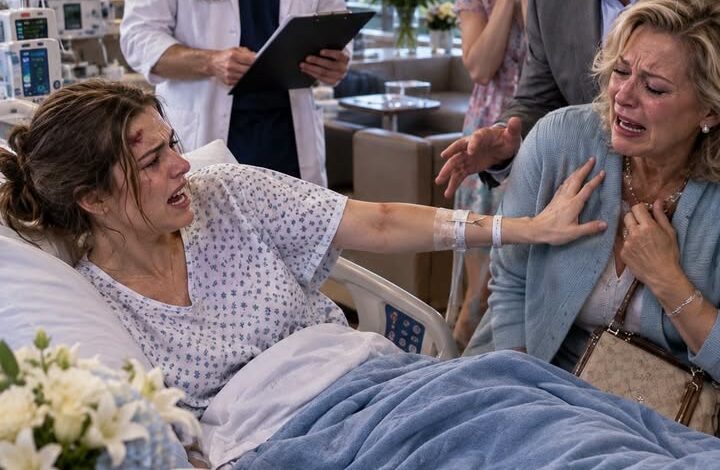
My father’s first question after learning I’d changed my estate plan wasn’t whether I was still in pain.
It was about the foundation.
“What did you do with it?”
The hospital room went silent.
Julian Vance, my estate attorney, looked at me before answering. I gave him a small nod.
“The foundation still exists,” I said. “I didn’t dismantle anything.”
Dad’s shoulders loosened slightly.
Then I finished.
“I changed who gets to control it.”
Julian opened the final set of documents.
“The foundation will continue supporting medical scholarships, emergency-treatment grants, and related charitable programs,” he explained. “The difference is that the board positions previously contemplated for Mr. and Mrs. Hayes are no longer part of Miranda’s plan.”
My mother stared at him.
“You removed us?”
“Yes,” I said.
Her face crumpled with disbelief.
“But we built that foundation with you.”
For years, I would have let that sentence pass.
I would have softened the truth because correcting her would have seemed petty.
Not anymore.
“No, Mom.”
She looked at me.
“I built it. You attended the dinners.”
She flinched.
The words sounded crueler spoken aloud than they had in my head, but they were true.
My parents had always treated my accomplishments as communal property.
When my medical-software company succeeded, Dad introduced himself at events by saying, “We built something special.”
When I sold it, Mom told relatives, “We’re finally secure.”
When I established the foundation, they spoke enthusiastically about “our mission.”
I never corrected them.
Partly because I loved them.
Partly because I enjoyed giving them a life they hadn’t imagined having.
And partly because somewhere along the way, I’d confused providing for my family with earning my place inside it.
Dad lowered himself into the chair beside my bed.
“Miranda, we made a mistake.”
“A mistake?”
My voice was weak, but I didn’t look away.
“A mistake is forgetting an appointment. You knew I’d been hit by a truck. You knew I’d had surgery.”
Mom wiped her face.
“We thought you were stable.”
“You saw my calls.”
Nothing.
“Nine of them.”
She looked down.
“You even texted me asking whether it was urgent.”
“I thought if something was really wrong, someone from the hospital would call.”
“I called.”
That stopped her.
“I was the person in the hospital, Mom. I was telling you something was wrong.”
Her mouth opened.
Nothing came out.
I turned toward the window because suddenly the anger was gone.
What remained hurt much more.
“I wasn’t asking you to save me.”
My voice cracked.
“I wasn’t asking for money. I didn’t need you to call a specialist or solve some business problem.”
I swallowed.
“I wanted my mother.”
She began crying.
“And I wanted Dad.”
My father covered his mouth.
“I was scared,” I whispered. “I didn’t know what was going to happen. And I wanted my parents.”
Mom moved toward the bed.
My instinct was still to comfort her.
That realization almost made me laugh.
I was the one recovering from surgery, yet some old reflex inside me still wanted to make her feel better about abandoning me.
I let my hands remain beneath the blanket.
Dad finally asked, “What do you want us to do?”
That was the question everyone in my family always asked when consequences appeared.
What payment fixes this?
What apology?
What gesture?
What do we have to do to restore the previous arrangement?
“For once,” I said, “I don’t want you asking what you have to do to get something back.”
His expression changed.
“I want you to decide whether you still want to be my parents when there’s nothing to inherit.”
Mom stared at me.
“Of course we do.”
“Then nothing should change.”
She had no response.
“If the inheritance wasn’t why you loved me, removing it shouldn’t affect whether you call me tomorrow.”
Dad closed his eyes.
“If the lake house wasn’t why you visited, you’ll still visit.”
Mom looked away.
“If the foundation wasn’t why you were proud of me, you can still be proud without sitting on its board.”
The silence answered more than either of them could.
Eventually Mom stood.
“We do love you.”
And strangely, I believed her.
That was what made everything so complicated.
My parents weren’t cartoon villains who had spent decades plotting to steal my money.
They loved me.
But they had also become comfortable benefiting from me.
They had grown accustomed to the daughter who needed less and gave more.
Lauren needed rescuing.
Miranda handled herself.
Lauren needed money.
Miranda had money.
Lauren needed help moving.
Miranda would understand.
Over enough years, my competence had become permission to neglect me.
Love existed.
So did entitlement.
One didn’t erase the other.
Dad walked toward the door.
Then stopped.
“Will you forgive us?”
I thought carefully.
“Maybe.”
He nodded.
“But forgiveness doesn’t automatically restore access.”
He looked back.
“To what?”
“My money. My decisions. My plans. My time.”
Then I added, “Or me.”
Mom started crying again.
This time, I didn’t interpret her tears as an instruction.
They left quietly.
Julian waited until the door closed before shutting his briefcase.
“You okay?”
I looked down at the documents.
“Ask me tomorrow.”
He smiled faintly.
“Fair.”
Then I surprised myself.
“But I think I will be.”
Three months later, I walked into the foundation’s first meeting under its restructured leadership.
My ribs still ached occasionally.
I moved slower than before the accident.
But the room felt different.
Nobody there had been promised a position because we shared DNA.
The new board included people with experience in healthcare, nonprofit administration, finance, and patient advocacy.
We spent that first meeting discussing scholarship applications.
Emergency medical grants.
Families suddenly drowning in expenses because illness and accidents don’t wait until anyone is financially prepared.
At one point, I looked around the table and thought about the hospital.
About lying beneath fluorescent lights and discovering how quickly an ordinary day could split a life into before and after.
For years, my foundation had been something my parents displayed proudly.
Now it finally felt like something useful.
Lauren contacted me eventually.
Her first message was long.
Defensive in places.
Apologetic in others.
She said she hadn’t understood how serious my condition was.
I believed that.
But she also admitted something I hadn’t expected.
She hadn’t asked.
Mom and Dad arrived at her house, and Lauren accepted their help without wondering whether they should be somewhere else.
For once, she didn’t make herself the innocent younger sister.
She simply said:
I should have asked where you needed them more.
I replied.
We didn’t immediately become close.
I didn’t restore her to my estate.
But we started having conversations without money hiding underneath them.
My relationship with my parents changed too.
Several weeks later, Mom visited.
No flowers worth hundreds of dollars.
No dramatic apology.
She brought soup.
Dad brought pastries from the bakery I loved as a child.
They stayed for an hour.
Nobody mentioned the will.
Nobody asked about the foundation.
Nobody brought up the lake house.
Dad told me about a disastrous attempt to repair his garage door himself.
Mom complained about his refusal to read instructions.
I laughed hard enough that my ribs hurt.
Mom immediately stood.
“You okay?”
“I’m fine.”
She sat back down.
That tiny moment meant more to me than another apology.
She had noticed.
When they left, Dad hugged me carefully.
“Call us if you need anything.”
I looked at him.
He caught himself.
“No. That’s not right.”
“What?”
“You called before.”
He paused.
“We need to answer.”
I didn’t say anything.
Neither did he.
There are wounds that shouldn’t be wrapped in a perfect ending.
My parents didn’t become different people overnight.
Neither did Lauren.
Neither did I.
Trust returned in inches.
Sometimes it moved backward.
There were uncomfortable conversations and boundaries they didn’t like.
There were moments when Mom slipped into old habits and expected me to rescue Lauren financially.
There were moments when Dad spoke about the foundation as though removing him had been an embarrassment rather than a necessary boundary.
But something fundamental had changed.
I stopped negotiating against myself.
I never restored the old estate plan.
Not because I wanted my parents punished forever.
Because eventually I understood that the document wasn’t a family report card.
It didn’t measure how much I loved anyone.
It was a practical decision about what should happen to everything I’d spent my life building.
My parents didn’t need an inheritance to prove they were my parents.
Lauren didn’t need a trust to prove she was my sister.
And I didn’t need to attach financial rewards to relationships in order to keep people close.
The accident nearly took my life.
The nine unanswered calls took something else.
An illusion.
For years, I believed being the strong daughter meant needing less.
Then, from a hospital bed, I finally asked for something money couldn’t purchase.
Presence.
Nine times.
They didn’t come.
I couldn’t change that night.
I could decide what I learned from it.
So I stopped confusing dependence with devotion.
I stopped confusing generosity with closeness.
And I stopped arranging my future around people simply because I had spent years hoping they would eventually become the people I needed.
My parents hadn’t lost my love.
They hadn’t even necessarily lost my forgiveness.
What they lost was automatic access to everything I had built.
There was a difference.
And once I understood that difference, I could finally love my family without paying them to stay.