For years, the Bennetts had survived on one simple advantage:
They controlled the story.
Whenever something happened behind closed doors, they already knew what they would say afterward.
Emily was emotional.
Emily misunderstood.
Emily exaggerated.
Their son was under pressure.
Marriage was complicated.
Families had disagreements.
There was no reason to involve outsiders.
And, above all:
Let’s keep this private.
That sentence had protected them more effectively than any locked door.
Privacy sounded respectable.
Mature.
Civilized.
But in their hands, privacy meant something else.
No witnesses.
No records.
No consequences.
They had repeated the same explanations so many times that eventually they stopped sounding like explanations at all.
They became facts.
At least inside the family.
I had watched it happen gradually.
At first, I questioned myself too.
Maybe Emily really was overwhelmed.
Maybe I was being an overprotective mother.
Maybe the tension I sensed between her and her husband was ordinary marital conflict.
Every family has difficult seasons.
Every marriage contains arguments.
And the Bennetts were exceptionally skilled at making concern feel embarrassing.
They never screamed when they could smile.
They never threatened when implication worked better.
They didn’t need to tell me to stay out of their affairs.
They simply made me feel uncivilized for wanting to step inside them.
“Emily needs space.”
“We’re handling it.”
“You know how she gets.”
Those phrases built a wall.
For too long, I respected it.
Then came the hospital.
By the time I arrived, I had already made myself one promise.
I would not argue.
That might sound strange.
My daughter was hurt, frightened, and surrounded by people who had spent years explaining away everything that happened to her.
Every instinct inside me wanted confrontation.
I wanted names.
Answers.
Confessions.
I wanted someone to look me in the eye and tell me exactly what had happened.
But anger would have given them what they needed.
An emotional mother.
A scene.
Chaos.
Something they could point toward and say:
See? This is where Emily gets it.
So I did something much harder.
I became boring.
I wrote things down.
Times.
Names.
Statements.
Who arrived.
Who called.
Who said what.
I photographed what needed photographing.
I saved messages.
I asked questions once and listened carefully to the answers.
When someone contradicted something they’d said earlier, I didn’t shout:
“You’re lying.”
I wrote down both versions.
That frightened them more.
Because arguments disappear.
Paper remains.
The hospital changed everything for another reason too.
The Bennetts were accustomed to operating inside family space.
Hospitals are different.
There are procedures.
Records.
Intake questions.
Privacy rules.
Staff members whose loyalties do not belong to the wealthiest or most persuasive relative in the room.
Emily wasn’t somebody’s difficult wife there.
She was a patient.
That distinction was enormous.
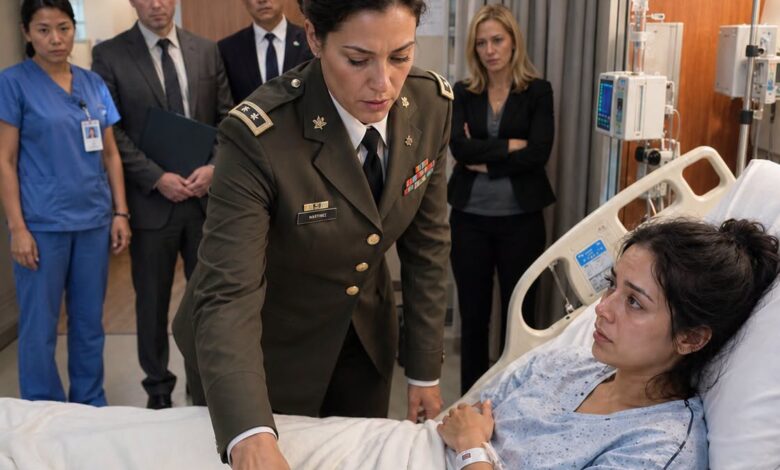
A nurse asked her a question directly.
One of the Bennetts answered for her.
The nurse looked back at Emily.
“I’d like to hear from her.”
The room changed.
It was almost imperceptible.
But I saw it.
For years, people had spoken around Emily.
About Emily.
For Emily.
Now somebody was waiting for her answer.
Her husband tried again.
“She’s exhausted.”
The nurse didn’t argue.
She simply waited.
Emily looked at me.
I wanted desperately to speak.
I could have filled that silence with everything I’d been thinking for years.
Instead, I stayed quiet.
Because this could not become another room where someone else decided what Emily meant.
Her lips trembled.
Then she said it.
“I want them out.”
Nobody moved at first.
Her husband stared at her.
His parents looked almost offended.
Not frightened.
Offended.
As though Emily had violated some basic rule of the universe by issuing an instruction they hadn’t approved.
Her mother-in-law recovered first.
“Sweetheart, you’re upset.”
Emily closed her eyes.
“I want them out.”
That second time was stronger.
A staff member stepped forward.
And suddenly the sentence became more than sound.
It became action.
They were asked to leave.
Her husband began protesting.
He wanted to know who had authorized this.
He insisted he was family.
He said Emily wasn’t thinking clearly.
He invoked concern.
Marriage.
Misunderstanding.
Everything except the one fact that mattered.
Emily had said no.
The hospital respected it.
Watching them encounter a boundary they couldn’t negotiate was almost surreal.
They were accustomed to boundaries being conversations.
If Emily said no, they explained why she meant yes.
If she asked for space, they told her why isolation was unhealthy.
If she objected, she was emotional.
If she cried, she was unstable.
If she became angry, that anger proved their point.
But hospital policy did not care about their family mythology.
Neither did the door.
They left.
And when it closed, Emily began shaking.
People imagine freedom as exhilaration.
Sometimes it looks like terror.
Because when you’ve spent years learning that saying no produces punishment, having your no respected can feel almost dangerous.
Emily stared at the door as though someone might burst through it.
“They’re going to be furious.”
I sat beside her.
“Probably.”
She looked at me.
I could see the fear immediately.
She expected reassurance.
No, they won’t.
But I wasn’t going to lie to her anymore simply because the truth was uncomfortable.
They might be furious.
That wasn’t the question.
The question was what they were allowed to do with that fury.
For the first time, Emily had people around her whose job was not to preserve the Bennetts’ comfort.
The next several hours were painfully uncinematic.
No triumphant speech.
No dramatic confession.
No villain suddenly admitting everything.
Forms.
Questions.
Phone calls.
More forms.
A social worker.
Medical staff.
Documentation.
Information about options.
Emily signed things with a hand that wouldn’t stop trembling.
At one point she apologized for how slowly she was writing.
The woman helping her said:
“Take your time.”
Three ordinary words.
Emily almost cried.
I understood why.
Her life had been built around urgency whenever the Bennetts wanted something.
Answer now.
Come home now.
Stop embarrassing us now.
Forgive him now.
Move on now.
Suddenly someone was telling her that her own pace mattered.
Take your time.
So she did.
When we eventually left the hospital, I knew the most dangerous mistake would be assuming the difficult part was finished.
Leaving a room is not the same as leaving a system.
The Bennetts still had phone numbers.
Passwords might still be known.
Keys might still exist.
Accounts could still be accessible.
There were practical connections everywhere.
So we treated safety like administration.
Not emotion.
Administration.
Locks.
Passwords.
Documents.
Accounts.
Contacts.
Records.
Every small task closed another door they had previously walked through without asking.
A locksmith arrived late.
The sound of the old lock coming apart was strangely satisfying.
Emily stood nearby wrapped in a blanket.
She looked exhausted.
“This feels ridiculous,” she said.
“What does?”
“Changing locks in the middle of the night.”
“No.”
She looked at me.
“What feels ridiculous is that you were taught needing a lock was somehow ruder than someone ignoring the door.”
She didn’t answer.
The new lock clicked into place.
That sound mattered.
Passwords came next.
Email.
Banking.
Phone.
Cloud accounts.
Anything connected to her private life.
We enabled additional security where possible.
We documented communications instead of deleting them in anger.
When messages arrived, I wanted to respond.
Some were insulting.
Some were pleading.
Some rewrote the entire situation within hours.
They were worried.
They loved her.
They couldn’t understand why she was doing this.
This wasn’t like Emily.
That last one almost made me laugh.
No.
It wasn’t like the Emily they preferred.
The Emily they knew apologized before saying no.
This Emily had discovered that a sentence could end with a period.
We saved the messages.
No arguments.
No midnight essays.
No attempts to make them understand.
That was another lesson I learned quickly.
You can waste years trying to explain a boundary to someone whose real objection is that the boundary exists.
Understanding isn’t always the missing ingredient.
Sometimes access is.
They understood perfectly well that Emily wanted distance.
They simply didn’t believe she had the authority to require it.
Documentation changed that.
So did professional involvement.
So did procedure.
The Bennetts had money.
Connections.
Confidence.
I had my own position and experience.
But none of those things became the decisive factor.
The most powerful thing in the entire ordeal remained one frightened woman’s sentence:
“I want them out.”
Everything afterward existed to protect her ability to mean it.
That was important for me to understand too.
I could help.
I could make calls when Emily asked.
I could organize documents.
I could drive.
I could sit beside her.
I could make sure she wasn’t isolated while frightened.
But I couldn’t replace one controlling family with a controlling mother.
That would not be rescue.
It would simply be new management.
There were moments when I wanted to decide everything for her.
I knew what I thought she should do.
I knew what I wanted her to say.
I knew what outcome would make me sleep better.
But this was Emily’s life.
Her freedom would mean very little if everyone around her kept speaking on her behalf.
So I learned to ask:
“What do you want?”
Sometimes she didn’t know.
That was allowed.
People emerging from controlling environments are often expected to transform instantly into decisive heroes.
Real recovery can be much messier.
When someone has spent years being punished for preferences, even simple choices can become frightening.
Where do you want to stay?
Do you want to answer this?
Who should know?
What do you want to do next?
Every decision uses a muscle that may have been weakened through years of disuse.
Emily started small.
No, don’t answer that call.
Yes, save that message.
No, I don’t want them here.
Yes, I want someone with me.
Each answer belonged to her.
The Bennetts responded exactly as people do when an old arrangement stops working.
First came disbelief.
Then persuasion.
Then anger.
Then concern.
Then attempts to recruit other people.
They told relatives there had been a misunderstanding.
They implied I was influencing Emily.
They suggested professionals had overreacted.
They insisted private family matters were being unnecessarily escalated.
The script hadn’t changed.
The audience had.
That was their problem.
Now there were records.
Now dates mattered.
Now contradictions could be compared.
Now Emily’s wishes had been stated in front of people outside the family.
Secrecy had once protected the system.
Daylight weakened it.
This is why documentation can matter so much in situations involving intimidation or coercion.
Memory can be challenged.
Emotion can be dismissed.
A written timeline is harder to wave away.
A saved message has exact words.
A photograph freezes what someone later claims never happened.
A professional record creates another point of reference.
None of those things guarantees justice.
Systems are imperfect.
People still fail.
But documentation reduces the amount of reality that can be rewritten afterward.
For years, Emily had been trapped in conversations where certainty won.
The Bennetts were always more certain.
They spoke confidently.
She questioned herself.
Therefore, their version survived.
The paper trail didn’t care who sounded confident.
That changed the balance.
Weeks passed.
The immediate crisis slowly transformed into ordinary work.
Appointments.
Legal processes.
Practical arrangements.
Sleep.
Food.
Therapy.
Silence.
More sleep.
Some mornings Emily seemed almost like herself.
Other days a single notification could undo hours of calm.
Healing was not linear.
I stopped expecting it to be.
There was no cinematic moment when she announced she was finally free and inspirational music began playing.
Freedom looked like checking the locks twice.
Then eventually once.
Then one night not checking them at all.
It looked like seeing a familiar car and feeling her stomach drop.
Then realizing it wasn’t theirs.
It looked like laughing unexpectedly and then becoming quiet because laughter still felt suspicious.
It looked like making plans more than a week in advance.
It looked like buying something she liked without wondering whether someone else would approve.
It looked like changing her hair.
Then changing it back because she decided she didn’t like it.
That tiny decision made me absurdly happy.
Not because of the hairstyle.
Because she was experimenting with preference.
She was learning that choices did not have to become permanent evidence against her character.
The Bennetts gradually lost something they had once considered permanent.
Access.
That was the real shift.
Not money.
Not reputation.
Not status.
Access.
They could no longer enter simply because they believed they belonged.
They could no longer demand immediate answers.
They could no longer transform every private confrontation into a closed family discussion where Emily stood alone against three confident voices.
The doors were different now.
Literal ones.
Legal ones.
Emotional ones.
Some had locks.
Some had policies.
Some consisted only of Emily saying:
“No.”
And meaning it.
People sometimes ask whether I felt victorious.
No.
Victory is the wrong word.
There was too much damage for victory.
Too much fear.
Too many nights lost.
Too many moments when my daughter had learned to doubt herself.
I didn’t want the Bennetts destroyed.
I wanted their ability to control Emily’s life destroyed.
Those are different things.
Revenge asks:
How can I hurt you?
Protection asks:
How do I stop you from hurting her again?
That distinction became my compass.
Every time anger tempted me toward something dramatic, I asked whether it would actually make Emily safer.
Usually, the useful answer was boring.
Save the message.
Call the appropriate person.
Write down the time.
Follow the process.
Keep the appointment.
Change the password.
Do not engage.
Boring saved us repeatedly.
Drama had been the Bennetts’ territory.
Documentation became ours.
Months later, I found Emily sitting alone at the kitchen table.
Sunlight was coming through the window.
There were papers in front of her, but for once they weren’t hospital forms or legal documents.
She was making plans.
Her plans.
Nothing extraordinary.
Work.
A possible move.
Something she wanted to study.
A place she wanted to visit.
She looked up.
“What?”
I realized I’d been staring.
“Nothing.”
She narrowed her eyes.
“Mom.”
I smiled.
“I’m just listening.”
She laughed.
“There isn’t anything to listen to.”
There was.
I could hear something I hadn’t heard clearly in years.
Her future.
Not the one the Bennetts had planned.
Not the one I might have chosen for her.
Hers.
That was when I finally understood what had happened in the hospital.
The important moment wasn’t when security escorted anyone away.
It wasn’t when forms were completed.
It wasn’t when locks were changed.
It wasn’t when outside professionals became involved.
Those things mattered because they protected the moment.
But the moment itself belonged entirely to Emily.
“I want them out.”
Five words.
Cracked.
Frightened.
Barely louder than the room.
Yet everything changed because someone finally treated those words as instructions rather than an opening for negotiation.
I had spent years believing that protecting my daughter meant finding the right argument.
The right confrontation.
The right person powerful enough to force everyone else to behave.
I was wrong.
My most important job was simpler.
Clear the space around her voice.
Document what threatened it.
Bring in appropriate help.
Refuse secrecy.
Refuse bait.
Then step aside enough for Emily to speak.
I could not give her freedom by commanding her to take it.
She had to draw the line.
I could only make sure that when she finally did, she wasn’t standing there alone.
The Bennetts had spent years rehearsing their roles.
The reasonable family.
The concerned husband.
The misunderstood parents.
The people who always knew what was best.
But scripts require cooperation.
Emily stopped reading hers.
And once she did, something extraordinary happened.
Their certainty began collapsing.
Not because someone screamed louder.
Because the doors closed.
The records remained.
The professionals listened.
And Emily discovered that “no” did not require unanimous approval.
Eventually, the Bennetts walked away with something they had never expected to lose:
the assumption that they would always have access.
Emily walked away with something far more valuable:
authority over her own life.
She still had healing ahead.
There would be difficult days.
Fear doesn’t disappear because a lock changes.
But she had crossed the line that mattered.
She understood now that boundaries weren’t requests for other people to become reasonable.
They were decisions about what she would permit.
And for the first time in years, the person drawing those boundaries was not her husband.
Not his parents.
Not me.
Emily.
Her voice drew the line.
The rest of us simply made sure it held.