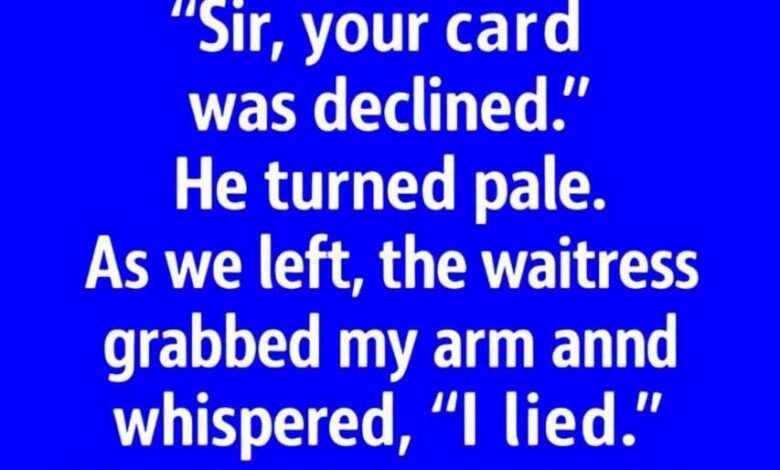
The waitress didn’t hand me the receipt normally.
She folded it once, pressed it into my palm, and held my eyes for half a second longer than necessary.
At first, I thought she was trying to tell me that my card had been declined.
That’s what she’d announced at the table.
“I’m sorry, ma’am. There’s a problem with your payment. Could you come with me?”
My date gave an irritated laugh.
“Seriously?”
I apologized and followed her toward the register, already reaching into my purse for another card.
The moment we turned the corner and were out of his sight, her expression changed.
“Don’t go back to that table,” she whispered.
I stared at her.
“What?”
She pushed the folded receipt toward me.
There were five words written across the back.
PLEASE DON’T DRINK YOUR WINE.
My stomach tightened.
I looked toward the dining room.
“What are you talking about?”
The waitress lowered her voice.
“I saw him near your glass when you went to the restroom.”
For several seconds, I couldn’t speak.
My first instinct was disbelief.
There had to be some misunderstanding.
The man sitting at my table was charming, successful, and almost excessively polite.
We’d met online two weeks earlier.
He remembered small details from our conversations.
He held doors open.
He complimented the waiter.
He talked warmly about his mother.
Nothing about him had seemed threatening.
That was precisely what frightened the waitress.
“You need to trust me,” she said.
Then she told me something that made the room feel suddenly colder.
She had seen him before.
Twice.
Different women.
Same restaurant.
Same carefully polished behavior.
Both evenings had ended strangely.
One woman became so disoriented that she could barely stand.
Another disappeared with him after telling the waitress she suddenly felt sick.
The waitress had remembered his face.
When he walked through the door with me that evening, she immediately recognized him.
She had been watching our table ever since.
I wanted to believe there was an innocent explanation.
Then I remembered my wine.
I’d taken only a few sips before going to the restroom.
When I returned, he’d pushed the glass slightly toward me.
“You’re barely drinking,” he’d joked.
At the time, it sounded harmless.
Now I felt sick.
“What do I do?”
The waitress already had a plan.
The declined-card story had been invented.
She needed a reason to separate me from him without making him suspicious.
Another employee had quietly contacted the manager.
Someone was calling for help.
“You don’t have to go back there,” she said.
“But my purse—”
“We’ll get it.”
My hands started shaking.
Until that moment, fear had been something abstract.
Then I realized my keys were inside that purse.
So was my address on my driver’s license.
Suddenly every ordinary piece of information felt dangerous.
The manager led me into an office near the kitchen.
A few minutes later, another employee brought my purse.
I sat there listening to muffled restaurant noise through the wall.
Glasses clinking.
People laughing.
Music playing.
The strange normality of it was almost unbearable.
My date was sitting perhaps thirty feet away, surrounded by people enjoying dinner, while I was hiding in an office wondering what he might have done.
Eventually, he realized I wasn’t returning.
He became impatient.
Then angry.
According to the manager, he demanded to know where I was.
The waitress remained calm.
She told him there was still an issue with the payment.
He asked whether I’d left.
She didn’t answer.
Then he stood up.
By that point, help had arrived.
Everything that followed happened without the dramatic confrontation I had imagined.
No screaming.
No overturned tables.
No heroic speech.
Just questions.
A preserved drink.
Statements from employees.
And a man whose charming expression seemed to disappear the moment he realized people were paying attention.
I went home that night shaken but safe.
I thought that would be the end of it.
It wasn’t.
Two days later, I posted a carefully worded message in a local women’s safety group.
I didn’t make accusations I couldn’t prove.
I simply described what had happened and asked whether anyone recognized him.
For almost an hour, nothing happened.
Then a woman sent me a private message.
I went out with him last year.
She described becoming unusually dizzy after one drink.
She remembered very little about the rest of the evening.
Another message arrived.
Then another.
The stories weren’t identical.
That somehow made them more disturbing.
Different restaurants.
Different dating apps.
Different neighborhoods.
But the same man appeared again and again.
One woman had saved text messages.
Another still had the ride-share receipt showing where she’d been picked up.
Someone else had photographs from the restaurant.
Another had messages she’d sent a friend that night saying she suddenly felt strangely ill.
Individually, each woman had spent months questioning herself.
Maybe she’d drunk too much.
Maybe she’d misunderstood.
Maybe she was remembering things incorrectly.
Maybe she was overreacting.
Together, their stories formed something harder to dismiss.
A pattern.
We began organizing everything.
Dates.
Locations.
Screenshots.
Receipts.
Messages.
Names of possible witnesses.
Nobody was trying to create an online mob.
We wanted evidence preserved and properly investigated.
That distinction mattered.
Rumors can destroy innocent people.
Evidence can establish what actually happened.
So the women who were comfortable doing so spoke with investigators.
Some found the process exhausting.
Others nearly backed out.
Telling a frightening story once is difficult.
Telling it repeatedly to strangers while wondering whether they’ll believe you can be much harder.
But gradually, the pieces began connecting.
The waitress gave her statement too.
She explained why she’d recognized him and why she’d invented the story about my card.
“I couldn’t accuse him in the middle of the restaurant,” she later told me. “I didn’t know how he’d react.”
So she improvised.
She created an ordinary inconvenience.
A declined payment.
Something boring enough that nobody would become suspicious.
That tiny lie gave her the opportunity to get me away from the table.
I kept thinking about how easily things could have gone differently.
What if she’d been busy with another table?
What if she hadn’t recognized him?
What if she’d convinced herself it wasn’t her responsibility?
What if she’d worried about embarrassing a customer and remained silent?
Instead, she noticed.
And then she acted.
Months later, the investigation reached a point where authorities took formal action against the man.
Seeing him confronted with the consequences was strange.
I expected satisfaction.
Maybe even triumph.
Instead, I mostly felt tired.
The other women seemed to feel something similar.
Nobody threw a party.
Nobody treated it like entertainment.
There were too many painful memories attached to what had happened.
What we felt was closer to relief.
For so long, each woman had carried her experience alone.
Once those experiences were placed beside one another, isolation became evidence.
That changed everything.
A few of us eventually returned to the restaurant.
The waitress was working that evening.
We brought flowers.
The moment she saw us, she started crying.
Then we did too.
She kept insisting she hadn’t done anything extraordinary.
“I just wrote something on a receipt.”
But that wasn’t true.
She paid attention when ignoring the situation would have been easier.
She trusted her instincts.
She found a way to intervene without unnecessarily escalating the danger.
And most importantly, she treated a stranger’s safety as though it mattered.
I still have that receipt.
The paper has faded slightly.
The edges are bent.
The warning written across the back is still visible.
PLEASE DON’T DRINK YOUR WINE.
Five words.
That’s all it took to change the direction of an evening.
But the larger lesson came afterward.
One woman’s warning became another woman’s story.
That story encouraged someone else to speak.
Then another.
And another.
Eventually, isolated experiences became a pattern that could be examined instead of dismissed.
That’s what I remember most.
Not the handcuffs.
Not the investigation.
Not even the fear I felt sitting inside that restaurant office.
I remember women who had spent months doubting themselves finally hearing someone say:
“I believe you.”
There is enormous power in those words when they are accompanied by careful listening, preserved evidence, and responsible action.
Because dangerous behavior often survives in isolation.
It survives when each person believes she’s the only one.
It survives when embarrassment creates silence.
It survives when everyone assumes someone else will speak first.
That waitress spoke first for me.
She didn’t know my family.
She didn’t know where I lived.
She didn’t even know whether I would believe her.
She simply saw something that frightened her and decided my safety mattered more than avoiding an awkward situation.
Her courage wasn’t loud.
It was written in pen on the back of a restaurant receipt.
And sometimes that is exactly what courage looks like.
Quiet enough not to attract danger.
Clear enough to save someone from it.