The first thing that fell from the shattered piggy bank wasn’t a coin.
It was a tiny plastic bag.
I stared at it on the porch boards, surrounded by pieces of pale ceramic, while the police officer beside me immediately raised his hand.
“Don’t touch anything.”
My stomach tightened.
A folded piece of paper had fallen out with it. Then another. Neither looked like something that belonged inside a child’s savings bank.
Behind me, Oliver appeared in the doorway.
“Mom?”
I turned so quickly I nearly knocked into the officer.
“Stay inside, sweetheart.”
“But why are there pigs everywhere?”
“I don’t know yet.”
That was the truth.
Less than twelve hours earlier, I had gone to bed believing my six-year-old son had simply done something extraordinarily kind.
Mrs. Adele, our eighty-one-year-old neighbor, had spent three nights without electricity. Oliver noticed before I understood how closely he had been watching her little yellow house across the street.
No porch light.
No television.
No kitchen lamp after dinner.
He had walked into our living room carrying the piggy bank where he’d saved birthday money and coins for nearly a year.
“She’s cold,” he’d said. “And she’s by herself.”
Then he gave her everything.
Mrs. Adele had resisted.
Oliver hadn’t.
“You need it more than I do.”
Eventually, with tears in her eyes, she accepted his money.
Before we left, she bent down and whispered something into his ear.
Oliver refused to tell me what she’d said.
“It’s a secret.”
I thought that was where the story ended.
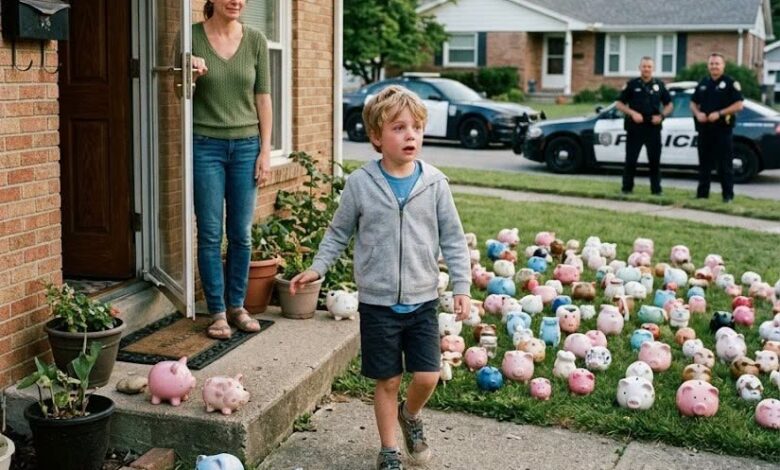
Now police cars were blocking my street, dozens of unfamiliar piggy banks covered my property, and one of them had just spilled something suspicious onto my porch.
The officer crouched without touching the items.
“Ma’am, where did these banks come from?”
“I was hoping you could tell me.”
He looked toward his partner.
The second officer was already speaking into his radio.
“Did you put any of these here?”
“No.”
“Did your son?”
“He’s six.”
That wasn’t exactly an answer, but apparently it was enough.
The officer carefully unfolded the paper using gloves.
I watched his expression change.
“What?”
He didn’t answer immediately.
Instead, he asked, “Who is Mrs. Adele?”
My heart lurched.
“Our neighbor.”
I pointed across the street.
Her house looked different that morning.
The porch light was glowing.
Her electricity was back.
But the curtains were closed.
The officer looked toward the yellow house.
“Stay here.”
“What does the note say?”
He hesitated.
Then he showed me.
There were numbers written across it.
Dates.
Dollar amounts.
Initials.
Nothing that meant anything to me.
At the bottom was one sentence:
ADELE DOESN’T KNOW.
My mouth went dry.
“What doesn’t she know?”
“We don’t know yet.”
That morning became a blur.
Officers began photographing the piggy banks before moving anything. More police arrived. Neighbors stepped onto porches, watching.
Then Mrs. Adele finally opened her front door.
She looked frightened.
The moment she saw the police, one hand went to her chest.
Oliver slipped around me before I could stop him.
“Mrs. Adele!”
He ran across the grass.
I caught him before he reached the street.
Mrs. Adele saw him and began crying.
That was when I knew this wasn’t some neighborhood fundraiser.
Something had happened overnight.
Eventually, we learned enough to understand why.
When Oliver and I left her house the previous evening, Mrs. Adele had sat alone at her kitchen table looking at the money he’d given her.
Twenty-eight dollars and some change.
To anyone else, it was almost nothing compared with an overdue utility bill.
To her, it was everything a six-year-old owned.
She couldn’t bring herself to spend it.
Instead, she called the police non-emergency number.
Not because of the money.
Because Oliver’s gift had finally pushed her to admit why her electricity had been disconnected.
For months, money had been disappearing from her bank account.
Small amounts initially.
Then larger ones.
Mrs. Adele believed she’d simply become forgetful.
She was embarrassed.
Someone close to her had reinforced that fear, repeatedly telling her she was getting confused about bills and probably spending more than she remembered.
The person helping manage some of her finances was a distant relative who visited occasionally.
Mrs. Adele trusted him.
But after the power was disconnected, she finally checked the paperwork he’d told her not to worry about.
The numbers didn’t match.
She had enough income to keep the electricity on.
Or she should have.
When the first officer came to speak with her, Mrs. Adele showed him a box of financial papers she’d been too frightened to examine closely.
Inside were bank statements, withdrawal slips, utility notices—and several handwritten records she didn’t recognize.
Then she remembered something else.
Months earlier, that relative had stored several boxes in her garage, claiming he was moving.
Among them were cartons filled with novelty piggy banks.
He had told her they were merchandise from a closed business.
After Oliver left that evening, Mrs. Adele opened one.
It didn’t contain coins.
It contained records.
And cash.
That was when she called police again.
The banks covering my yard had not been delivered as gifts.
They had been moved there overnight by someone who apparently realized investigators might search Mrs. Adele’s property.
Our yard, directly across the street, had been chosen as a temporary hiding place.
The assumption seemed to be that nobody would connect dozens of children’s banks to financial records.
But the police had arrived before whoever moved them could retrieve them.
One officer had noticed a broken seam on the bank he handed me.
He wanted it opened while I was present because it had been found on my property and they needed to establish immediately whether it contained ordinary savings or something potentially connected to Mrs. Adele’s report.
Suddenly those cheerful little pigs scattered across my lawn looked completely different.
They weren’t cute.
They were containers.
By afternoon, investigators had removed them.
Some contained ordinary coins.
Others held cash, documents, receipts, account information, and records that required proper examination.
Nobody stood in my driveway and announced that the mystery was solved.
Real investigations don’t work that way.
There were interviews.
Financial records had to be obtained.
Accounts had to be traced.
Mrs. Adele needed independent help reviewing what had happened.
I deliberately kept Oliver away from most of it.
He was six.
He did not need to understand suspected financial exploitation.
He only needed to know Mrs. Adele was safe and adults were helping her.
A few days later, she came over.
Her electricity was still on.
This time, she wasn’t wearing a coat indoors.
Oliver ran to her.
“Did my money fix your lights?”
Mrs. Adele looked at me.
Then back at him.
“In a way.”
He frowned.
“I gave you twenty-eight dollars.”
“You gave me something more important.”
“What?”
“Courage.”
Oliver clearly found that answer unsatisfactory.
“You can’t pay the electric company with courage.”
I had to turn away to hide my smile.
Mrs. Adele laughed.
“No. You certainly cannot.”
Then she reached into her purse.
She pulled out Oliver’s money.
Every dollar.
Every coin.
She had kept it separate.
“I can’t take this.”
Oliver folded his arms.
“You already did.”
“And it helped me.”
“Then why are you giving it back?”
“Because it already did its job.”
He considered that.
Mrs. Adele crouched carefully in front of him.
“Do you remember what I whispered to you?”
Oliver nodded.
I finally asked, “Am I allowed to know now?”
He looked at her.
She smiled.
Then Oliver repeated it.
“She said sometimes a little light shows you a big problem.”
I looked at Mrs. Adele.
She nodded.
“That boy walked into my dark house with everything he had. I was sitting there ashamed because I’d convinced myself losing the electricity was my fault. Watching him empty that piggy bank made me realize something.”
“What?”
“If a six-year-old believed I deserved help, perhaps I should believe it too.”
That nearly broke me.
The investigation continued for months.
I never learned every detail, nor did I need to. Authorities and the appropriate financial professionals handled the evidence, and Mrs. Adele received help securing her accounts and reviewing what had been taken.
What mattered inside our little world was simpler.
Her lights stayed on.
Neighbors began checking on her more often.
Not hovering.
Not treating her like she was helpless.
Just making sure she knew she wasn’t alone.
And Oliver?
He got another piggy bank.
Blue this time.
For several weeks, he rebuilt his savings.
Then one Saturday, I caught him removing money from it.
“What are you doing?”
He looked up.
“Mrs. Adele needs groceries.”
“She has groceries.”
He paused.
“Maybe somebody else doesn’t.”
There was no arguing with that child.
So we started something small.
A jar at the community center.
Nothing dramatic.
Neighbors could contribute when they wanted, and a local nonprofit helped make sure assistance went where it was genuinely needed.
Oliver insisted the jar needed a name.
He called it The Lights On Jar.
Months later, I asked whether he regretted giving away everything he’d saved.
He looked genuinely confused.
“Why?”
“You worked hard for that money.”
“But Mrs. Adele needed help.”
“You wanted that remote-control truck.”
He shrugged.
“I can save again.”
That was it.
The entire philosophy of my six-year-old son in four words.
I can save again.
Adults spend years learning to protect what belongs to us.
Money.
Time.
Pride.
Comfort.
Sometimes we become so good at protecting those things that we forget what they’re for.
Oliver hadn’t learned that yet.
He saw someone sitting in darkness and thought only one thing:
I have something that might help.
His twenty-eight dollars didn’t solve Mrs. Adele’s financial problems.
It couldn’t.
But it did something nobody expected.
It made an embarrassed woman stop blaming herself long enough to ask questions.
Those questions exposed records that needed examining.
Those records brought people who knew how to help.
And eventually, the lights came back on.
Sometimes kindness doesn’t fix the problem directly.
Sometimes it simply shines enough light for everyone to finally see what’s been hiding in the dark.