We thought Ethan’s final wish was to see a football game.
We were wrong.
The football game was only how he got us into the room where he could finally tell us what he actually wanted.
By then, our ten-year-old son had spent enough time in hospitals to understand adults better than adults understood themselves. He knew when doctors were choosing their words carefully. He knew when nurses smiled because they were trying not to cry. He knew that when Chris and I said, “We’re okay,” what we usually meant was, “We cannot talk about this without falling apart.”
And he knew what I was doing with my phone.
I photographed everything.
Ethan sleeping.
Ethan eating half a sandwich.
Ethan laughing at something on television.
Ethan holding Chris’s hand.
I recorded his voice when he told jokes. I saved videos of him complaining about hospital pudding. I photographed his shoes beside the bed because one day, I thought, I might need proof that those shoes had once been there.
After the doctor told us the treatment was no longer working the way everyone had hoped, the habit became almost frantic.
I was terrified of forgetting.
So I began converting my son into evidence.
Then the wish organization asked Ethan whether there was one special thing he wanted.
“A football game,” he said. “With Mom and Dad.”
That was all.
Game day felt like somebody had briefly opened a door back into ordinary life.
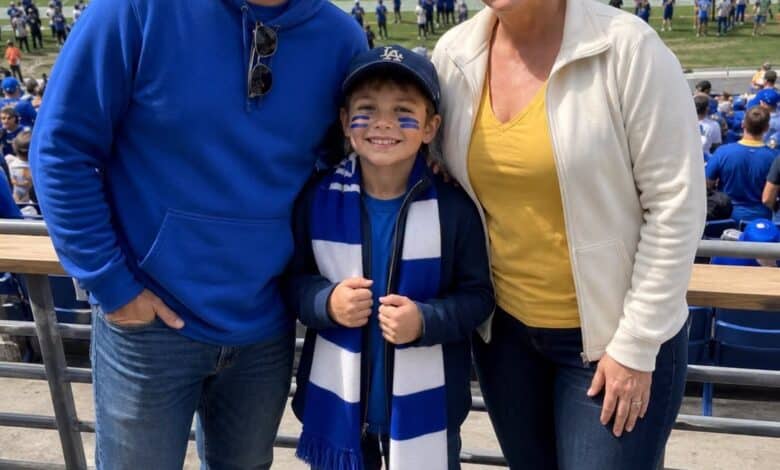
Ethan wore his blue jersey. The stadium concourse overwhelmed him at first—the music, vendors, shouting, thousands of people moving in every direction.
Then he saw the field.
His entire face changed.
He laughed when the crowd booed.
He ate half a pretzel and stole three bites of Chris’s hot dog.
When the stadium camera found us and Ethan appeared on the enormous screen, he threw both arms into the air.
“WE’RE FAMOUS!”
Everyone around us laughed.
I filmed it.
Of course I did.
Then the announcer said Ethan’s name.
The crowd cheered.
Ethan stared at us with a grin.
But he wasn’t surprised.
That should have told me something.
“Turn around,” the announcer said.
We did.
Walking toward us were people from the hospital.
A nurse from Ethan’s floor.
Cody and his mother.
Leo.
And Ray from facilities, whom Ethan had somehow promoted to “Coach Ray” months earlier.
Ray was carrying something beneath his arm.
Ethan’s battered plastic tabletop football game.
One corner was cracked. The field markings had faded. One of the tiny players leaned permanently sideways.
Ethan loved that ridiculous thing.
Chris looked at him.
“You did this?”
Ethan shrugged.
Maybe that was the moment I should have understood.
He hadn’t asked for a stadium surprise.
He had arranged one.
Later, when Ethan became tired, we were taken away from the crowd to a quieter family room.
The roar of the stadium became a distant vibration behind the walls.
Ray placed the tabletop game on a table.
“League championship,” he announced.
Ethan sat down.
Chris sat opposite him.
I remained standing.
And I lifted my phone.
Ethan looked at me.
“Mom.”
“What?”
“Put it down.”
I smiled automatically.
“I just want one picture.”
“No.”
Something in his voice stopped me.
I lowered the phone.
Ethan stared at the little plastic football field.
“Sometimes I just want stuff to be stuff.”
I didn’t understand.
“What do you mean?”
He pushed one of the players into position.
“Like this.”
“The game?”
“Yeah.”
He looked at me.
“I don’t want everything to be the last time.”
The room became completely still.
Chris looked down.
I felt my throat tighten.
Ethan continued.
“When I eat something, you take a picture. When Dad and me watch football, you record us. When I laugh, you get your phone.”
He wasn’t angry.
That made it worse.
“I just want to do things.”
I sat beside him.
“I don’t want to forget you.”
There.
The sentence I had been refusing to say.
Ethan looked at me with an expression no ten-year-old should ever have needed.
“I know.”
I began crying.
“I just thought someday I’d want all of it.”
“Maybe.”
He nudged the tabletop game toward me.
“But I’m here now.”
Chris covered his mouth.
For months, we had been treating Ethan’s remaining time as sacred.
Every meal mattered.
Every joke mattered.
Every sleepy goodnight mattered.
We had turned ordinary moments into ceremonies because we knew there would not be enough of them.
But Ethan had seen the cost.
We were so frightened of losing the future that we had stopped inhabiting the present.
I thought documentation was love.
Sometimes it was.
But sometimes my camera became a wall.
Instead of watching Ethan laugh, I watched him through a screen.
Instead of listening to his voice, I checked whether the recording had captured it.
Instead of sharing a moment, I preserved it.
I was building a museum for a child who was still alive.
Ethan didn’t want to be an exhibit.
He wanted to play football.
So I put my phone inside my bag.
Not face-down on the table.
Not beside me.
Inside the bag.
Ethan smiled.
“Okay,” he said. “Mom’s on my team.”
Chris protested.
“That’s completely unfair.”
“You’re bigger.”
“That has nothing to do with tabletop football.”
“Sounds like something a loser would say.”
Chris laughed.
A real laugh.
Not the careful laugh we’d been using around Ethan.
Ray declared the match officially underway.
For the next twenty minutes, nothing was symbolic.
The plastic football players were just plastic football players.
Ethan cheated shamelessly.
Chris accused him of moving the ball with his thumb.
Ethan denied everything.
I scored once and celebrated so loudly that somebody in the hallway knocked to ask whether we were all right.
“We’re winning!” Ethan shouted.
We weren’t.
Nobody corrected him.
In the weeks afterward, I still took photographs.
Ethan hadn’t asked me to erase the future.
He had asked me not to sacrifice the present to it.
So I learned to ask.
“Picture?”
Sometimes he said yes.
Sometimes he said, “No, Mom.”
And when he said no, the phone stayed away.
One evening, football was playing on the television at home.
Chris shouted at a terrible call.
Ethan laughed.
My hand moved automatically toward my phone.
Then stopped.
Ethan noticed.
“You’re not recording?”
“No.”
“Why?”
I looked at him.
“I’m watching.”
He smiled.
That moment exists nowhere except inside me.
There is no photograph.
No video.
No timestamp.
For a while, that frightened me.
Now I understand that its absence is part of what makes it precious.
Ethan’s wish had never really been about getting thousands of strangers to cheer his name.
He wanted the hospital people there because they were part of his league.
He wanted the battered tabletop game because it belonged to the life we had actually been living.
And he wanted Chris and me to understand something we had been too terrified to learn.
Dying had become the biggest fact in our family.
Ethan was asking us to let living be bigger, at least sometimes.
We couldn’t give him more time.
We couldn’t negotiate with the disease.
We couldn’t love him hard enough to change what the doctors had told us.
But we could stop making every remaining second carry the weight of eternity.
We could let dinner be dinner.
Football be football.
A joke be a joke.
A child be a child.
The stadium gave Ethan a roar loud enough for thousands of people to hear.
His real message came later, in a quiet room, over a battered plastic football game.
Sometimes I just want stuff to be stuff.
So we played.
No cameras.
No speeches.
No attempt to preserve what was happening.
Just Ethan, Chris, and me arguing over a tiny plastic football.
For once, we weren’t practicing how to remember him.
We were simply there.
And Ethan was still there too.