The vacation rental looked perfect at first glance. The photos matched the listing, the rooms were spotless, and nothing seemed out of place. After a long day of traveling, we did what almost every guest does—we dropped our bags, settled in, and began treating the space like home.
That sense of comfort would not last.
It began with something so ordinary that we almost ignored it.
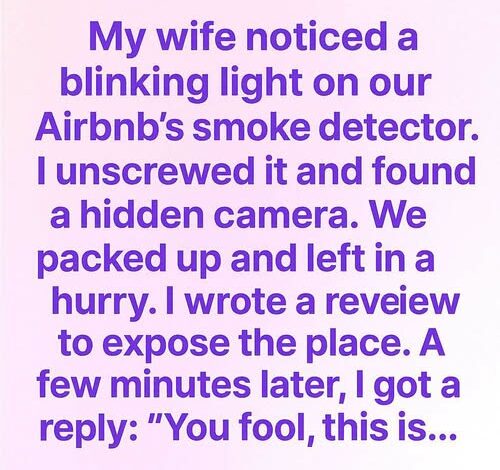
A smoke detector mounted high on the wall looked slightly different from the others. It wasn’t flashing, it wasn’t connected, and it seemed oddly positioned. At first, we assumed it was simply an older model or a decorative replacement left behind after renovations.
Curiosity, however, refused to let it go.
When the plastic cover came off, our stomachs dropped.
Inside wasn’t the empty shell of a broken smoke detector.
There was a tiny camera lens.
A memory card.
A small bundle of wires carefully arranged inside the housing.
Whatever this device had once been designed to do, detecting smoke clearly wasn’t one of its priorities anymore.
Silence filled the room.
For several seconds, none of us knew what to say.
Then someone looked around with fresh eyes.
If there was one hidden camera, could there be more?
The search began immediately.
Every object that had seemed ordinary only minutes earlier suddenly looked suspicious. We checked shelves, picture frames, alarm clocks, mirrors, power adapters, and anything else with an opening no larger than a pinhead.
Then we found another.
This one was concealed inside what appeared to be a motion sensor near the ceiling. From the floor, it looked completely convincing. Only up close did the tiny opening reveal itself.
Its angle wasn’t random.
It faced directly toward the bed.
The discovery made our hearts race.
Surely there couldn’t be a third.
But there was.
Hidden inside what we had laughed about earlier as a quirky decorative clock was yet another tiny opening. Once again, the direction was unmistakable.
Toward the sleeping area.
Toward the bathroom door.
Toward the small couch where we’d unpacked our clothes, changed after showering, shared conversations, watched television, laughed together, and simply lived as though no one else existed in the room.
In that instant, every ordinary moment suddenly felt different.
The jokes we’d shared.
The private conversations.
The arguments no one else was ever supposed to hear.
The quiet moments spent believing we were alone.
Whether any recording had actually taken place no longer mattered emotionally.
The possibility alone was enough to make the room feel unbearable.
We didn’t stay another night.
Before sunrise, we were packing as quickly as our shaking hands would allow. Clothes were shoved into half-zipped suitcases, chargers disappeared into backpacks without being untangled, and toiletries were gathered almost at random.
None of us cared about organization anymore.
We only wanted to leave.
Outside, the morning air felt strangely comforting.
Distance from the property offered some relief, but it couldn’t erase the feeling that our privacy had already been taken from us.
Reporting what we had found seemed like the obvious next step.
Surely something so serious would receive immediate attention.
Instead, the first responses felt frustratingly impersonal.
Automated acknowledgments.
Generic assurances.
Requests to wait while the matter was reviewed.
At a moment when reassurance and decisive action felt essential, the process seemed cold and mechanical. It was difficult not to feel as though procedures and customer satisfaction metrics mattered more than the fear experienced by the people who believed their privacy had been violated.
Eventually, appropriate authorities should be notified whenever hidden recording devices are suspected, as laws governing surveillance vary by location and unauthorized recording in private spaces may be illegal. Guests who believe they have discovered a concealed camera should avoid tampering unnecessarily with potential evidence, document what they observe if it is safe to do so, leave the property if they feel at risk, and report the situation to local law enforcement as well as the rental platform or property manager.
The experience changes the way you travel.
Checking into a room no longer begins with choosing a bedroom or unpacking a suitcase.
Now it begins with looking.
Smoke detectors.
Clocks.
Digital alarm displays.
Power strips.
Televisions.
Air vents.
Motion sensors.
Any object with an unusual opening suddenly deserves a second glance.
It’s not because every hotel room or vacation rental hides a secret.
The overwhelming majority do not.
But once the illusion of guaranteed privacy has been shattered, it’s difficult to stop asking questions.
Who installed it?
How long had it been there?
How many guests had unknowingly walked through the same rooms, believing they were alone?
How many birthdays, family vacations, honeymoons, celebrations, and ordinary evenings had been silently observed without permission?
Perhaps the most unsettling part isn’t the technology itself.
Hidden cameras are small.
They can be removed.
Investigations can determine whether laws have been broken.
What lingers far longer is the feeling that an intensely private space may not have been private at all.
A place meant for rest suddenly becomes associated with suspicion.
The room fades into memory, but the habit remains.
Now, before the luggage is unpacked, before anyone relaxes on the bed or changes clothes after a long journey, the room is quietly examined.
Not because fear should define every trip.
But because peace of mind has become something worth looking for before the vacation truly begins.